
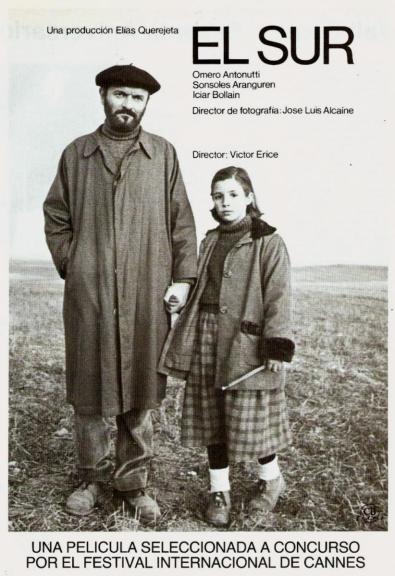
To turn from Ozu (see my recent post on Early Spring) to Victor Erice is an interesting experience as their films are both similar in their calmness and extremely careful mise en scène and lighting – but otherwise quite different. But Erice does acknowledge Ozu as one of the masters who have influenced him. Erice is much less prolific, partly because making films in the first few years of his career was much more difficult with Franco in power. El sur follows Erice’s first classic, The Spirit of the Beehive (1973) and like that film involves a (small) daughter and her developing relationship with her father but in the Francoist Spain of the late 1950s rather than 1940.
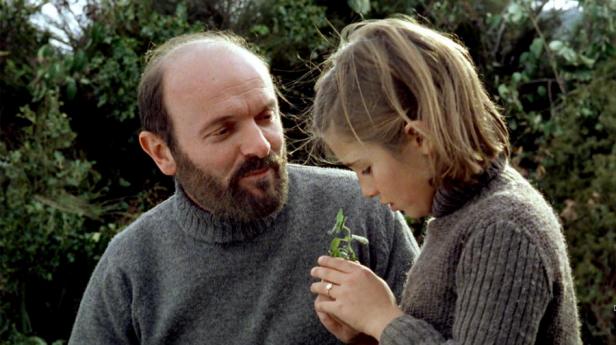
‘El sur‘ – the South – deals with a father who must leave his home in the South when he falls out with his own Francoist father. He moves North to live with his wife and child in an isolated house outside a walled town. Unfortunately Erice could not complete the film as scripted because the production funds were curtailed and ran out two-thirds through the shoot. But Erice was encouraged to give the shortened narrative a changed ending and when the film received high praise at its Cannes competition screening it went on to be released successfully in global markets.
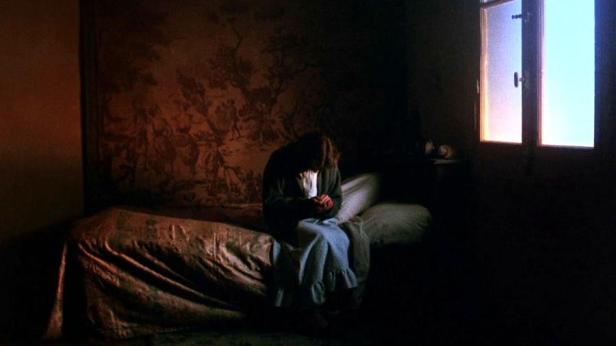
The opening of the film immediately introduces its marvellous visual qualities. The opening credits are set against a seemingly black screen but slowly a window emerges in the top right hand corner as the early morning light filters through. A dog begins to bark and a woman’s voice cries out ‘Augustín!’, repeating the call as we hear steps on a staircase. Now there is sufficient light to see a figure in bed beginning to wake up and when the shot reframes to show just the bed we see it is a teenage girl. As the light increases we see she is an attractive young woman reaching for her alarm clock. Meanwhile, the voices of her mother and their maid confirm that Augustín, the father of the household has gone, possibly on his daughter’s bicycle. The girl discovers something under her pillow as she sits on her bed.
Later we will realise that this is actually a shot from the end of the film and the narrative that follows will be a long flashback. Crucially the visual qualities of this first scene with rich colours emerging from the shadows in the bedroom will be partly inspired by classical fine art paintings by artists such as Caravaggio and Vermeer. Here the visual images are constructed by the great José Luis Alcaine, who would become internationally famous for his long collaboration with Pedro Almodóvar from the late 1980s onwards. In her first role as the teenage Estrella in her bedroom is Icíar Bollaín who would herself become a prominent film director in Spain. The story of Estrella and her father, Augustín is adapted from a short story/novella by Adelaida García Morales.
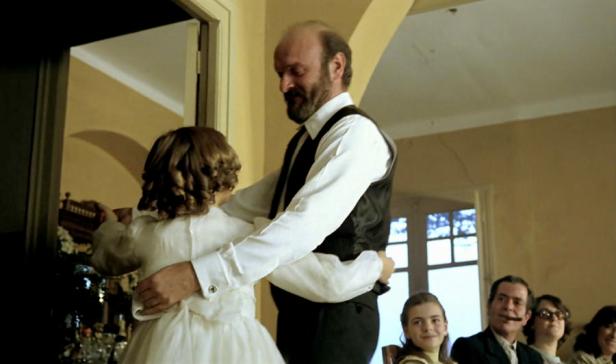
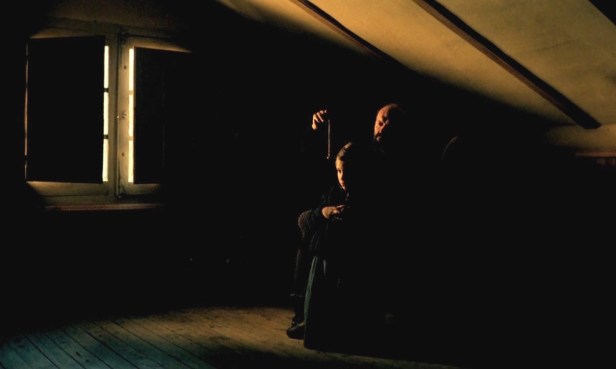
After the opening sequence, Icíar Bollaín’s voiceover will take us into the flashback, explaining how the little family moved around until they arrived at the house, known for its weather vane in the form of a seagull. It is now some seven or eight years earlier and the young Estrella is played by Sonsoles Aranguren in an extraordinary performance for a young actor. It soon becomes apparent that the narrative is going to centre on Estrella and her attempts to discover what makes her father tick. Why does he spend so much time in his attic room? His paid work is as a doctor in the town hospital but he also acts as a water diviner for local farmers – the object under Estrella’s pillow in the opening scene is her father’s pendulum, part of the divining process. Slowly, details of Augustín’s past will emerge, including something about his family past when his mother and his old family nurse Milagros arrive to witness Estrella’s first communion.We learn everything via Estrella and one facet of this is that we learn little about her mother, Julia. But we do know she was a teacher who probably lost her job because she could not conform to Francoist/Falangist restrictions.
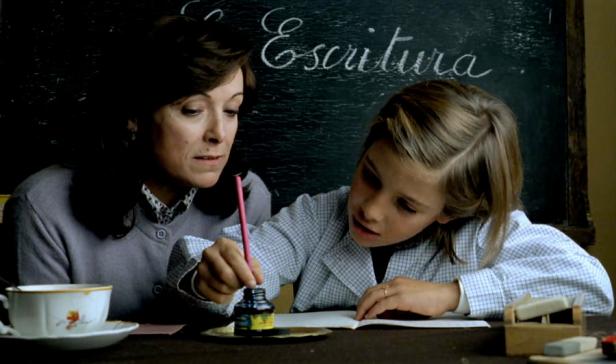
For audiences outside Spain it is important that they are aware of some of the basic points about Francoist Spain. The time is the 1950s and Spain is isolated from much of Western Europe. Franco’s policies promote traditional views and recognition of the church. Estrella’s parents both find themselves constrained and frustrated by these government policies but they are not discussed in front of Estrella. She discovers that her father is from ‘the South’, from Sevilla. She will simply recognise that Andalucía, where ‘tradition’ is supported, appears bright, colourful and exciting compared to the dull cold and wet of the North. The precise location is not mentioned but perhaps it is meant to be a Basque town? Victor Erice was born in Biscay province in the far North of Spain, with Bilbao as the nearest city. Franco’s victory in the Civil War was a triumph for the ‘old’ traditions of the land against the progressive ideas of industrialised Spain associated specifically with cities like Bilbao in the North and Barcelona in Catalunya. As a consequence, Spain in the 1950s has fallen behind other Western European countries in economic terms. Also relevant to Erice’s story is that children and young girls in particular have become the focus for many film productions. Films about young children are one of the few genres supported by government censors.
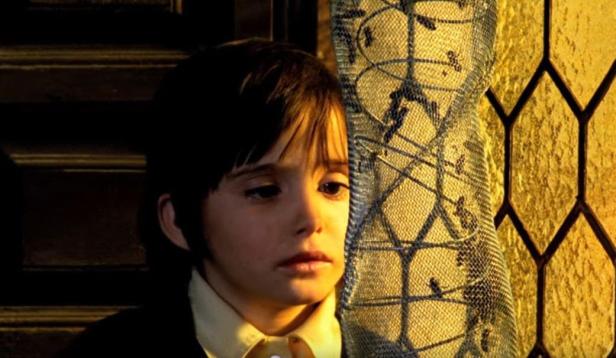
At this point it is useful to remember that Erice’s first feature, The Spirit of the Beehive (Spain 1973), also focused on a young girl played by Ana Torrent as the youngest daughter of a couple who have to a certain extent been marginalised in a small community in Central Spain. Made when Franco was still in power, the film is metaphorical and its meanings are allusive. The father has transgressed Falangist rules. He is an intellectual who has been marginalised and who focuses on his beehives and the little girl is entranced by her first sighting of Boris Karloff in the film Frankenstein (US 1931) seen in the village cinema. When she finds a Republican soldier/guerrilla in hiding she mistakes him for Frankenstein’s monster. This wonderful film offers a complex narrative and the meanings of the beehive and the monster have been argued over ever since its release. El sur has a similar father-daughter relationship and in both films, the mother is given less screen time but she is also suffering a sense of loss because the Falangists have won the war.
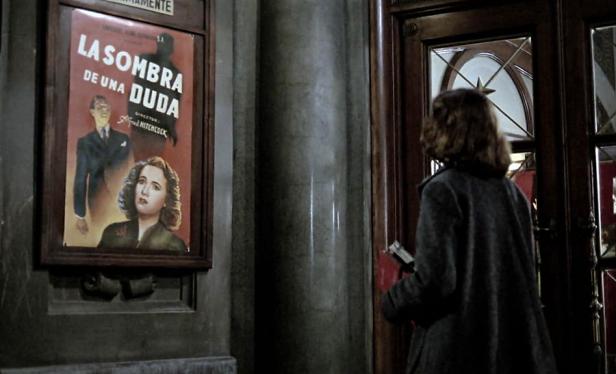
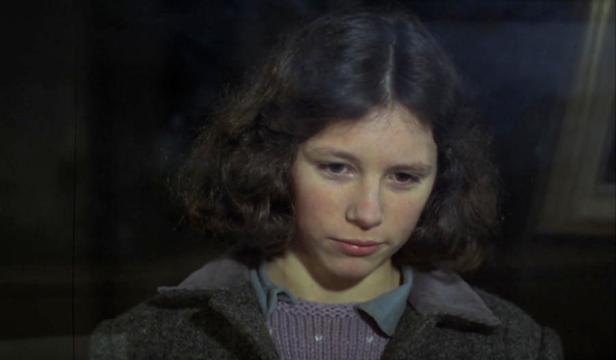
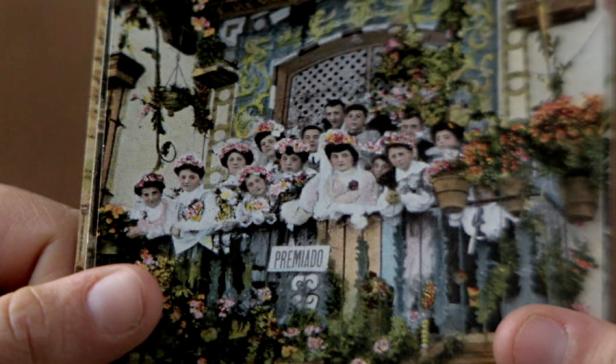
The other recurring feature in Erice’s three fiction films is a fascination with aspects of cinema. In El sur the younger Estrella comes across the name Irene Ríos in her father’s papers. Later, after school she notices that the town cinema is showing a film in which ‘Irene Ríos’ plays as a secondary character. She waits outside to see her father come out and go to a café. Several years later, the older Estrella is outside the same cinema which is showing Hitchcock’s Shadow of a Doubt (US 1943). In her voiceover she tells us that she often looks at the film posters outside the cinema to see if Irene Ríos is shown as featuring in a film. She then sees her father outside a bar but decides to hide from him. Both father and daughter at different times look at Estrella’s portrait in the photographer’s window close to the cinema. In Close Your Eyes (Spain 2023) the long narrative is about the director of a film that was never completed in 1990, when the lead actor went missing. Twenty-two years later, a TV programme dealing with past mysteries invites the director to discuss the disappearance which has never been solved. Ana Torrent, nearly fifty years after her appearance in The Spirit of the Beehive, plays the missing man’s daughter, as now a middle-aged woman working in a museum/gallery. It’s not too difficult to see the links between the three films.
Despite its success at various festivals and its growing reputation, El sur does present its own mystery. The necessity to create a new ending means that part of the original story is missing. We don’t know how Erice would have adapted the ending of the original story. We guess that it might have covered a trip to Sevilla for Estrella in which she would be confronted by aspects of what drove her father away and would the outcome of events for Augustín have been different? The film is now released in the US as part of the Criterion Collection and you can read an essay by Elvira Lindo about both the film and the original short story on the Criterion website. The original story was re-published in English as a 48 page novella by Criterion. The author Adelaida García Morales was married to Victor Erice but she died in 2014. Lindo points out that in the early 1980s when Spain saw the emergence of its first Socialist government following the death of Franco in 1975 and the eventual restoration of a constitutional monarchy and a democratic state, Erice was grappling with memory, mystery and the history of Spain.The completed film is around 90 minutes in length but the script was first written for a film of 130-140 minutes – more like the length of Close Your Eyes forty years later.
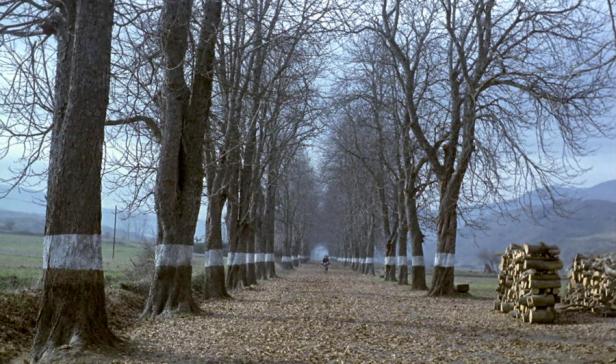
El sur is a marvellous film. Yes it is slow and mysterious but it exudes great emotional power like a mythological fable. One of the recurring shots in the film is that of both the younger and older Estrella and also her father travelling down the tree-lined street that links the isolated house with its weather vane and the walled town. The film is a visual treat but there is also emotional power in the musical score by Luis de Pablo and pieces by Enrique Granados and classical pieces by Schubert and Ravel. There are also moments of silence with great power. I must also praise the playing of the principal characters. I think all three of Erice’s films mentioned here need to be considered together and I will write about the third film soon. El sur is currently streaming on the subscription channel of BFI Player in the UK. It is available on Blu-ray and is streaming in many territories via Apple and Amazon. Here is the BFI trailer:
 itp Global Film