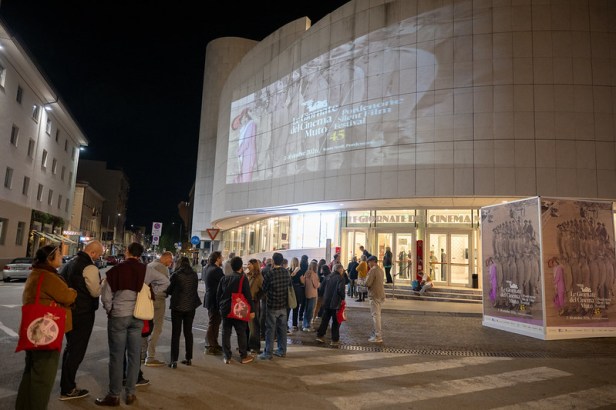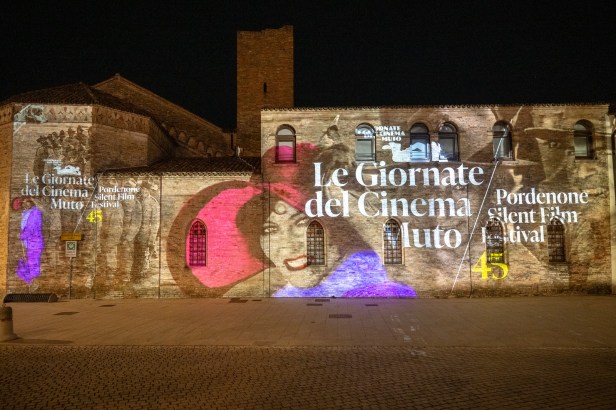
This was the 45th Festival of early cinema in Pordenone [or Sacile for a time] and once more guests and local citizens enjoyed a full and varied programme of silent films and titles, all with musical accompaniment. The majority of the screenings were of films transferred to digital but between 20% and 25% of the screenings were from 35mm prints. The Teatro Verdi, venue for the majority of the screenings, was packed for most of the week. And the Saturday morning at the Cinema Zero [whilst an orchestra rehearsed in the Verdi], was overflowing. There was sunshine for most of the week and the hotels, restaurants and cafes were very busy.
The opening night offered a screening Don Q, Son of Zorro (1925), with a special score by Andrej Goriar performed by the RTV Slovenia Symphony Orchestra. This was a vehicle for Douglas Fairbanks, a sequel to his more famous original ‘Zorro’. It had all the pleasures of a Fairbanks movie, with his acrobatic skills, romance and a sense of self-irony. The plot showed the symptoms of sequels, but it developed into a rousing climax with some fine sets and locations. This digital version was a restoration by the Danish Film Institute. The film was a great success on its release in 1925. There was also a return of a trope not seen for a number of years, the portrait of the star on screen as the audience applauded the film and the musicians.
Most of the week’s titles slotted into thematic or generic programmes. The first of these on the Saturday was The Biograph Project. Starting in 2016 the Film Preservation Society is restoring 450 split-reel, one-reel and two-reel films directed by D. W. Griffith. All of these surviving films were screened originally in the Giornate retrospective of the seminal film-maker’s work. Now, a number, but not all, of these restorations are screening in the Teatro Verdi in digital versions. Especially with the earlier work and those that only survived as paper prints there is a definite improvement in the visual quality on offer. So it provides an opportunity to not only revisit these early works but to review them and the way that Griffith developed his cinematic art. Thus One Touch of Nature (1909), a maternal melodrama, not only features some effective cross-cutting but some notable street location filming. Griffith, with his cinematographer Billy Bitzer fills the screen with people and action;
…street sequences. The first such scene includes a family playing ring-around-the rosy; a drunk falling on his backside; our evil hag and hapless orphan; multiple bowler-hatted pedestrians; and a trotting newsboy.” (Catalogue Notes by Tracy Goessel).
The Cord of Life (1909) has very dramatic cross-cutting. A Sicilian seeks a loan from a fellow country-man, Galora. Refused he seeks revenge on the family; entering their rooms whilst husband and wife are away he puts the baby in a basket and hangs it from the window, with the rope set to release basket and baby when the window is opened. He then finds Galora away from home and, gloating, tells him of the plot. Now the film cuts between Galora racing home through woods and streets whilst we see the wife at home nearly opening the window on several occasions. Galora saves the baby but it is a tortuous rescue with him held upside down by a policeman above the suspended infant.
The darker side of Griffith’s films and the culture in which he worked is apparent in The Valet’s Wife (1908). Bachelor Reggie has a remuneration from his Uncle to support his fictitious family. When the Uncle comes to visit Reggie borrows the wife and son of his valet. But the son is too old and, with a friend, is sent to find a baby. They return with one borrowed from an Orphanage which turns out to be black! The Catalogue quotes from the company,
Even worse: the Biograph Bulletin narrates the punchline thus:”one look was enough – ‘Great Jupiter, it’s a coon!””
This particular trope was a staple of silent film and continued into the sound era and even the last decade of the C20th. There were three more opening morning programmes of these titles.
The star focus this year Italia Almirante Manzini, carrying on the retrospective commenced in 2025. The Catalogue Notes comment,
“Almirante Manzini stands out from other divas of the time by her modern, measured acting stylr. Sensitive to the psychology of the characters, cleverly balancing sensuality and naturalness while also paying attention to detail and body language.”
The opening film, The Mask and the Face / La maschera e il volto (1919) was directed by the notable Italian film-maker Augusto Genina. This was a comedy, unusual for Manzini, with a convoluted plot. Savina (Manzini) is married but involved in an affair. He husband, Count Paolo (Vittorio Rossi Pinaelli) on discovering this states he will kill her. In fact, she leaves their home secretly and is supposed dead. The consequences of this deception play out until the climax of the title. This has great sets, as is common in Italian films and some fine locations around Lake Como with excellent cinematography. And Manzini proves an adept hand in a witty narrative. The Catalogue quotes from Film Review on,
“Manzini’s brief yet evocative stage presence and her powerful physicality’.”
The title cards were rather flowery, common in this period.
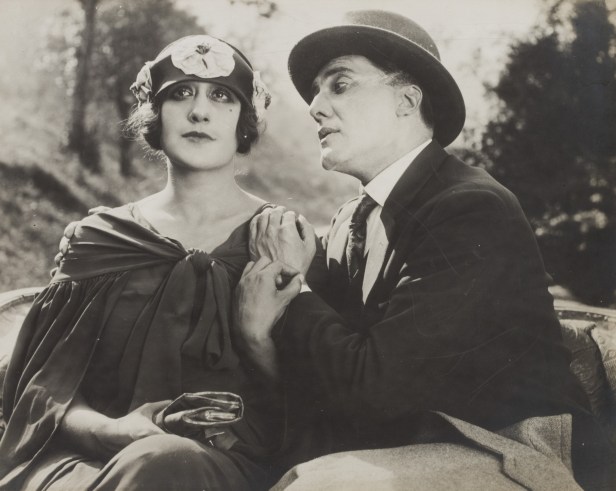
Italia Almirante Manzini, Andrea Habay
Credit: Collezioni Museo Nazionale del Cinema, Torino
There was a set of programmes on the Region of Lazio, which includes the capital Rome. As with previous years and regions this included both non-fiction and fiction films,
“we chose to offer an alternating selection of feature films and actualities, ……. between narrative and pictorial landscape….”(From the Catalogue Notes).
The opening screenings focused on Rome through Antiquities, Landscapes, Cars and Donkeys. These included a ‘family film’ from the Cines company: a film of a competition involving the crossing of the capital: a travelogue on Rome; the Pariloi race course: and Il romanzo di Maddalena (1913), a romance between a young flower girl and a young painter. The last uses well-known Roman locations, like the Spanish Steps in its drama. Later programme further focused on Rome but then on the wider region, always with the twining of fiction and actuality.
The director focus was on Marshall Neilan, Free Spirit of the Silent Cinema. Something of a maverick Neilan moved from stage to screen working alongside another silent era pioneer, Alan Dwan. He worked as an actor and then director from 1916. From 1917 he worked on five movies with Mary Pickford, the top movie star of the period. In 1919 he formed Marshall Neilan productions. However his love of alcohol subverted his film career and though he worked on through the 1920s his career faded with the coming of sound.
M’Liss was a Pickford vehicle from 1918. In the mode of ‘Calamity Jane’ M’Liss, daughter of a miner who has struck it rich, is the ragamuffin of Red Gulch. Armed with a sling shot M’Liss plagues the locals. The film’s narrative follows how she is educated and reformed by the new school teacher Charles Gray (Thomas Meighan). At the same time two scheming characters plan to rob M’Liss of an inheritance left by her father’s brother. Pickford dominated the film but the Neilan and his team produce a fine looking western.
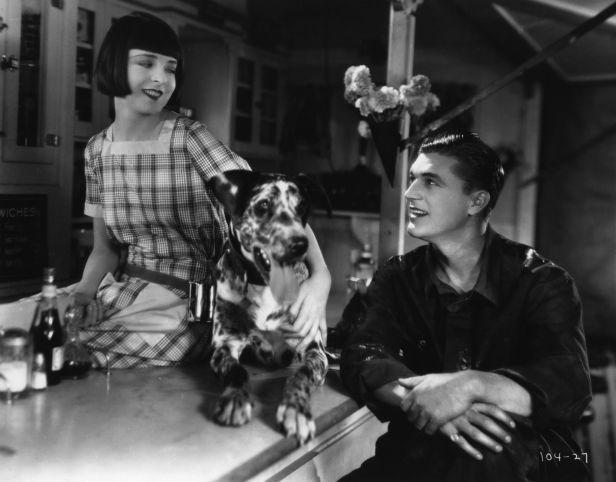
Her Wild Oat (1927) featured the comedienne Colleen Moore (Mary) running a lunch wagon on New York’s East Side. Mary spends her savings on a holiday on a holiday at a fashionable resort where she stands out from the other wealthy customers. The plot includes an impersonation which seems rather fanciful, but also a romance (Larry Kent) to set up a happy ending. This was one of the films with a notable canine character; a Dalmatian that helps police the lunch wagon.
Weimar Uncensored: Taboos and Transgressions in German Cinema, 1919 0- 1920 focused on that short, violent and chaotic period when expressionism, the avant-garde and changes in gender and sexuality erupted in German culture and produced a distinctive new cinema. It was aided by the lapse of Film Censorship between the end of the war and its re-establishment in 1920. So we enjoyed films addressing prostitution, Hedda’s Revenge / Heddas Rache [also The Prostitute’s Daughter], 1919: a film about a revue girl’s exploitation of sexuality for for wealth and social standing, Blondes Gift / Blonde Poison, 1919: a pact with the devil in The Devil’s Church / Die Teufelskirche 1919/20); a Svengali type tale with the star power of Conrad Veidt and Asta Neilsen, Der reigen / The Merry-Go Round, (1920): and a fantasy femme fatale held captive in an eccentric underground grotto, Genuine. The Tragedy of a Strange House / Genuine. Die Tragödie eines seltsamen Hauses, (1920); the last had the most expressionist style..
The Art of the Benshi –
“katdsudo benshi, literally ‘moving picture orator’ a live narrator who gave voice to individual characters – narrated the action and mediated between the film and its audience in real time.” (Catalogue Notes by Johan Nordström and Kotaro Shibata).
Early film elsewhere often had live narration accompanying film but the technique lasted a lot longer in Japan, into the early 1930s; moreover, the Benshi had its own distinctive mode and was also found on radio and sound recordings. These special events offered three features and a number of short films accompanied by three contemporary benshi – Kataoka Ichiro, Omori Kumiko and Yamauchi Nakano.
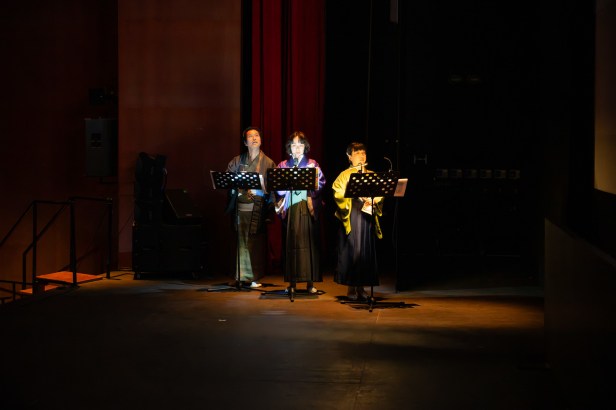
And there was also accompaniment from three contemporary Japanese musicians – Matsumura Makia pianist [whom I had the pleasure of hearing at a screening in New York], Katada Kisayo percussionist, and Kiyomoto Nobuakira playing the shamisen. These, effectively cine-concerts, were enjoyed and warmly received by packed audiences. Two of the features were familiar classic of Japanese cinema: A Page of Madness / Kurutta ippēji (1926) and The Water Magician / Taki no shiraito (19330. The third was, I think, more of a genre movie[ [kyugeki – old style period film], A Tale of Filial Devotion of Goro Masamune / Goro Masamune Koshiden (1915). Masamune was a legendary swordsmith from the C11th/C12th who has been popular in a number of dramatic mediums. This film traces his childhood as an ‘adopted son’ alongside an ‘actual son’. While making swords appears in the narrative it is mainly a family drama with young Goro suffering and seen as an interloper by the mother. This dwells on the emotional side of the family conflict and draws in traditional Japanese family rituals.
A contemporary newspaper review commented
“the film gradually won the viewer over and moved the audience to tears.” (Quoted in the Festival Catalogue).
I did find the emotional responses of both son and mother somewhat masochistic but the benshi accompaniment made the emotions powerfully present. The short films offered a range of subjects and form, including animation.
The Canon Revisited is a regular programme at Le Giornate. Happily one of these masterworks, The Outlaw and His Wife / Berg-Ejvind och hands hustru (Sweden 1918), was screened from a newly restored 35mm print. The film was directed by and stars Victor Sjöström, one of the outstanding film-makers of the silent era. As Berg-Ejvind, with his wife Halla (Edith Erastoff), he spends much of the film out in the the wild mountains, away from the class-bound system of law and order. The location work by the production team, especially cinematographer J. Julius, is magnificent. And whilst the early parts of the film have melodramatic aspects, as the narrative develops it reaches tragic proportions. We also enjoyed The Polish Dancer (US title) / Bestia (Poland 1917), an early vehicle for the star Pola Negri. The digital restoration is incomplete as are the titles. But there is enough to follow the plot as Pola (Negri) moves from the country to the city to achieve fame and fortune as a cabaret artist. The ending is downbeat but what stands out is the powerful and emotional performance of Negri.
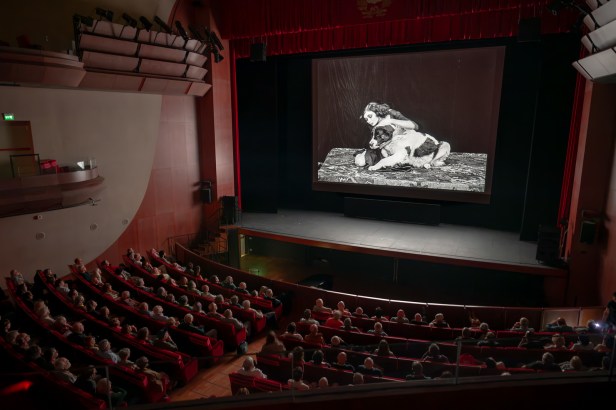
Another regular programme is Rediscoveries and Restorations. One of the entertaining titles was Seven Sinners (Warner Brothers 1925) directed by Lewis Milestone. This was a reconstruction from a decomposed nitrate original with stills and titles to fill in narrative gaps. Despite this the movie worked well. Led by an excellent Marie Prevost and Clive Brooks the titular number of burglars attempt to rob an empty mansion. The story managed to combine a lawful outcome with what is a happy ending.
Early Cinema was represented across several programmes. Apart from the Biograph Project we also enjoyed a series of short films of Tram Rides. These came from all round the world and featured a variety of trams with cameras tracking their process; rather like the Phantom Rides which were a popular genre in early cinema. There was something almost hypnotic as the moving cameras worked their way round mainly city scapes. And it was surprising what an amount and variety of street life was to be found in the early 1900s. There was also series of short films Greco-Roman Antiquities. These were provided by the BFI’s National Film Archive, some on 35mm prints, some digitised. We had Roman and Greek myths, Christian martyrs and [of course] Caesar and Brutus (Italy 1911). There were two programmes devoted to Female Madness – Madwomen: From Medicine to Melodrama which included medical recording son film, actualities and short dramas. Le Violon / The Violin, France 1908 depicted a woman who seemed struck by severe amnesia after a fire threatened her child. After time in an asylum she returned to the home where a violinist, playing at the time of the accident, played and helped release her from her delusion,. There was also a version of ‘Jane Eyre’ filmed in Italy, La Memorie di una Istitutrice (1917). Only half of the film survived from the point that Jane is installed as governess at Thornfield Hall. Even this seemed rather fragmentary, the most powerful scenes are concerning Bertha as she roamed the Hall at night and finally perished in the fire.
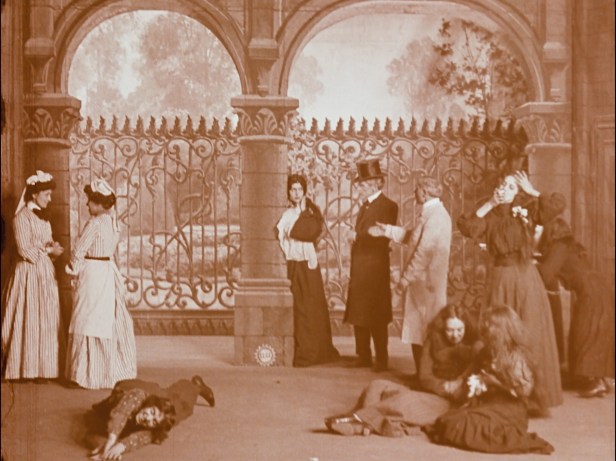
Credit: Gaumont Pathé Archives, Saint-Ouen
Other programmes of mainly short films were on offer. There was Spanish Cinema, 1896 – 1919. There were actualities, including events, bull-fights and popular city/landscapes, important occasions, bourgeois and workers: Spanish dance: and short dramas including an early Carmen (1911). There was Czech-Avant Garde from the later 1920s and early 1930s. These struck me as more experimental works than actual avant-garde. There were industrial promotion films like How is a Typewriter Created? / Jak vzniká psací stroj? (1934) whose ingenuity pleased the audience. Another film aired of fears regarding militarism, The Story of a Soldier / Příběh vojáka.
There were also a couple of films addressing militarism during World War I. Peace on the Western Front (Britain 1930) was a ‘pacifist’ reflection on the war. Provided in a digital version by the Imperials war Museum the title originally had a sound recorded commentary, now lost. So what has been recovered from the materials was voiced by actors alongside the screen. There was footage of the surviving devastation in European sites of war but the battle sequences were recreations rather than wartime footage. I did wonder if the pacifist intentions of the production meant it was not able to access the official film records. Unfortunately this method showed in the footage: I saw the same hillock in several different scenes of different battles. More seriously the film had no conception of the imperialist nature of the war which meant their critical stance was inadequate.
The same problem bedeviled Lest We Forget (France 1918). Filmed in the latter stages of World War I with US support, there were different versions of the production, and it is a digital restoration based on the French material. Rather like J.’accuse! (1919, a far superior study] the film uses a fictional narrative with some basis in actual events. But it never breaks out of the chauvinist values of the French and US allies, though does it recount much of the damage and devastation of the conflict.
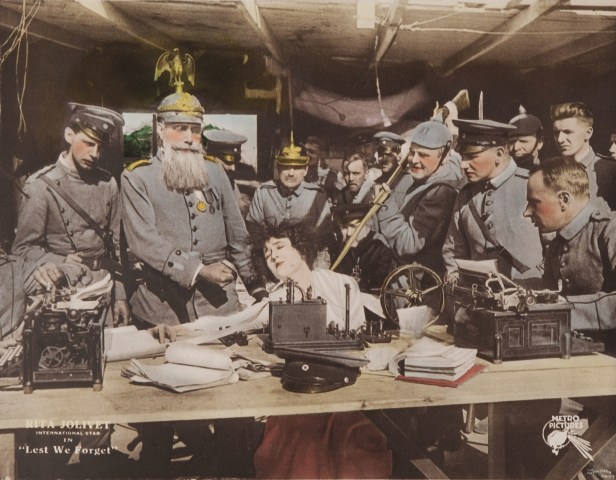
Lobby card
Credit: Courtesy of the Dwight M. Cleveland Collection
And finally we had Sine Nomine, short films and fragments that have not yet been identified. Those that do get recognised are recorded on the Festival Web pages; among which is Gendarme et voleur (from between 1905 and 1910) and featuring two heroic Police dogs.
The whole programme with the excellent and very full notes are available in an online version of the Catalogue. The printed versions are carefully conserved treasures by cinephiles like myself. The Catalogue has been produced for the last seventeen years by Catherine A. Surowiec with Piero Patat. After all these years of painstaking work Catherine is retiring and Le Giornate will have a full task in replacing her. Catherine was one of the people thanked publicly by the Director, Jay Weissberg, at the final Screening. This long list of funders, archives, writers, projection staff, musicians, Theatre staff and Festival staff is set out in the opening pages of the Catalogue Jay’s list received deserved warm applause. To which was added the name of Livio Jacob, President and one of the founders of the Festival. These days Livio is only able to attend the Festival in a wheelchair but he was there through out the week.
The other names to note are the presenters of the Festival Lectures: Allyson Nadia Field on “Rediscovering Black Film, Rewriting Film History” as the Jonathan Denis Memorial Lecture: and on Costume Design and Silent Cinema,, “The Artist (2011): A Recollection with Costume Designer Mark Bridges. There were also a number of book presentations alongside the Film Fair, with a collection of books, DVD/Blu-rays and film memorabilia. And away from the main exhibition there were the Festival Music Masterclasses and the Collegium for young film students joining the Festival.
The Jean Mitry Award this year went to two archival staff at the Eye Museum: Catherine Corman : Elif Rongen-Kaynakçi. We also had a presentation by Peter Bagrov, current Present of the Fédération internationale des archives du film, Peter also took the opportunity to add to his comments from 2025 regarding the commitment to 35mm prints by archives. He now added that he was pleased that this year he calculated a small increase in the combine total of feature length and shorter films on 35mm. One of these was the Haghefilm Selznick Fellowship Award print, Katerina (Russia 1911), a melodrama about a young Ukrainian Woman seduced by a Cossack soldier. And there was a brief comment by ta young Brazilian student who won the Collegium Essay Prize, Thaynara Brito for “Haunting Presences and Image Restitution”. She had written about the importance of overt politics in early film and this included a mention of the genocide in Palestine, which occasioned an amount of supportive applause but also a couple of Boos. Presumably one of the latter was the person who tried to get an official complaint about the comment- happily refused. The genocide has been an unfolding tragedy during the Festivals for the last four years. In 2023 it was a struggle to follow as the opening events unfolded in occupied Palestine: 2024 was marred by the screening of a contemptible 1920s Zionist propaganda print: 2025 improved with the Cine-concert of film of Gaza from World War 1. This year it was good to get a critically supportive comment from the stage.
I should add words of praise for the musicians who accompanied every foot of film screened at this year’s Festival. These are all listed in the Daily Schedule. The music this year struck me as uniformly excellent and really adding qualitatively to the films. Unlike 2024 or 2025 there was not a single screening I attended where the music seemed inappropriate. They are really a talented and committed group of musicians.
I am looking forwarded to 2027 when the Festival will enjoy being held in Pordenone, selected as the Italian City of Culture that year; therefore likely to be even more crowded. I also had a few thoughts about aspects I would like to see improved or amended.
First: After 45 years there is still not an official history of the festival though there are a couple of accounts of its founding, though they differ in detail. I think this would be of real interest to people who attend and people who follow it from a distance, including through the festival stream.
Second:I was happy, like Peter Bagrov, at the 35mm screenings this year. However, the short films were often interspersed with digital versions. There was an early Cinema section of BFI prints, all 35mm. I find there is a particular pleasure in watching a series of 35mm early film prints with accompanying music. I enjoyed the other 35mm short prints, but spread between the rather different digital versions they lack the overall feel. Perhaps we could have more of complete 35mm sections.
Third: For the opening and closing screenings, as the film ended and the musicians took the applause of the audience, Portraits of the Star/Director appeared on the screen. This was a return to a practice that had dropped out the Festival for a number of years. Apparently Festival staff thought that the earlier practice was only on opening and closing nights. My memory, dating back to the old Verdi, was that they were more frequent. I think that the Festival could make this a trope for at least all the evening features.
If you do come next year look out for the postcards with photographs taken by Valerio Greco inside the Teatro Verdi during screenings; they are great to send home to friends.