
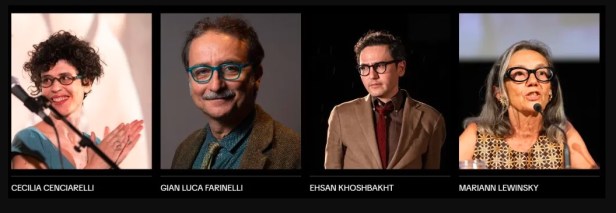
This year’s Festival was the hottest and largest on record. To celebrate forty years the directors produced an exciting, varied and compelling set of programmes. They likely did not plan the temperatures; as high as in most of Europe. Fortunately, the cinema air conditioning systems coped well and the open-air screening were warm but beyond the daytime sun. And guests attending passed 5,000: joined by local citizens, for the Piazza Maggiore events in their thousands.
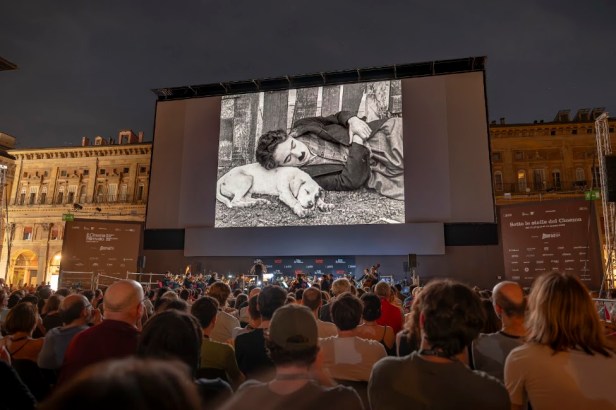
The night-time screenings in the Piazza Maggiore included a newly restored version of Sunrise (1927 ): Martin Scorsese’s musical New York, New York (1977): ending the week with two restored Chaplin titles from 1918; A Dog’s Life and Shoulder Arms. Both were based on prints derived from the original negatives for US prints; with high quality and using Chaplin’s first choices of takes. There was an orchestral accompaniment; with Timothy Brock arranging Chaplin’s own scores and conducting, as earlier he arranged the accompaniment for the screening of Sunrise.
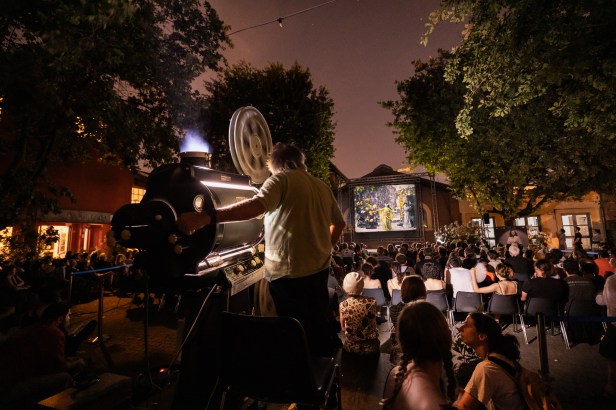
The popular carbon arc events in the Piazzetta Pasolini presented three evening screenings. The 1906 programme included films directed by Albert Capellani and Ferdinand Zecca: and one of the best canine movies of the week, Chiens Contrebandiers, with a pack of dogs acting as smugglers. 1926 was represented by Lotte Reiniger’s The Adventures of Prince Achmed / Die abenteuer des Prinzen Achmed and Soviet pioneer Lev Kuleshov Collective Po Zakonu / By the Law. The latter screening was unfortunately interrupted when the reel of film came off the projector, causing some damage to the print. However, the screening was able to continue after repairs.
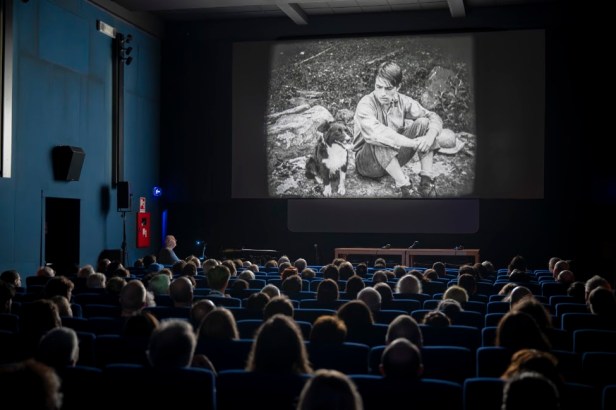
1906 was the latest in the series Century of Cinema. The programme included actualities: what we now term documentaries: early development of narrative: and the experimentation that was part and parcel of early cinema. These are short films, rarely running more than ten minutes and many of only a minute in length. But many were on 35mm prints: often using early colour technologies and all accompanied by music. They offered a delightful and sifting tapestry of moving images. And in addition some of the prints had a narrative accompaniment; a live voice over with plot, character and emotion added.
1926 was the year of A Hundred Years Ago. We enjoyed Alberto Cavalcanti’s pioneering documentary,
he took cinema to the streets and depicted a marginal and contradictory Paris in Rien que les heures. (Festival Catalogue, Roberto Ellen Canuto).
in a restored digital version: Soviet film-maker, Yakov Protazanov, Process o trëch millionach The Case of the Three Million, a visually impressive play on criminality. And of particular interest for me was a Swedish title, Flickan I frack / Girl in Tails. I saw the first reel of this film years earlier at another Festival but gave up as it was projected in the wrong aspect ratio. So I finally caught it. The first two thirds was fine and witty, but in the last third the heroine, cause of a minor scandal in a small town, returns to conformity.
Alongside these titles was an interesting programme presenting Matinee Idols: Women’s Male Stars; four icons from Hollywood in the 1920s, Richard Barthelmess, Thomas Meighan, Wallace Reid and Rudolfo Valentino. My favourite star and film was Barthelmess in Henry King’s Tol’able David (1921). In fact the film also presented an iconic canine star, a border collie.
Among the pleasures of sound film was one of my favourite female stars of he 1930s and 1940s, Barbara Stanwyck. The programme included films from early in her career up to 1957 and Forty Guns. It included a couple of her early films I had never seen before. There was a 35mm print of her ‘first significant film’, Ladies of Leisure (1930), directed by Frank Capra. The ‘leisure’ refers to a ‘girl-on-the-make’. She was cracking in the early stages of the film but her character lost its edge as she became increasingly involved with a bourgeois ‘domesticated male’, played by Ralph Graves. What particularity struck me about Stanwyck’s performance was the clarity of her dialogue even though coping with the limitations of early sound. There was also a strong supporting role by Marie Prevost as her flat-mate. Also in the programme was the classic melodrama Stella Dallas ( 1937), directed by King Vidor. There was already a fine silent version from 1925 directed by Henry King with Belle Bennett in the title role. Both Bennett and Stanwyck are excellent as the self-sacrificing mother, though I think Ronald Colman is more interesting that John Boles as the bourgeois ‘domesticated male hero’. Certainly the the sound version has one of Stanwyck’s great final scenes with minimal dialogue but massive emotion.
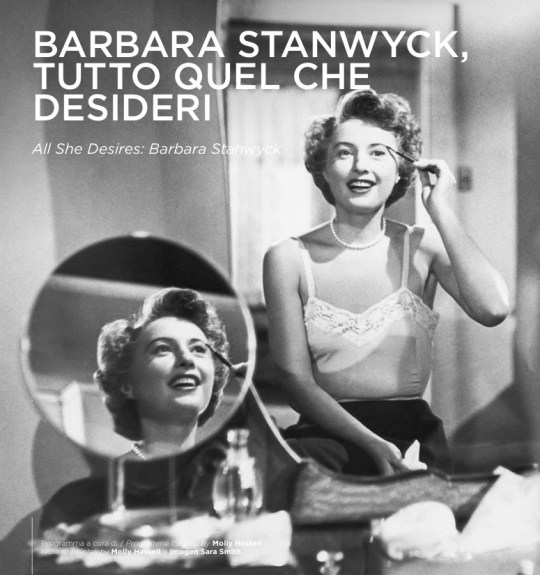
We also had a programme of titles directed by Mitchell Leisen, who progressed from set design to direction in the 1930s and 1940s Hollywood. Barbara Stanwyck was one of the stars who worked with him in those decades. In fact, we had had a selection of films from Leisen at an earlier festival and I think we had the best of them then. So I watched some of the ones that I had not seen. They were well-made but not great. There was Hands Across the Table from 1935, with Carole Lombard and Fred MacMurray. But MacMurray appeared to be imitating the style of the early James Stewart, not that effectively. And Murder at the Vanities looked like a attempt at titillation wrapped round a corny script; none of the likely victims of the murderer looked like they would be missed. There were the fine examples of his work like Midnight (1939) and Hold Back the Dawn (1941, in digital versions.
One of the real treats of the festival was a retrospective of the Japanese film-maker Ito Daisuke. Curated by Alexander Jacoby and Johan Nordström; their programmes in recent years have all been excellent presentations. Ito was a pioneer director in the silent era, and especially in the genre jidai-geki, including samurai films. Much of his early output is sadly lost or incomplete and I had seen some of this work at Le Giornate del Cinema Muto., But we also had later sound films which were new to me and were uniformly impressive. The narratives were challenging,often with quite a number of characters and specific Japanese tropes and motifs. But they repaid close attention: as well as mastering the genre Ito films were notable for the moving camera and their impressive sets; whilst he worked mainly with talented leading actors. We enjoyed one of the most complete silent films, Oatsurae Jirokichi koshi / Jirokichi the Rat (1931), close to how it was screened on release with a Benshi, Kataoka Ichiro, and musicians on traditional Japanese instruments, Kisayo Katada on narimono [percussion] and Nobuko Kawashima on biwa [a lute-like instrument], both joined by Gabriel Thibaudeau at the piano . Jirokichi was an actual historical character, a thief in the Edo period who became a sort of folk-hero. The plot is relatively simple, following Jirokichi’s relationship with two women. But there is also the conflict with law and order, including using a finely filmed chase after dark illuminated mainly by lanterns.
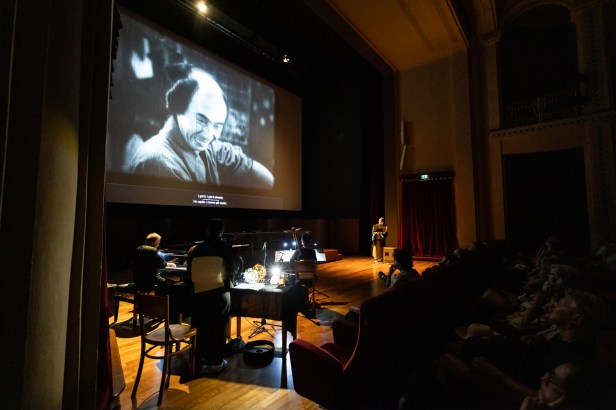
The later sound films, from the 1940s and 1950s, were all impressive. An early example is Osho / The Chess Master (1948). In fact the film follows the career of an amateur and then professional player in the Japanese board game, shoji. [Detailed on a page in Wikipedia]. The treatment both of the game contests and the home life of Sankichi Sakata (Bando Tsumasaburo – playing another actual historical character] are both well handled. The cinematography, with frequent moving camera, is excellent and the film, shot in a studio, has a striking central set where Sankichi resides; noirish in its visual character.
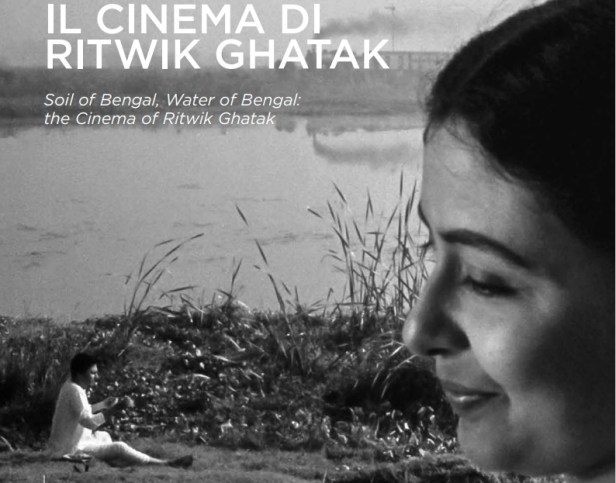
There was also a retrospective of the films of Ritwik Ghatak, the Bengali film-maker who was a strong influence on the later Indian Parallel Cinema. Some of the titles had been screened at an earlier Festival but these were mainly restored version in digital formats. They include the well-known and highly praised productions as Meghe Dhaka Tara / The Cloud-Capped Star (1960) and Titas ekti nadir naam / A River called Titas ( 1973). There were also films more rarely available like Komal gandhar / A Soft Note on a Sharp Scale (1961). The title is inspired by the great Bengali writer Rabindranath Tagore, whose songs/poems are included in the narrative.
named … after a musical note in the scale, used widely in Ragas /Indian melodic framework to create and evoke pathos, longing and introspection.” (Sanghita Sen in the Festival Catalogue)
Drawing on his experiences in the Indian Peoples’ Theatre Association, the films follows the the travails of an independent theatre company and two key characters working in it.
There was the regular address of ‘political cinema’ in the Cinema Libero programme. Here we endured rather than enjoyed Dayereh-ye-mina / The Cycle (1974). Part of a trilogy in pre-revolutionary Iran, by film-maker Dariush Mehrhjui. This is a bleak tale centred on a father and son seeking medical treatment in the capital and becoming involved in the various scams exploiting the sick and poor, including the marketing of blood. The film is in colour and very well filmed, but it is a depressing situation and setting. The film was, predictably, banned for a time. Such a bleak world one wonders how anyone can support the return of the Pahlavi clan to power in Iran.
Over the Festival I saw and enjoyed over thirty features or programmes of shorter films, the majority on 35mm. Some of my friends managed over fifty. Even so, with over 400 screenings in nine different venues there was much one could not get to see. Incredibly I did not see any of the Visconti retrospective of the week. I did manage La Sirène des tropiques (1927) starring Josephine Baker. But the stresses of programmes and the heat meant that I missed Joan Antonio Bardem’s Calle Mayor (1956) with Betsy Blair fleeing the U.S. Blacklist. The provision of a trolley between cinemas during the day did actually help get around.
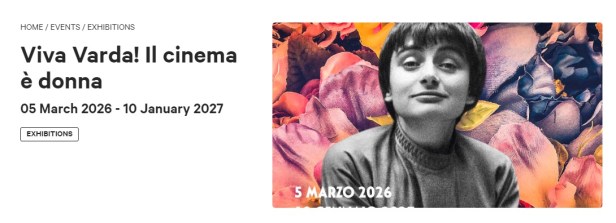
And then there were a whole series of talks, presentations and interviews in the Damslab. Whilst I missed these I managed to visit the exhibition at the Galleria Modernissimo on Agnes Varda. This was extensive and I would have liked to have made second, longer visit. Still it was a fulfilling and absorbing week; there is not any other festival quite like the Ritrovato.
There was a loss as well. Mariann Lewinsky, a key member of the directors, who has contributed to the Festival for several decades, especially addressing the silent period and with a preference for 35mm prints, retired. There was a well-deserved and emotional presentation to her.
Stills and photographs courtesy of Imagini del festival 2026 and Valerio Greco

