
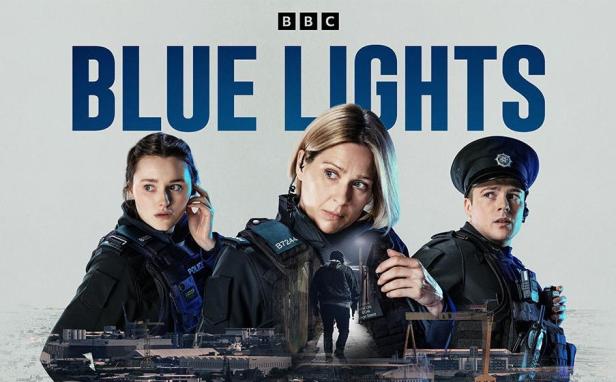
Blue Lights Series 4 is about to start transmission in the UK during this coming week. It is a series that has received great support from audiences and critics/scholars alike. I actually started a posting on the first three series back in November 2025 but failed to publish it. With the new series coming I thought it would be helpful to complete and post it now. I was a late convert to this BBC police procedural serial set in Belfast. When it first aired in 2023 I was just too busy to watch it and once one serial had gone, I didn’t feel I could catch up. But more and more people have told me how good it is and eventually Des convinced me to watch it. I began at the beginning with Season 1, Episode 1 and was instantly hooked. In fact I finished all three seasons over five days. Why was I hooked so quickly?
Season 1 begins with a focus on three new recruits for PSNI (Police Service of Northern Ireland). For those readers outside the UK, you should know that policing in Ulster is different from anywhere else in the UK. PSNI was a new police force to replace the RUC (Royal Ulster Constabulary) created in 2001 after the Good Friday Agreement brought a form of stability to the North of Ireland. However, that didn’t mean that all the problems went away. The Royal Ulster Constabulary was formed in 1922 after the partition of Ireland and it was always seen as a controversial entity being staffed mainly by officers from the Protestant community. From the late 1960s onwards it became more and more a militarised and heavily armed force with armoured vehicles and police stations fortified against attacks. The force saw over 300 officers killed and it was in turn accused of killing over 50 civilians. The PSNI was initially required to adopt a policy of recruitment of Catholic officers to improve the balance between the communities and this has been achieved to a certain extent, but the armed threat from dissident Republican and Loyalist gangs remains. Consequently the PSNI is the only UK police force (apart from specialist teams) that is routinely armed with both handguns and assault rifles and it still operates armoured vehicles for certain jobs.
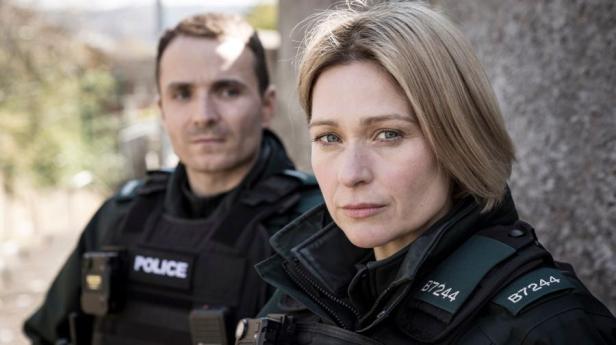
The TV serial is a ‘procedural’ because it deals with a specific police station in Belfast (later merged in a re-organisation) and focuses on the so-called ‘response officers’ who operate in pairs in patrol cars and are the first to respond to any incident in their part of the city. This takes the BBC back to one of its earliest iconic ‘cop series’, Z-Cars (1962-78) set in the fictitious ‘Newtown’ and its neighbour ‘Seaport’ (Kirby and Liverpool). Of course narratives about the police in patrol cars had been successful in the UK and US from around 1950 but Z-Cars was innovative in several ways including in the relationships between police officers in their response vehicles and CID (i.e the detective force) and later Special Branch (the intelligence services) as well as criminals and informers. The long-running serial also moved towards ‘realism’ and engaged with social issues. Perhaps most importantly it was set outside London and the South East (although it was later filmed in West London). The big difference is that Z-Cars ran for 801 episodes. So far Blue Lights has managed just three seasons of six 58 minute episodes. Television has moved on in many ways but Blue Lights succeeds partly by focusing on the same aspects of policing as the classic series.
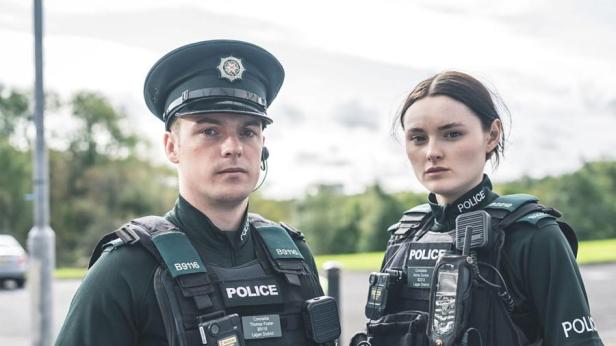
Episode 1 begins with three new recruits and their mentors who have long experience of ‘response’ work. Annie is a young woman with steely determination from a rural Catholic community and Grace is a woman in her early forties who has decided to change her career. She is from the English Midlands and a single mother with a son doing his A Levels. Finally Tommy is a ‘fast track’ recruit with a degree who is expected to progress quickly. Grace is paired up with Stevie, seen as the loner in the local station, while Tommy is paired with Gerry, the longest-serving response officer. Annie is taken out by Sgt Helen McNally to test her observation skills. Series one deals with a powerful gang of ex-Republican gangsters focused on the McIntyre family. Series two considers a Loyalist part of the city where an ex-British Army veteran disrupts the balance between two criminal families and Series three focuses on an Irish gangster group from Dublin which sees an opportunity to fill the vacuum. Each series sees drugs networks as the basic funding methods of the criminal gangs. The campaign against these criminal gangs forms a narrative arc across each season and they are linked together in intriguing ways. But alongside these major stories are the more mundane but essential police activities and on top of all the narrative threads is the story of the police station itself which features a large cast but the two characters who are perhaps most important in ‘keeping the show on the road’ are the two sergeants, McNally and Cliff, who seem to be known as ‘skippers’.
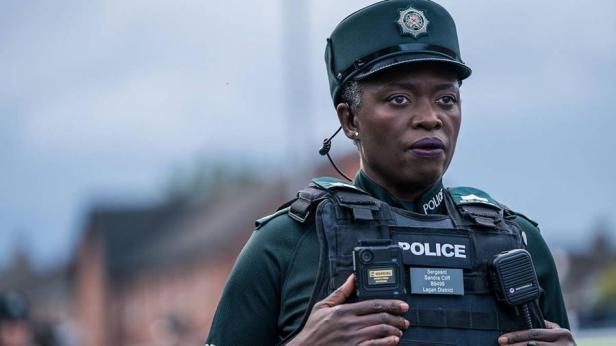
That’s the structure but now I want to pick out the elements which make the show distinctive. Let’s start with the casting. It’s very important that many of the characters are ‘local’ to Northern Ireland and a few from the South. Mixed in are individuals from the rest of the UK like Grace and Sgt Sandra Cliff, but that focus on the local is carried through. There is a use of local dialects and it is worth remembering that the North of Ireland has three languages, Irish Gaelic, Scots-Irish and English. Annie is the character who is most likely to use local expressions from her community. She is a Gaelic Games player. The script doesn’t generally make community backgrounds explicit and this may be a problem for some viewers outside Ireland but locals will know immediately from a character’s name if they are from Protestant or Catholic communities and Belfast itself is still divided in some parts of the city into enclaves where integration hasn’t yet broken up the sectarian divisions. The three lead actors, Sian Brooke as Grace, Katherine Devlin as Annie and Nathan Braniff as Tommy are all in my view excellent. They are very different characters from different backgrounds but they gell as a group and develop separately in entirely believable ways.
One aspect of local parlance which amuses me is that everyone seems to use the term ‘peelers’ to refer to the police. I don’t know if this is authentic, but I assume it is. I haven’t heard the term for years. It refers to Robert Peel, the politician from Bury in Lancashire who more or less invented modern British policing when he set up the Metropolitan Police in London in 1829 when he was Home Secretary (and later he was seen as one of the founders of the modern Conservative party). Police have also been called ‘bobbies’ after ‘Robert’ Peel. What I also didn’t realise is that Peel was first an MP for a ‘rotten borough’ in Tipperary, representing the Protestant landowners in colonial Ireland and later he was Chief Secretary for Ireland and associated with setting up the ‘Royal Irish Constabulary’. He was opposed to Catholic emancipation. So perhaps ‘peelers’ has a substantial Irish history, especially for Catholics?
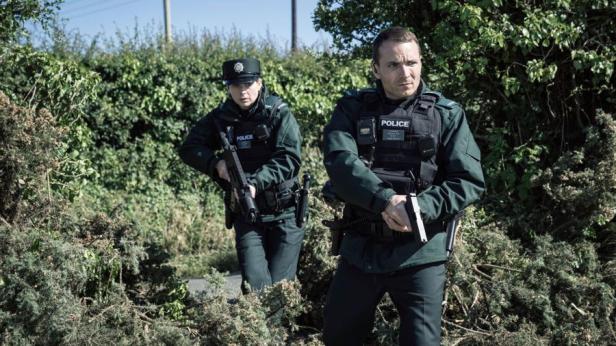
The other distinctive ‘localism’ in Blue Lights is the realism of shooting on the streets of Belfast. This is in sharp contrast to another hit BBC police series, Line of Duty (2012-2026) which has been partly filmed in Belfast but set in an unnamed English city. Blue Lights is more clearly Belfast-based with drone shots and long shots to show the hills round the city and the two giant cranes of the Harland & Wolff shipyards. One episode uses the ‘Titanic Belfast’ in docklands. What I’m trying to emphasise is that Blue Lights is ‘rooted’ in a distinctive culture that only exists in Belfast (Derry, the second city of Northern Ireland is similarly distinctive but not as large and with some different elements). Neither Belfast or Derry are as large as the major English or Scottish conurbations such as London, Birmingham, Manchester or Glasgow but they both have the distinction of sharing an island with Dublin, still a city that is part of the European Union. The creative teams and crews for the series are also Irish or Ireland-based. The show was created initially by local production company Gallagher Films in conjunction with BBC Studios and Two Cities Films (a company headed by Michael Jackson, former Controller of BBC1 and 2 and Stephen Wright former Head of Drama, BBC Northern Ireland). Louise Gallagher, Declan Lawn and Adam Patterson are listed as the creators of the series which have tended to have one or two directors for each series/season. Of course the personnel have changed over three series and it will be interesting to see who is still there for Series 4. The series have each ended with major stories coming to a climax involving characters who have generated strong emotional responses in audiences. Our emotional attachment is to the response team officers first but also to the skippers in the station. This focus on the ordinary coppers rather than the detectives or senior officers is important. The only other series that I can think of which did this in the UK was The Cops (1998-2001) filmed in Bolton but presented as a fictional Greater Manchester town.
Blue Lights has been sold to 160 territories according to the BBC so I won’t be the only one looking forward to the new series (go to justwatch.com to check local streamers). I think I’ll go back to the final episode of Series 3 to remind myself of where we left the central characters. The previous series should be on BBC iPlayer. Here is the teaser for Series 4 in which one of of the regular officers attempts to boost crime figures by stopping and elderly motorist driving erratically:


Your emphasis on response officers and a specific local setting suggests a useful way to introduce an ensemble: let a routine task reveal how differently the characters read the same situation. I would begin an original workplace scene with a newcomer needing to understand one small, practical detail while an experienced colleague responds almost automatically. For a fictional scene brief planned with Kling AI, I would map where each person stands, what each notices and how the task changes their relationship. That could make the place and the group legible through action before adding much biographical explanation.
LikeLike
This appears like an ad for AI assisted software but it is an interesting observation about scripting and direction.
LikeLike