
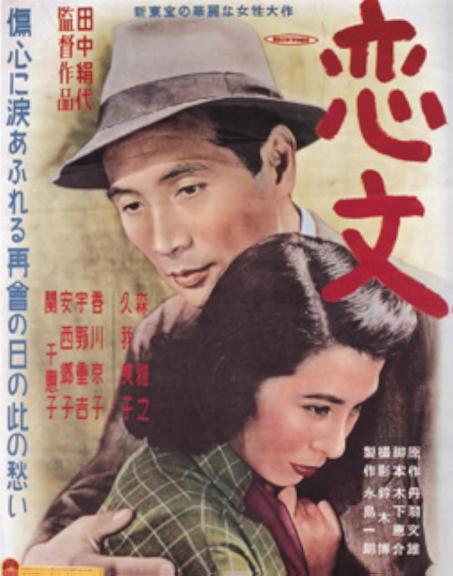
This year’s Leeds International Film Festival is the 40th and one of the strands presents ‘The City Plays Itself’, a varied selection of films from across the world set in different time periods in which cities themselves and especially cityscapes become ‘players’ in the narrative. I’m aiming to see at least two of the films in this strand and the first was this wonderful directorial début film by the Japanese actress who dominated Japanese cinema in the 1940s and into the 1950s, Tanaka Kinuyo. The film was briefly introduced by someone who unfortunately didn’t introduce himself. He gave the background to the production and told us that film scholars today still haven’t properly appreciated Ms Tanaka (19o9-1977) as a major filmmaker. This was slightly odd in the sense that LIFF itself had hosted a workshop run by Leeds University on Tanaka in 2012 accompanied by a selection of her films, three as an actor and two as director. You can find our reviews of both the workshop and the films via this Tanaka Kinoyu tag. The screening of Love Letter was made possible by restorations of her films which in turn enabled Criterion to release a set of six films in their Eclipse series in July 2026 and the Leeds print came from Criterion.
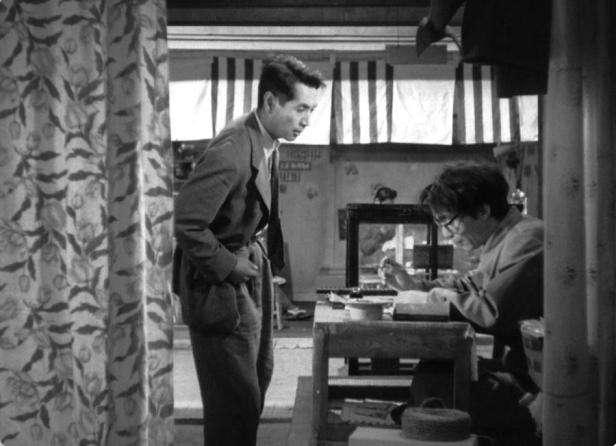
Love Letter is intriguing in many ways. The source is a novel by Niwa Fumio adapted by the renowned screen writer and director Kinoshita Keisuke. The narrative is set around 1950 during the Allied Occupation of Japan – there is a reference by a character to the war having ended five years earlier. The Occupation ended in 1952 before the film was released. Up until 1952 scripts had to be submitted to the Occupation authorities before Japanese films could be produced. Many Japanese films of the late 1940s early 1950s avoided discussing the Occupation itself and in particular didn’t show American GIs. This narrative focuses on the interaction of GIs with Japanese women and Americans do appear briefly both in and out of uniform.
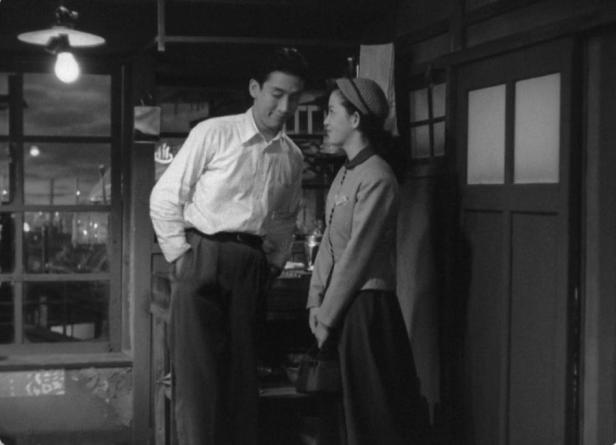
The central character is Reikichi played by Mori Masayuki, like Tanaka a major star who played opposite her on several films and became associated with Kurosawa Akira in particular. Here he plays a man who as a student at a naval academy was in the Imperial Navy during the war and has so far failed to adjust to peacetime in Japan. Before the war he had fallen in love with Michiko, a young woman whose father persuaded her to marry an older man who wasn’t in the armed forces. Since his return from the war Reikichi has been searching for Michiko across the whole Tokyo region without success. He has survived by living with his younger brother Hiroshi and taking in translation work which pays, but not very well. He has then been offered a job by an old naval colleague Yamaji. The two men use their language skills to write letters for the Japanese women who previously had relationships with American GIs. Most of these are in effect begging letters seeking support for children, pregnancies etc. Some of the women appear to have had several American lovers but others have perhaps had only one. Distinctions like this will become important.
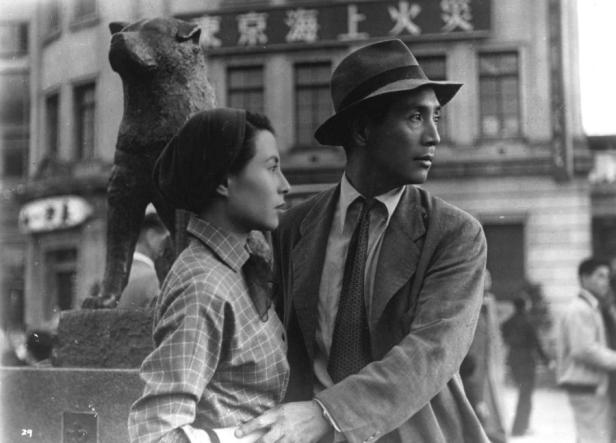
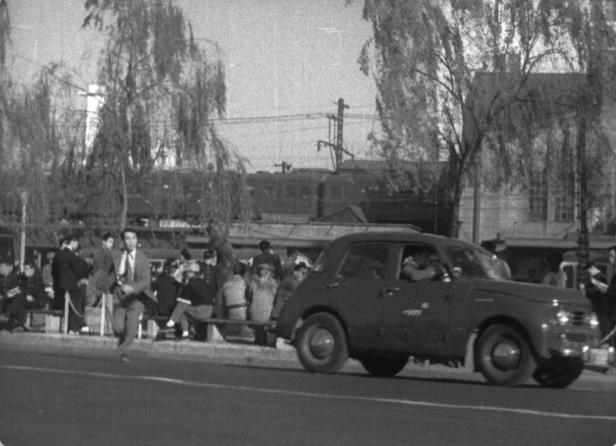
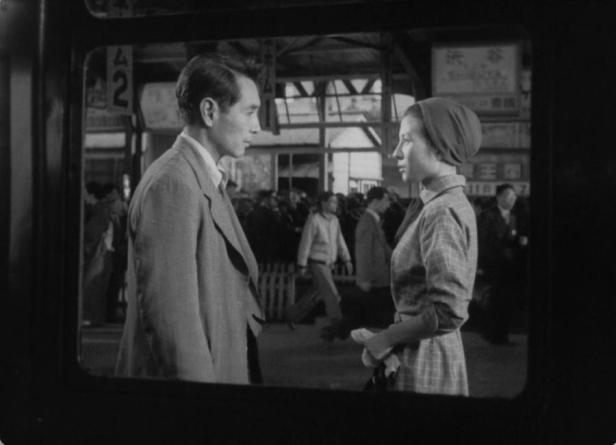
One day Reikichi is resting behind a curtain in Yamaji’s ‘office’ when he hears a conversation with a woman seeking a letter. It takes him a little while to realise that he knows the woman’s voice but he is too late to confront her. He sets off in pursuit through the Tokyo streets and into the busy Shibuya railway station. Tanaka stages one of the most dramatic meetings I have seen for a while when Reikichi reaches Michiko (Kuga Yoshiko) just as the doors are about to close. A transition then takes us back to the childhood relationship between a young boy and girl and develops into a further flashback to wartime and how Michiko dealt with the news of casualties. This flashback in a sense marks the end of the first part of the film and we wonder what will happen now that the couple have met again.
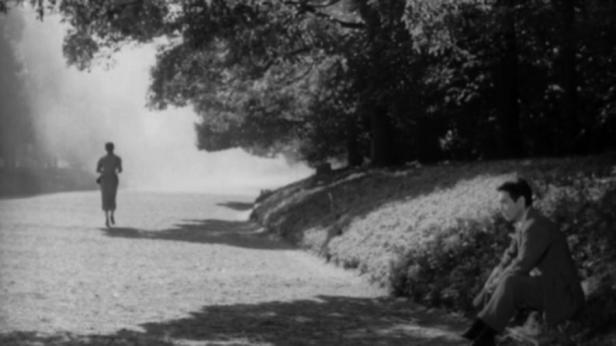
The second part of the film deals with the new contact between the pre-war sweethearts. I won’t spoil the narrative any more in case you want to watch the film. I found three versions of the film available to download free but I am interested in the US collection from Criterion which offers all six of Tanaka’s films as director. All I will say is that the film has an open ending which at least suggests the possibility of a pleasing outcome, though as a 1950s melodrama we might expect a tragic ending or at least a ‘punishment’ of some kind for the ‘progressive woman’ in this kind of picture. The overall theme of the film is the sense of coming ‘modernity’ to Japan. Michiko was forced to marry who her father chose for her but by 1950 things are starting to change. One of the benefits of the Occupation for Japanese women was that they were granted the vote for the first time and they were gradually able to move away from a father or male relative’s control. You may well be familar with this change from the other films from classical 1950s Japanese cinema. At the same time, the plot hinges on the grasp of modernity by Reikichi’s younger brother. Hiroshi (Dôsan Jûzô) is an energetic young man keen to make the most of business opportunities in the backstreets of central Tokyo such as buying books and magazines cheaply (American etc.) and selling them to bookshops and customers directly for profit. He hasn’t yet got married himself but seems well aware of the advantages and he sees that Reikichi would benefit from a serious relationship.
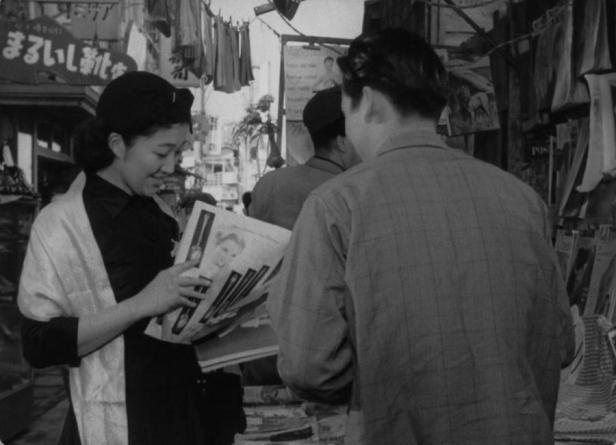
But of course, the new ‘freedom’ for women has its downside as well. In most of the Axis countries and those occupied during the Second World War, women who ‘fraternised’ with the enemy were condemned and punished. Michiko lived with at least one American. Could it have been more than one? Reikichi seems stuck in the pre-war era whereas some of his friends seem more attuned to the ‘new Japan’. I’ve seen some reviews of the film that complain about the values expressed by some characters but the narrative is realist in terms of the differing approaches to the changes. An aspect of this that was a welcome surprise was Tanaka’s own ideas about presenting the narrative. There is location footage in many Japanese films of the period but often, as in the case of Ozu, we see real locations being used for ‘pillow shots/transition shots’ – e.g. the view out of an office window – but in Love Letter the cinematography by Suzuki Hiroshi often utilises a tracking camera, weaving through the crowds on the streets like ciné-vérité or perhaps like Italian neo-realism. I thought that overall this was an astonishingly good presentation of the city for a début directorial effort. I’ve read several reviews of the film written more recently and I’ve been surprised at some of the comments which don’t seem to take note of the period, Reikichi is pilloried for some of his statements directed towards Michiko seen as mysoginistic but I think it must have been very difficult for men who had been at military academies in the 1930s and were now struggling to come to terms with the post-war and post-Occupation world of Japan.
I think Love Letter succeeds on many levels and it is certainly one of the best films I’ve seen this year.

