
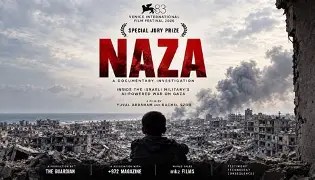
This is documentary that has caused a stir far beyond Occupied Palestine where the action actually took place. It has been produced by The Guardian Newspaper [a first?] and independent producer J. Wilson of JW Films. It was screened at the Venice Film Festival where it received the longest ovation so far in the Festival’s History. It won the Special Jury Prize at the Festival and is inline for awards at a number of other Festivals. The critical response has been overwhelmingly positive and it has achieved audiences that documentaries rarely obtain. Wikipedia has a long an detailed page on the documentary, its production, its distribution and responses and a substantial record of critical responses. Which makes it easier for me to concentrate on what really struck me in viewing this title.
The title is taken from a Hebrew phrase, Nezek Agavi, which is a military term for ‘collateral damage’; that is not buildings, machinery, vehicles or even animals but actual people, and people who are properly titled civilians. The phrase is one offered by one of 24 military personnel from the Israeli Defence Force interviewed on rooftops in Tel Aviv, at night and between 2023 and 2025.
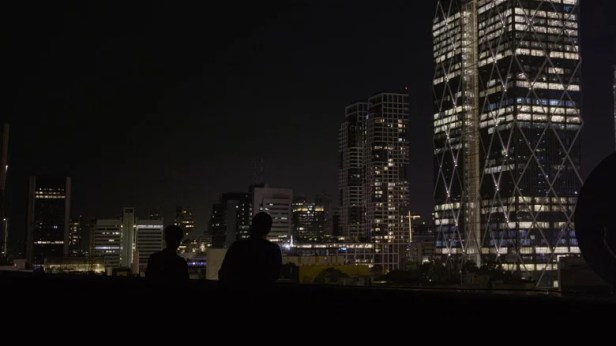
A screen title informs viewers that their appearance and voices have been digitally altered to preserve their anonymity. As far as I can tell only one of the 24 is female. I could not tell if we heard all 24 people interviewed; it was clear that some appeared several times, some only once.
The majority worked/work in elite military units, seemingly based in the HQ in Tel Aviv, supervising the targeting of ‘Hamas operatives’ in Gaza. At least one also saw active service in Gaza. Some comment on how other military envy the elite units. One explains that one particular unit reports directly to the office of the Prime Minster. They work with sophisticated software programmes, automated to a degree and also relying on what is termed ‘Artificial Intelligence. Their vast amount of material appears to include all, or nearly all, of the Palestinian cell phones in Gaza and topography of most of its buildings.
Views vary on how reliable all this sophisticated soft ware is, but examples are quoted where its targeting information was incorrect. The NASA function comes into play in regards of who authorizes actual strikes. Most, but not all, comments that a figure of 20 bystanders/family members is acceptable to proceed. Above that senior personnel make decisions, and this can reach, according to at least one respondent, 300 or 500 casualties. One of the nastiest aspects is part of the programme termed ‘Where’s Daddy’, which uses the phones of children to determine when the target a father returns home. The considered view among the military that this is the best and most effective time to catch operatives; and, of course, their families.
Listening to these often clinical descriptions it comes as no surprise that the Gaza casualty totals, now at around 75,000, is so high. One voice admits that carry to the conclusions available to the programmes it could reach Gaza’s entire population. The actual results of this targeting has ben viewable on media outlets, notably Al Jazeera. But the IDF consistently avoids explaining the operations an justifies them on what is fairly flimsy evidence.
Along side the targeting of ‘collaterals / ordinary people’, the work of the units also included organising access to supplies, including food and medicine, in order to move the population into the south of Gaza; and of course, currently, into the diminishing western Gaza. An especially nasty incident describes the shooting of Palestinians queuing for food supplies from the inappropriately named Gaza Humanitarian Foundation; it seems that the U.S.’s lack of a sense of irony is spreading amongst its allies.
Much of the descriptions of these processes and incidents sounds like many of the descriptions by earlier colonialists on the actions of British and other European occupiers. It also sound like some of the connected actions by European Fascists. The voices of the respondents tend to the neutral, but it is difficult to tell how far this is connected to the digitisation of their voices. However, this is film, so we also see, though only through the darkness of night-time roofs. The body language of these military suggests more than detachment; whilst this varies with respondent, there is frequently a sense of felt guilt.
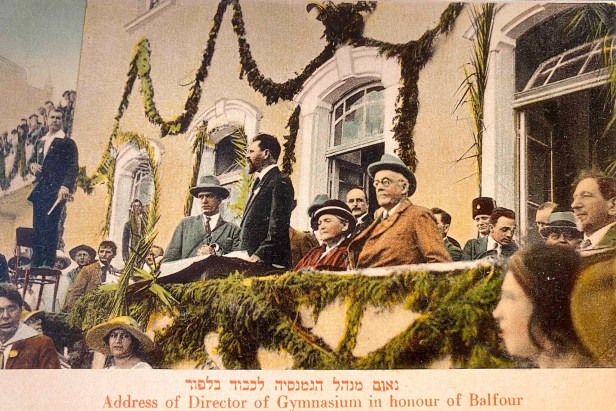
And the film’s mise en scene and sound take us beyond this. There are several sequences of found footage; two excerpts from a black and white [academy] military training film: a Zionist propaganda film of the 1930s,[black and white, silent] celebrating the founding of Tel Aviv: followed by colour footage of contemporary Tel Aviv with the sole surviving Palestinian building from the claimed empty desert: and the a telling piece of contemporary Israeli Television where Netanyahu defined terrorism, though not intentionally also defining the actions of the IDF which so clearly fit this.
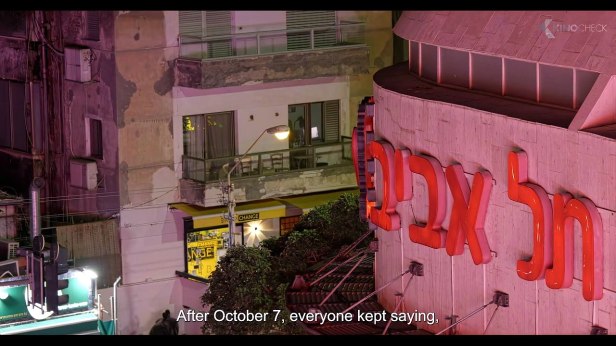
More telling are the pans and zooms of the camera of surrounding Tel Aviv as the interviews take place. These parallel the interviews but also, subtly, comment on the content. At time we hear aircraft overhead, at one point a rockets and distant explosion. Other times we see long shots of traffic, brightly lit on motorways and flyovers. But we also see into the surrounding apartments in high rise blocks. These are blocked by walls, pillars and window bars so we never see a person fully. But we can hear the television and its sounds. At times it is Israeli news channels, sometime with government minister commenting, sometimes reports on Gaza; at one point it sounds like children’s television; at another time someone is preparing a meal. At another point we hear that is is ‘Holocaust day’ and there is a cut to overhead shots of stationery cars and pedestrians during the two minute silence.
The everyday, apparently quite affluent, and undisturbed by violence is a striking contrast to the death and mayhem described in Gaza by the respondents. Only at the end is some brief footage from Gaza, already familiar to many viewers. We see the privileged, in this context, existence in which the respondents live. Thus this is more than a television-style report; a darkly poetic vision of the conflict.
The critical respondents were generally positive but there were also critical attacks. The IDF apparently did a close study coming back and countering much in the film, especially the quotation about 300 or 500 NAZA. The Government denounced the film, including predictably labeling it anti-Semitic. It also attack the military who had been interviewed, though it has not so far identified them? Other critics doubted if Government Ministers had actually watched it.
Two particularly interesting responses were by Palestinian writers. Watching ‘NAZA’ Amid the Gazan Rubble by Mohammed Sawwaf, The New York Times: I’m from Gaza. NAZA made me scream. Samah Sabawi The Electronic Intifada 29 October 2026. [Both are on the webpages of Jewish Voice for Liberation]. The two articles take rather opposing views on the documentary but both are worth reading in full. I tend to think that criticising the documentary for presenting anonymous Israelis on the genocide is informative and, presumably, we only get to hear them because they are unidentified.
Samal Sabawi also criticise the lack of genuine apology or remorse for the role the respondents played in the reported crimes. I do think they appear feeling genuine guilt in nay cases. I also think that expected ‘remorse’ from these representatives of a settler-colonial society is not too grasp the fundamentals of its culture. Frantz Fanon, at the beginning of ‘The Wretched of the Earth’ writes that,
“Their first encounter [coloniser and colonised] was marked by violence and their existence together – that is to say the exploitation of the native by the settler – was carried on by dint of a great array of bayonets and cannon. … The settler owes the fact of his very existence, that is to say his property, to the colonial system.”
Settler identity is based on a sense of the rightness of their position, of ownership, usually supported by some sort of religious values. It is those continuing colonial values and interests, that inhibit the British government from taking actual actions against the genocide, despite the historic British role in setting up the occupation.
Sabawi made one other point which was to question why the documentary was only 82 minutes in running time. This is an aspect that I also wondered about. If we do see and hear all 24 respondents then it is only for three minutes of less each. There must be hours of interviews. I would be interested to hear the film-makers commenting on that?
Actual screenings in Europe and North America appear to have ended with a profound silence. That was the case when I saw the documentary at the Hyde Park Picture House. However, I did note that two members of the audience left about a third of the way into the screening. When I left I asked the staff whether they had offered any comment as they left, but it seems they did not. So their response is unexplained. Excepting people who support the Zionist campaign, right or wrong, it would seem that for most audiences this is a salutary insight into the minds and actions of the Zionist occupation. So it is a title that needs to be seen by as many people as possible.

