
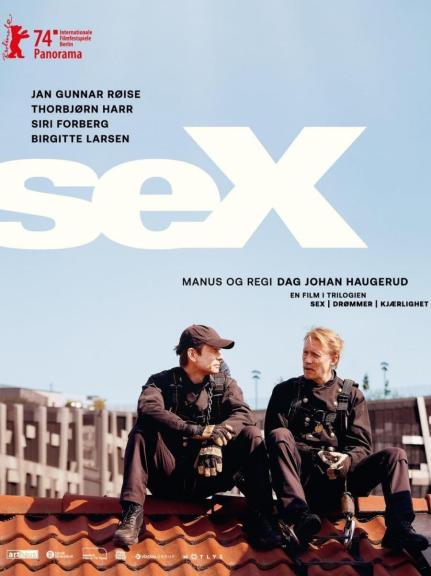
Sex is the first part of the trilogy of Sex:Love:Dreams by the Norwegian writer-director Dag Johan Haugerud. I have now seen all three films on BFI Player and I think it’s useful to make a couple of clarifications early on. Despite the title, there is no sexual display in Sex, it is mostly talk – in fact ‘talk’ dominates all three films. Secondly, although IMDb categorises Sex as ‘Drama, Romance’ and Wikipedia describes it as a ‘romantic drama’, my own reaction was to see it as a drama-comedy.
The three full-length films were all released in Norway during 2024 and arrived in the UK a year later. They each take a different approach to the same basic questions about gender identity and relationships in contemporary society. Haugerud (born 1964) published several well received novels in Norway in the 1990s before moving into films in the 2000s. The trilogy has had a major international roll-out with the films appearing at Berlin and Venice in 2024 then Berlin again in 2025 and in each case winning prizes. They are all shot by Cecilie Semec in Oslo and this becomes another ‘Oslo Trilogy’ following the films from Joachim Trier, whose three ‘Oslo films’ were spread over 15 years. The two men at the centre of the story are both chimney sweeps, an occupation that I haven’t encountered for most of my adult life since the days of domestic coal fires in the UK. Norways’s modern chimney sweeps appear to wear dark uniforms which reminded me of the ‘firemen’ who burned books in Truffaut’s Fahrenheit 451 (UK 1966). The Oslo chimney sweeps are not menacing but they are formalised by their uniforms. Later in the film we are introduced to one of the mythical aspects of the ‘sweep’ when one of the men in uniform is asked to have his photo taken with a pair of newly-weds. The tradition of ‘lucky sweeps’ may be Norse in origin and it is still a thing in the UK today.

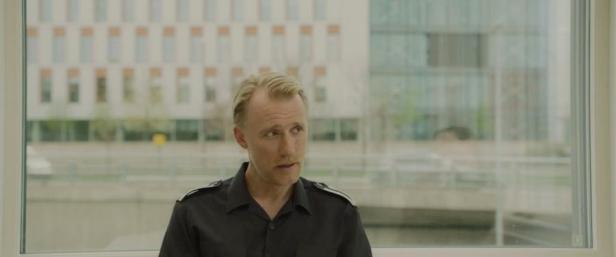
In the opening sequence of the film we see one of the sweeps wearing the traditional sweep’s top hat, emphasising this history. We also see other sweeps in a variety of headgear. All of these are long shots viewed from a high vantage point with sweeps on the roof of various Oslo buildings. We also see men in a swimming pool in conversation in long shot. Long shots and sweeping vistas accompanied by a pounding score suggest an urban melodrama and eventually the camera takes us through a high window I was reminded of Hitchcock’s Psycho but without the foreboding) into a room where our principal characters are chatting in what is perhaps a coffee break or after work chat. The senior man, Avdelingsleder (Thorbjörn Harr) is recounting a dream in which he meets David Bowie. He struggles to remember the dream but perhaps the significant parts of it are that at first he isn’t sure whether it is Bowie or perhaps God (later we will learn about his Christian faith) and then that Bowie might have looked at him as if he was looking at a woman. This is all focused on the speaker while we can just see the other man Feier (Jan Gunnar Røise), reflected in the window glass through which we can also see the Oslo traffic in the streets below.
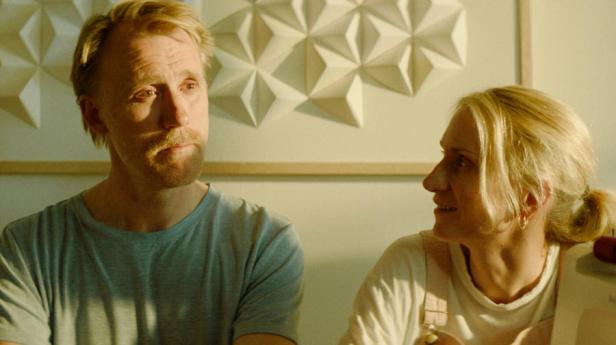
When Feier begins to tell his own story he tells his boss that today he has had an extraordinary encounter with a man, who after his chimney was cleaned, invited Feier to have sex with him. Feier at first said no and left but then thought, “why not?” and returned. Feier says he is not gay but he realised he did at that moment want to have a sexual experience. He doesn’t seem sure as to whether he enjoyed the experience or not but he seems intrigued rather than disturbed by what happened. The men talk calmly about their different experiences but clearly there is going to be a ‘fallout’ from their experiences as they digest what has happened. Avdelingsleder worries about what his dream means about his faith and he links the dream to a physical change in which he imagines his voice has changed so that he sings in a higher pitch. He is part of a church band and choir soon to give a performance alongside is young teenage son. Feier decides to tell his wife about his experience, perhaps not thinking too much about how she is likely to react.
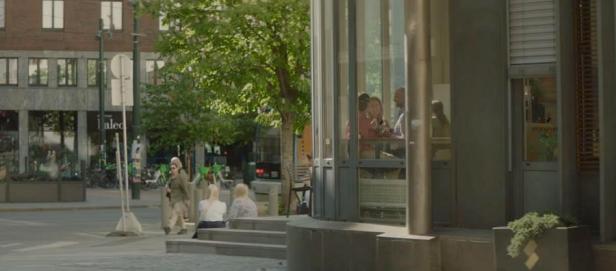
Not surprisingly Sex has divided audiences. Haugerud’s skill as a novelist is evident in the long dialogue exchanges but these are not likely to engage a mainstream audience when there is little conventional action. At the same time the camerawork and framing in ‘Scope (2.39:1) is very elegant and presents the open and beautiful city of Oslo in the sunshine but doesn’t ‘propel’ the narrative forward in a conventional way. Personally I found the film quite funny and I was engaged by the two leads and Avdelingsleder’s rather earnest son who accompanies him to see a voice coach and then a doctor after an accident in which the boy injures himself. He too is having an interesting experience related to his masculinity as he tries to help a girl in his class at school. I think the two ‘experiences’ of the central characters are rather different in the sense that Feier’s impulse lands him in a familiar situation (for characters in films!) of having an argument with his partner about his behaviour. Avdelingsleder, in contrast seems to have entered a more philosophical discourse about gender. The references to his religious beliefs and his involvement in the church also add something. I clearly haven’t seen enough Norwegian films or read enough Norwegian novels because I’ve never noticed religion as a central activity in any Norwegian narratives before. The film’s ending is ‘open’ and one element includes the performance given by Avdelingsleder in a dance sequence which has certainly baffled many reviewers. The public performance by the choir on the other hand is a familiar part of Norwegian and Northern Europe culture. The bizarre tongue-pulling sequence (part of ‘treating’ the high-pitched male voice) is bizarre but very funny.
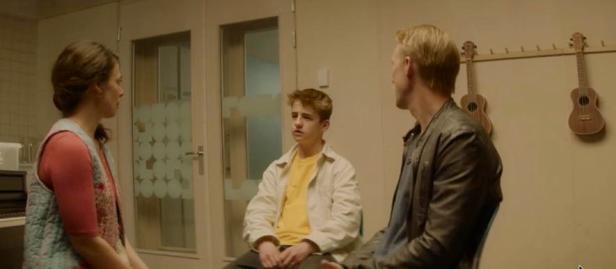
Overall I found this an engaging film with an original approach to discussions about gender. From my perspective (pun intended) the camerawork and my recollections of Oslo as a beautiful and surprisingly sunny city added a great deal. The two central characters seem to me to be both ‘ordinary men’ and quite comic in a deadpan way. The two performances are excellent and they deliver the well-written dialogue in very believable ways. Strangely this film seems to be the least popular of the films in this ‘Oslo Trilogy’ and I’m not sure why. One moment in the film that I would like to pinpoint is when the ‘voice coach’ tells Avdelingsleder and his son about Hannah Arendt’s ideas re the ‘public sphere’. This is suddenly a deep philosophical moment as Arendt is disputing the idea of the public sphere as defined by Jurgen Habermas. I was struck by this as it seems highly topical. See for instance this 2025 paper from the Cambridge Journal of Political Affairs. Sex is indeed a fascinating film. The Oslo Trilogy is currently streaming on BFI Player in the UK and on many streamers/online in other parts of the world.

