
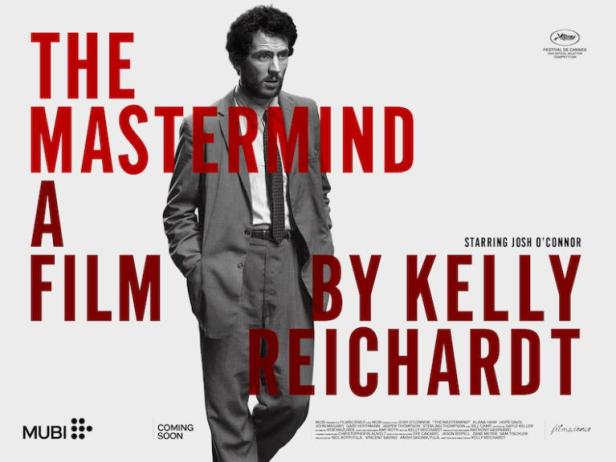
‘The Mastermind’ here is James B. Mooney (Josh O’Connor), a suburban family man and unemployed fine art graduate who decides to steal four abstract paintings from his local museum/gallery. The title chosen by writer/director Kelly Reichardt is ironic or possibly satirical since Mooney is rather naive in his attempts to stage a ‘heist’ – or rather he plans the actual robbery carefully but fails to think through what might happen afterwards. The story is set in 1970 in New England and was inspired by a similar real life robbery in Worcester, Massachusetts in 1972. Kelly Reichardt chooses to place her narrative in Framingham a town nowadays some 40 minutes down the commuter line from Worcester to Boston but the art gallery/museum in the small town is fictitious. The timing of the story is important, especially for the discourse around ‘JB’s’ sense of individualism and freedom up against the nascent feminism and growing resistance to the Vietnam War during this period. It also allows Reichardt to develop her seeming fascination with the ‘look’ of the US in terms of the autumnal colours and design issues of the period.
This is possibly the biggest budget Reichardt has worked with but this has not prevented the resistance by mainstream audiences to adjust to the director’s slow pacing. A quick glance at IMDb’s user comments shows the wide disparity of responses to the film. I missed this on release and I’ve finally managed to watch it on the Blu-ray disc released by MUBI. I have to confess that it took me two viewings to get up to the 40 minute mark (of a film lasting 110 minutes). I was surprised that I struggled with the set-up of the robbery and then its execution. But on my third viewing I was highly engaged by the aftermath of the robbery and I do wonder if the film wasn’t perhaps intended to have the structure which I accidentally constructed for myself. The central character is presented through a wonderful performance by Josh O’Connor who in 2025 was seen as ‘hot’, appearing in four American films including The History of Sound as well as Challengers in 2024. I remember his performance in God’s Own Country (UK 2017), filmed around Airedale in West Yorkshire, and this was the film that Kelly Reichardt remembered him from.
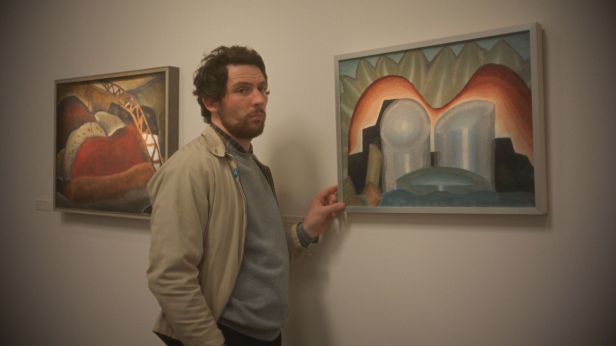
Part of the confusion for mainstream audiences comes from the character of JB as well as the pacing and camerawork. He isn’t the dynamic hero or anti-hero of conventional Hollywood and Reichardt doesn’t ‘explain’ him in the early scenes. Instead she simply frames the set-up of the robbery, challenging her viewers to work out what is going on. But if you’ve seen previous Reichardt films you’ll know the kinds of things to look for. JB observes the lax security of the gallery on a family visit with his two pre-teen sons and their mother. JB’s wife Terri is played by Alana Haim but she says very little in the film. She appears to assist in the heist but her main contribution is to be the breadwinner for the family. JB gets the money to set up the heist by conning his mother who has her own funds and is persuaded that JB has a new project for a client. The third main female character appears later in the narrative when JB is ‘on the run’ and crashes with his old university friends, Fred and Maude. Fred is played by John Magaro, a regular Reichardt player reminding us of her other films. He is happy to help his old friend but Maude (Gabby Hoffman) sees through JB immediately and soon ‘moves him on’.
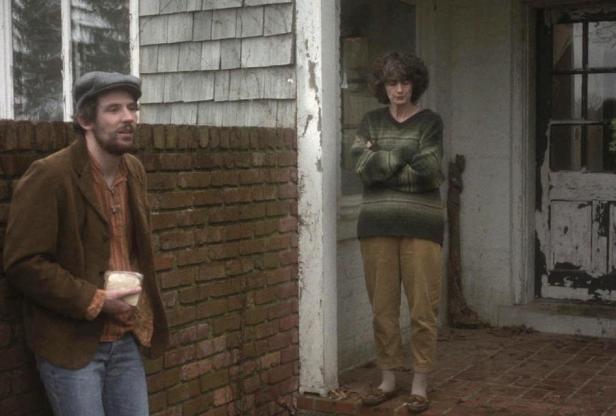
Throughout the film, JB meets women with whom he doesn’t really communicate. The women’s responses remind me of Reichardt’s Western Meek’s Cutoff (US 2010) in that the men are fairly useless and the women ought to replace them as leaders of the wagon train. Meek’s Cutoff was shot in Academy Ratio (1.37:1) with the suggestion that the ‘boxy’ shape expressed the women’s limited viewpoint, constrained by the bonnets they wore. The Mastermind is presented in 1.66:1, again narrower than most widescreen films in Hollywood. This appears to be an hommage to the film that inspired Reichardt in thinking about the ‘heist drama’, Jean-Pierre Melville’s Le cercle rouge (France-Italy 1970), since that ratio has continued in use in some European art cinema films.
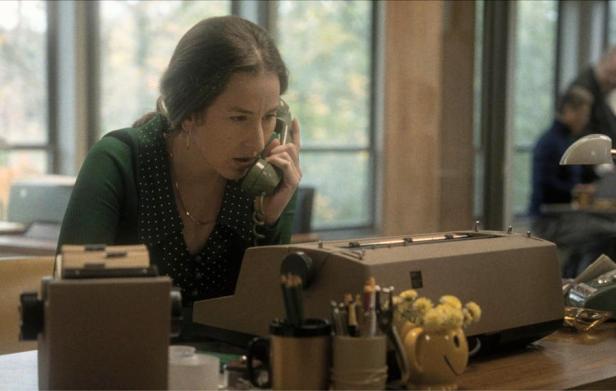
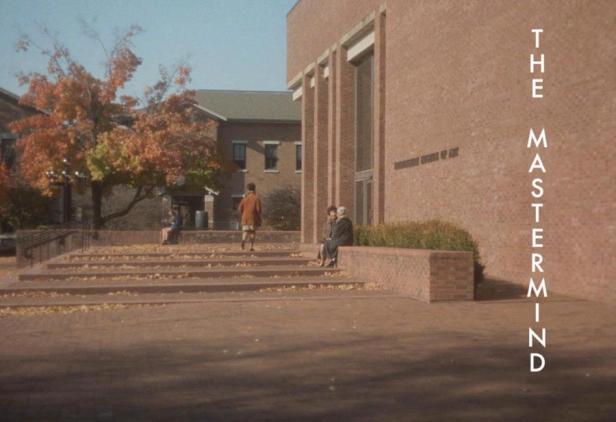
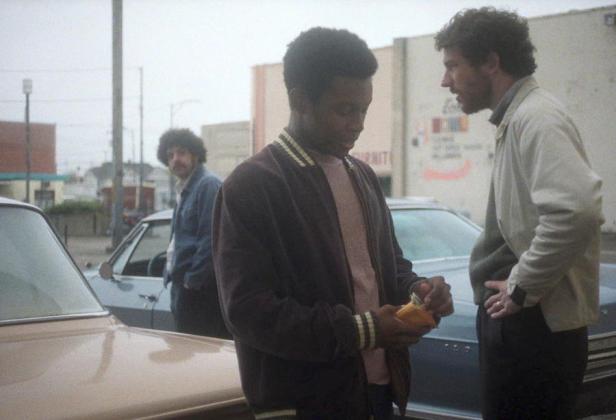
Camerawork, lighting and mise en scène are central to the presentation of 1970s New England in The Mastermind. Reichardt works to present the colour palette dominated by browns and muted colours often thought to represent the era, but for my money the clincher here is the use of period ‘automobiles’, those long Detroit vehicles which feel more like boats adrift on the road. This was just a few years before the oil crisis changed motoring habits worldwide. The aftermath of the robbery takes us into rural New England with misty scenes of Autumn. I later learned that many of these sequences were shot in Ohio but the important point is that Reichardt and her regular cinematographer Christopher Blauvelt manage to find a certain kind of beauty in landscapes. Meanwhile in the final section JB will find himself on buses between small towns as he seeks to get away.
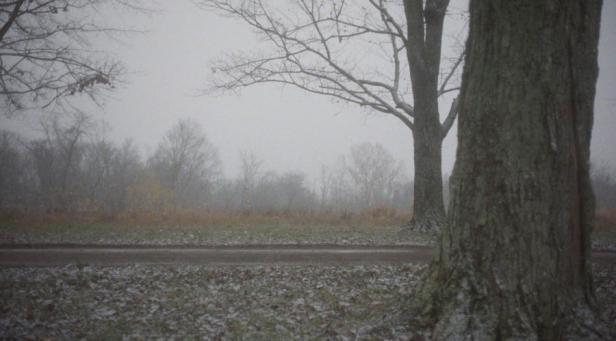
Throughout the film there is another discourse in which we gradually become aware of the unrest developing in the US in 1970, especially around the war in Vietnam and the final section sees us still following JB who is becoming increasingly desperate. At one point he refuses the opportunity to cross the border into Canada and stay with a contact. He jokes that he couldn’t get mixed up with “a commune”. Kelly Reichardt was only a child in 1970 but she seems to have skewered JB as the kind of American middle-class man who didn’t really know what was going on in the world. Fortunately, Josh O’Connor is such a great actor that we are still fascinated by JB and what becomes of him even when we are aware of all his inadequacies as a human being.
I found it fascinating reading some of the reviews of the film and one interesting comment was about the four paintings that JB stole. The artist is Arthur Dove (1880 – 1946) and the film’s plot assumes that JB would have seen a print of a Dove abstract painting in his thesis supervisor’s office at college. The paintings by Dove that JB stole were not particularly valuable and in 1970 he wasn’t particularly rated by academics or collectors. But there is a connection between the painter and the fictitious JB in that both were born into middle-class families in which their parents expected them to choose a degree and pursue a lucrative professional career, but each instead chose an art degree. Dove’s reputation has risen since his death and the suggestion is that JB possibly sees himself as a kind of middle-class rebel matching Dove but really doesn’t have the intellect or the discipline to see through any form of rebellion. The other discussion is around Reichardt’s touchstones in 1970s ‘New Hollywood’ and I’ve come across Five Easy Pieces (1970), Vanishing Point (1971), Two Lane Blacktop (1971) and Dog Day Afternoon (1975) as films she might have thought about. Each of these films deals in some way with the state of US society in the early 1970s while also exploring ideas around genre but each also has different narrative resemblances to aspects of The Mastermind. Coupled with the approach of Melville in Le cercle rouge these references do open up the possibilities of different meanings in The Mastermind. My first responses to this latest Reichardt film were tinged with disappointment but the more I’ve thought about it and tried to write this piece, the more I’ve come to recognise its undoubted merits. The Blu-ray does include a video essay by Amos Levin which extends the range of Reichardt’s references and is certainly worth a watch. I realise I haven’t mentioned the jazz score by Rob Mazurek which appears to have divided audiences but I found its mix of jazz and electronic music to work well. I once challenged film students to think about Kelly Reichardt as a ‘genius’ of contemporary American cinema. The Mastermind sees a strengthening of my belief.

