
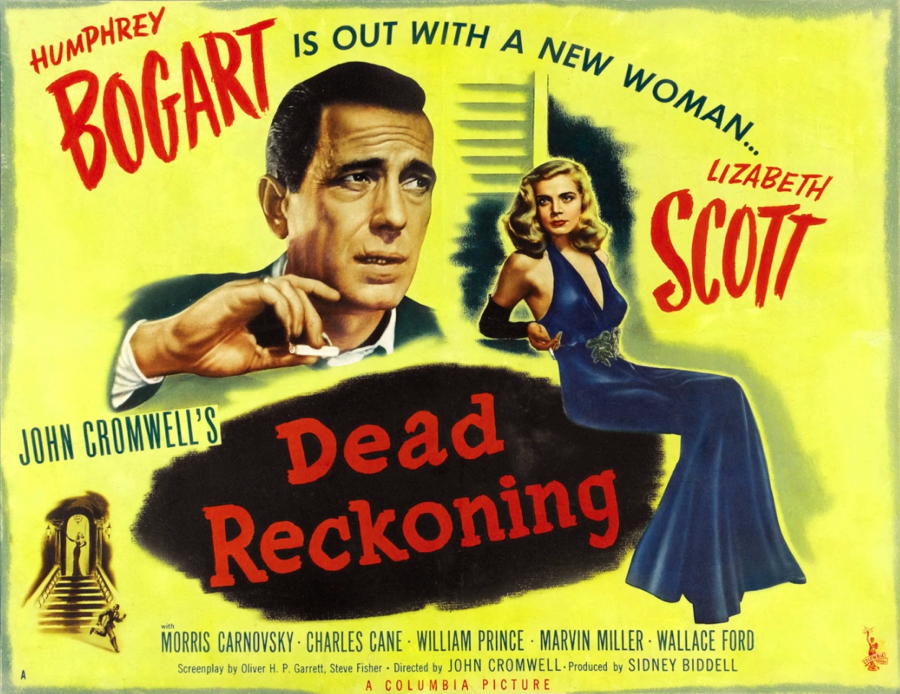
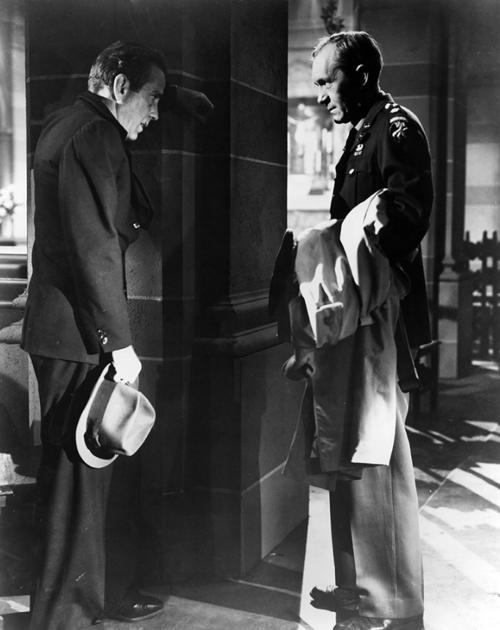
This is another film from the ‘Columbia Noir’ boxsets, included in Vol 5 devoted to Humphrey Bogart titles. In the case of Dead Reckoning the noir tag is certainly appropriate. The Bogart character is a recognisable noir male character as the returning war hero Captain ‘Rip’ Murdock of a parachute regiment who must become an investigator when his young Sergeant, Johnny Drake (William Prince), goes missing. It is 1946 and the pair have arrived back from convalescence in Europe to find themselves called to Washington but Johnny does a runner when it turns out journalists are waiting for them. Rip will later discover that Johnny’s disappearance involves a genuine femme fatale played here by Lizabeth Scott as Coral Chandler. We also know it’s a noir because much of the story is narrated in a long flashback by Rip as he stands in the shadows of a church at night addressing a US Army chaplain. Characters, themes and low-key cinematography combine to create the textbook film noir in the period often thought of as the high point of noir production. However, the film doesn’t have a particularly high profile. Is this a rare gem or perhaps just a crime genre picture that entertains but doesn’t offer much more? I note, by the way, that the American Film Institute Catalog defines its genre solely as ‘film noir‘.
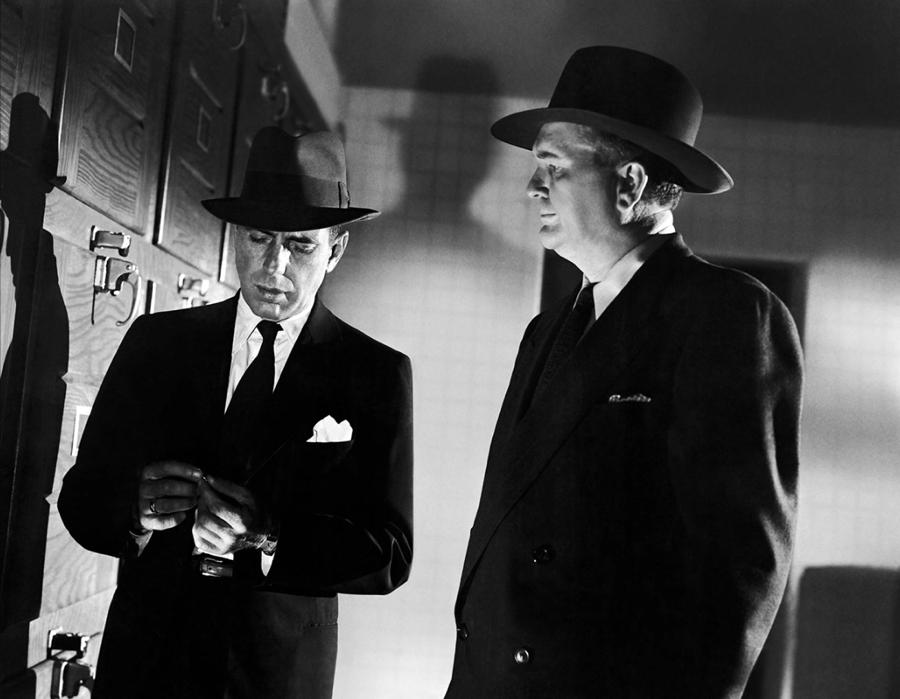
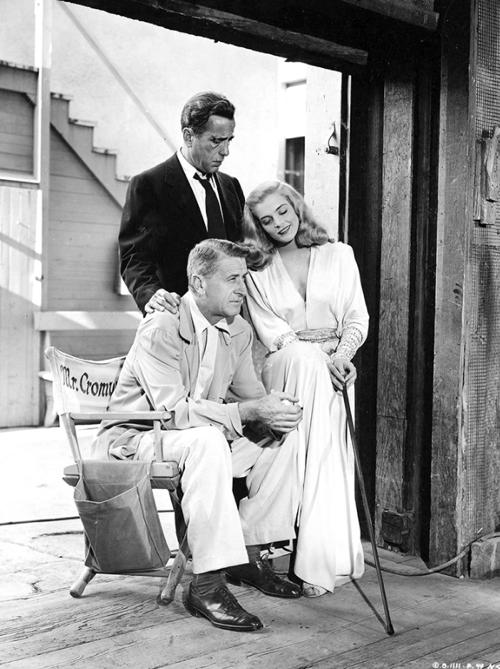
To begin with the main credits on the film, it seems that Columbia boss Harry Cohn was intent on creating a larger budget film as a vehicle for his contracted star Rita Hayworth and he had decided to pay what would have been a significant loan fee to Warner Bros to hire Bogart, who was a hot property in 1946: Kingsley Canham (1976) suggests that the loan was linked to an earlier use of Columbia players by Warners. But having made that deal Cohn found Hayworth to be in dispute over her contract and he was forced to find a substitute. He turned to Lizabeth Scott who was under contract to Hal Wallis at Paramount. All this is explained on the BD by Tony Rayns, who also includes some discussion of the third-billed Morris Carnovsky. Primarily a theatre actor and a member of ‘The Group Theatre’ in the 1930s, Carnovsky had a relatively limited film career partially curtailed from the late 1940s/early 1950s by the blacklist of personnel fingered by HUAC and then McCarthy. He had been a Communist Party member but here plays against type as the rather suave villain, Martinelli. Cromwell, who saw himself as a ‘Liberal Democrat’ but certainly not a Communist was worried by the HUAC moves at this point. The next few years would be fraught for many filmmakers in Hollywood. Canham’s piece on Cromwell (possibly the source for Rayns) tells us that Bogart had a say on the director and chose Cromwell who had once given Bogart a start on Broadway. Canham also suggests that the film suffered from Scott’s “inadequacy as the villainess”. That sounds a bit harsh. Cromwell had first worked in the theatre in the 1910s and began working in films for Paramount in 1928. In the 1930s he was best known for his work on the ‘women’s picture’ with a wide range of leading actresses. Working with actors was his strength but he had experience of a range of genres and was a respected filmmaker. One of his other films on this blog is Of Human Bondage (US 1934). Cromwell had worked with major studios and independents like Selznick and he was adept at freelancing. (See Kingsley Canham’s essay in The Hollywood Professionals, Vol. 5, Tantivy Press 1976.)
I’m a little wary of Hollywood films that need several writers. Dead Reckoning was a story by Sidney Biddell (also the film’s producer) and Gerald Adams. It was then adapted by Allen Rivkin and the final screenplay required a further two writers, Oliver H.P. Garrett and Steve Fisher – both experienced writers. The resulting script includes many familiar scenes but I may be thinking of later films so perhaps it was more original. But I do think the narrative has some obvious holes in it. The film was shot by Leo Tover. He was a seasoned pro working consistently from the mid 1920s until 1943 but this was his first feature for three years after Army service in a Photographic team. He seems to have been at Paramount in the early 1940s, so another of the production team from outside Columbia. The main action of the film takes place in ‘Gulf City’ and scenes were shot in Biloxi, MS and St. Petersburg in Florida.
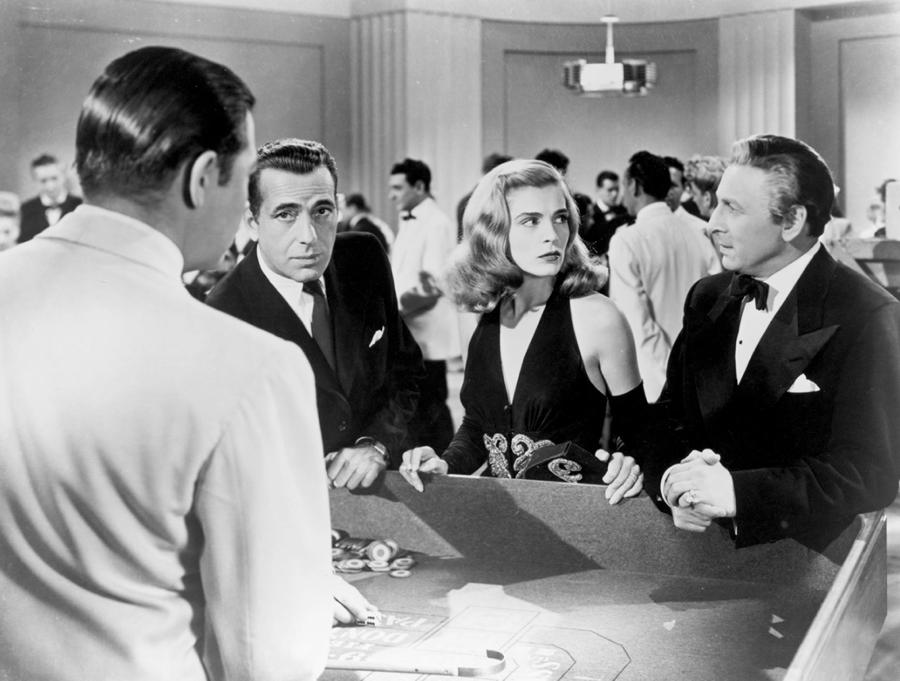
The idea of returning service personnel from Europe or the Pacific faced with a ‘changed’ United States became a common element in several film narratives associated with film noir. Alan Ladd in The Blue Dahlia (US 1946) springs to mind and of course Bogart himself would play an officer who is investigated by one of his own wartime colleagues in In a Lonely Place (1950). One intriguing aspect of Dead Reckoning is the use of the paratroopers exclamation of “Geronimo!”. There are various explanations of how this came to develop in the US Army, some arguing that trainee paratroopers had been watching the 1939 film Geronimo and chose the name as a kind of war cry as they jumped from the plane. I remember as a child in the 1950s that we shouted it in the school playground playing the the game ‘British Bulldog’ as we ran through a crowd of boys trying to stop us. I wonder where we got it from? Possibly it was from relatives who had been paras. In the film, ‘Geronimo’ is a codeword between Rip and Johnny and there are a couple of scenes where it seems Rip is remembering the parachute jumps when he may have used the name. There is also a letter which is supposedly crucial to the plot – a letter Johnny wrote to Rip in a secret code. This is delivered to Rip and then stolen but it appears to be a MacGuffin and is never found – or rather it is taken from Rip after he finds it but the contents are never revealed.
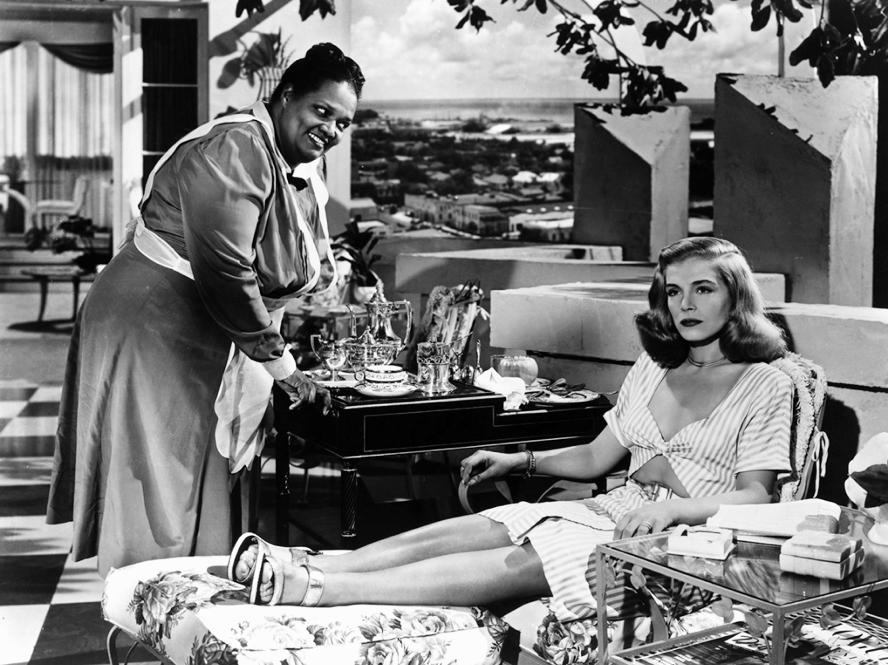
The key to the plot is the Lizabeth Scott character Coral. I don’t want to give away too many spoilers but Rip’s problem is the familiar one facing the noir male – is Coral the wronged woman Johnny was trying to save or the wicked woman who was duping him? Rip will also find himself very attracted to her, but does he know what is going on? Scott has been compared to Lauren Bacall and her luxuriant hair and slender model’s figure also suggests Rita Hayworth and no doubt several others. I’m not sure about her. On a first viewing I found her less convincing than in her later Hammer ‘B’ picture Stolen Face (UK 1952) but on a second viewing she grew on me a little more. Overall I think this is a well-made genre piece and if I was still teaching, I think Dead Reckoning would make a good case study for students. It’s an ‘A’ picture of over 100 minutes and the larger budget is evident in the locations and sets. If you are a Bogart fan this is a must. He gives his usual assured performance even though he was in the process of settling down with Lauren Bacall during the shoot.


given Bogart’s situation with Betty Bacall it may seem odd she wasn’t offered the femme fatale role when Hayworth was not available but, come to think of it, although Bacall was notable in film noir I cannot ever recall her playing a real bad girl like the lady here. Maybe it was not her preference. I think the one-time Emma Matzo did very well. If I am right this is the film Bogart refers to her as ‘Cinderella with a husky voice’. Every bit as good as Jane Greer in a similar role.
LikeLike
Bacall was three years younger than Scott. It doesn’t sound much but it would have made her a teenager when she knew Johnny. Also, I think Bacall was probably under contract at Warner Bros. and Jack Warner drove a hard bargain. Bacall would return to play with Bogart in Dark Passage (1947) and Key Largo (1948). I did think about Out of the Past when I watched Dead Reckoning but I think I would take Jane Greer over Lizabeth Scott.
LikeLike