
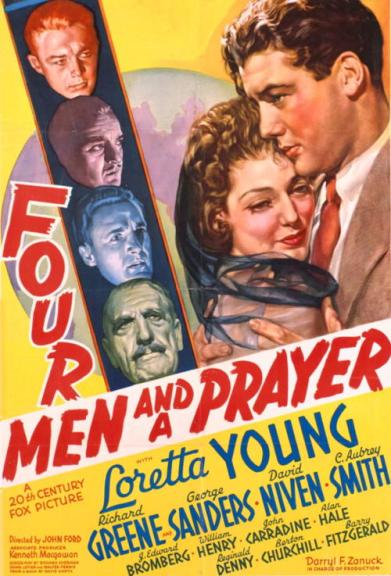
John Ford had one of the most productive periods of his career during the late 1930s and early 1940s at the newly-formed 20th Century-Fox under the control of Daryl F. Zanuck. Zanuck and Ford didn’t necessarily agree on several major issues but they respected each other as filmmakers. Ford tried to avoid any interference by studio executives but Zanuck always attempted to have his say on how films turned out. Inevitably there were tensions between the two men. For Ford, however, there were possible benefits. The new studio was an ‘integrated’ film corporation, the fifth ‘major studio’ in Hollywood. Ford would have bigger budgets, possibly A List stars and Zanuck had a record of producing successful commercial pictures for both Warner Bros. and 20th Century Pictures.
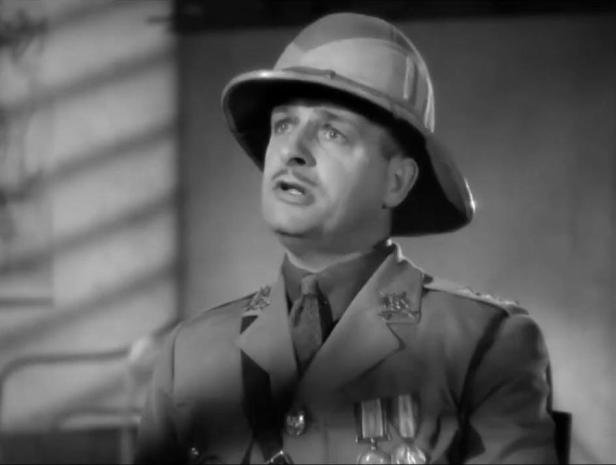
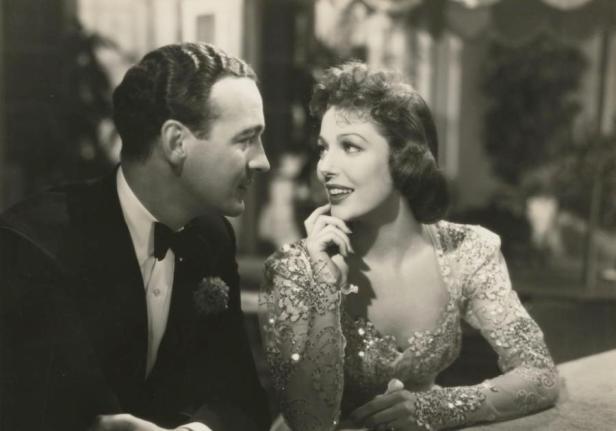
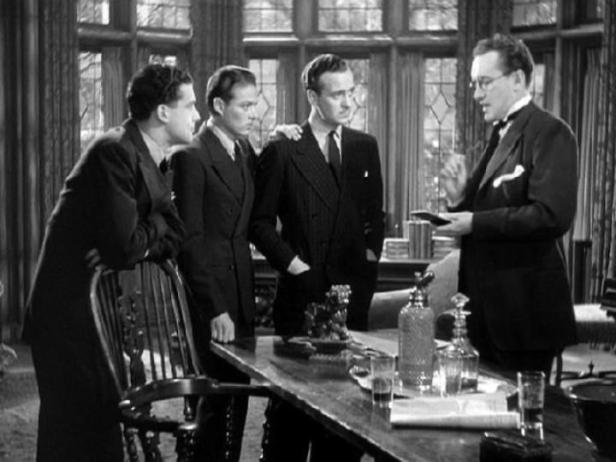
But not every film on the studio slate would be to Ford’s liking. Four Men and a Prayer has some elements that might be considered ‘Fordian’ but overall it is a simple adventure story in which comedy and violence mix uneasily and the script seems at times quite silly. On the plus side there is a high profile cast, once again drawing on the British acting community in Hollywood. The male lead is Richard Greene, then a successful young stage actor in London who had appeared in a small part in Sing as We Go (UK 1934). He was signed by Zanuck as a ‘Robert Taylor’/’Tyrone Power’ type and this was his first lead opposite the studio’s leading female star Loretta Young. The property was a novel by David Garth published in January 1937 and bought earlier by Twentieth Century-Fox when it was serialised in Hearst’s International-Cosmopolitan in 1936. The AFI Catalog entry suggests four writers were involved in producing the final screenplay which may explain the clunky script. The plot sees a Colonel in the Indian Army (C. Aubrey Smith) given a dishonourable discharge by a court-martial in India. He returns to England to meet his four sons and to go through what has happened. The eldest son Wyatt is a barrister (George Saunders), the middle two are Christopher, an RAF pilot (David Niven) and Geoffrey, a diplomat (Richard Greene). The youngest is still at Oxford (William Henry). Convinced of their father’s innocence the four men head off to find those responsible for what they see as a forged order that purports to come from their father which led to troops being withdrawn and and a local massacre by armed rebels. Loretta Young plays a woman who appears to have escaped from a Hawksian screwball comedy (this was the period of Carole Lombard, Katherine Hepburn and Barbara Stanwyck and Ms Young struggles to match them). She is besotted with the Greene character and follows him across the globe. She appears to be an intelligent young woman who has whose large allowance from a business tycoon father seems to have turned her head away from practicalities.
The plot allows a number of locations signalled by a tourist photo and elaborate sets. We are whisked from India to an English country house and to Buenos Aires, a private yacht, Alexandria and back to London. IMDB suggests that some footage was shot in Venezuela and some in the ‘Santa Monica Mountains’. The director of photography is Ernest Palmer, a long-time contractee at Fox and 20th Century-Fox. Art direction is by Bernard Herzbrun and Rudolph Sternad both of whom produced standout work during their careers. The film looks good but the script is hopeless. The ‘Fordian elements’ include a the bar-room brawl familiar in later Ford films and the casting of two familiar actors in the form of Barry Fitzgerald and John Carridine. A third actor, William Henry would become established as a Ford stock company bit part player much later in his career. Two actors are carried over from The Lost Patrol (US 1934) – Alan Hale and Reginald Denny.
Four Men and a Prayer is the fourth of Ford’s films to have at least an element of a Raj/Indian Army narrative. The first was The Black Watch (1929) followed by The Lost Patrol (1934) (a narrative which draws on the Indian Army experience of some of its characters) and Wee Willie Winkie (1937). Perhaps he felt he was being given the same kinds of narratives? More likely he was prevented from re-writing the script and simply retreated into turning out a competently-made film in which he had little investment. However, it seems that the audiences in 1938 quite liked the film and so did some of the critics. There is some suggestion that Richard Greene was a hit with female audiences. The film does have the benefit of a crisp 84 minute runtime and Loretta Young is praised highly, even by Monthly Film Bulletin (June 1938). But more recent critical reviews have followed Variety who found it ultimately ‘disappointing’. Today on IMDb it has one of the lowest rankings of any Ford film and significantly none of my texts which usually supply me with material on Ford’s films have very much to say about the film. Tag Gallagher and Joseph McBride both see some merits in the craft skills of Ford and his crew and the general high levels of performance. In addition they make what might be considered ‘auteurist’ comments in relation to various scenes, e.g. the sons’ respect for their father and the idea of their mother looking down from her portrait on the wall (McBride) and some links to the much later Ford film which is held in some esteem in which Ford ‘plays’ with his character creations in the form of John Wayne and Lee Marvin in Donovan’s Reef (1963).
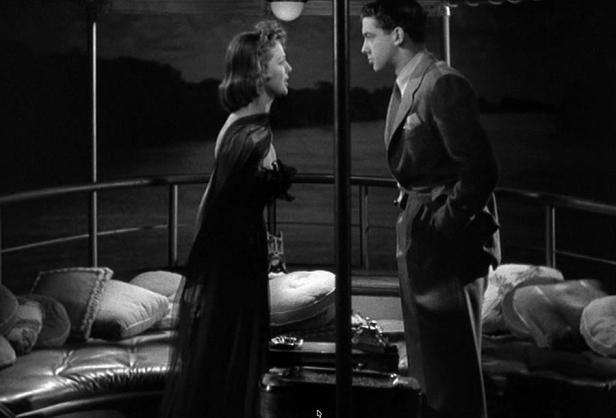
I think maybe I have been a bit harsh on Loretta Young, but my other point remains. The script is a mess. It does have some good lines and the occasional bit of comic business but for me it is soon forgotten. I think that the Variety reviewer hit the mark with ‘disappointing’. This film perhaps shows what happens when an experienced and talented director isn’t really engaged by the assignment he is given and despite the bigger budget and the talented crew and cast, the film doesn’t take off. There is a an interesting idea in the mystery – why has the Colonel been killed and what is the international conspiracy that takes his bereaved sons around the world – this is 1938 after all. I realise now I should also have mentioned the high quality production design at various points as picked out by Tag Gallagher. Perhaps an interesting failure then and an expose of the weakness of the studio system in the 1930s? The only way to see the film in the UK is on a Region 2 DVD from Simply Media and here is the company’s trailer:


Not seen this one. Sounds good. Just thought I would mention that Canadian film ‘Red Rooms’ finally made its way to terrestrial
LikeLike
Do you mean that Red Rooms has made it to broadcast TV? If so I will look out for it. I hadn’t realised it was directed by Pascal Plante who directed both Fake Tattoos (2017) and Nadia Butterfly (2020), both discussed on this blog.
LikeLike
Red Rooms was on a couple of nights ago on Film4 with a lateish start at 11:10 pm, finishing at 01:30. No problem for me watching at this hour, even for the third time, because it is a gripping drama. May well show up again or could be on C4 catchup. Have not seen either of the other films you mention but they are on my radar now.
LikeLike
just checked. Red Rooms is on C4 catchup with 28 days left. Also Sisu on there with a couple of weeks to go. The latter may just be me.
LikeLike