
What do you do in London on a hot afternoon with a couple of hours spare? I decided to see what was on at the Curzon Bloomsbury, a cinema I have visited many times in its different guises since the 1970s and these days because it is within walking distance of King’s Cross and my train home. Saturday’s visit cost me a staggering £18.45 – nearly three times the price of a seat at my local cinema in West Yorkshire for mainly Hollywood fare. Admittedly, Nino is in the UK classed as an arthouse feature (i.e, in French and subtitled) but Curzon’s prices are twice those of our regional arthouses. Fortunately, the film was very good so I’m not too aggrieved.

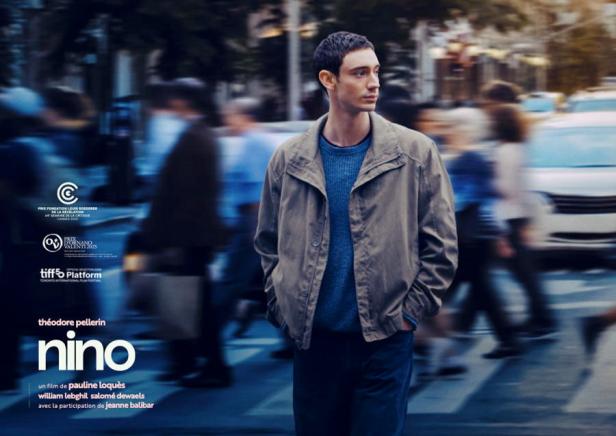
Nino is the first feature by Pauline Loquès who worked as a journalist before training as a scriptwriter. The film credits her as director and also as writer ‘in collaboration with Maud Ameline’. One of the intriguing aspects of the production is that Loquès was inspired by the tragedy of a young man in her family who died of cancer aged just 37. Consequently she decided to explore what it might be like for a young man to be given a diagnosis of cancer at a young age. At first a little daunted by the task she set herself it became easier when she found her leading man, Québécois actor Théodore Pellerin. She also answers the question of women telling stories about men in the Press Notes:
I definitely asked myself this question, but then I thought about all the male directors who have depicted women without much hesitation! As for friendship between guys, I simply imagined that Nino’s connection with [his best friend] Sofiane wouldn’t be that different from the one between my best friend and me. What I’m interested in is the resilience of this bond, which transcends gender, in my view.
Pauline Loquès chose to work with a production team which comprised women in nearly every role. It was odd then that I watched the film with a small audience of around seven or eight people, all of whom were men.

In trying to classify Nino, I should point out that the wall of the small foyer of the screen ‘The Plaza’ was decorated with large stills of Agnès Varda’s Cléo de 5 à 7 (France 1962). I’m not sure if this was deliberately related to this specific screening but Cléo is indeed the film that in several ways most resembles Nino. In Varda’s film Corinne Marchand as Cléo, a pop singer, is waiting for two hours for medical test results and she spends the time with various characters she meets, some friends but others chance encounters. Nino has the whole weekend, 72 hours from Friday morning to Monday morning in which to come to terms with a cancer diagnosis and to carry out two tasks the clinic doctor gives him. This perhaps makes Nino also a form of thriller or quest narrative, will he manage the two tasks? It is also a form of family melodrama with a discourse about ‘parenting’ – he visits his mother (played by Jeanne Balibar) on the eve of his 29th birthday, worries when he remembers the death of his father as a relatively young man. One of his tasks is to find someone to accompany him when he starts treatment on Monday morning but he struggles to reveal his problem and ask his mother. His second task is to produce enough sperm to be frozen for the future because his treatment may well make him infertile. This task might not seem too daunting apart from the very real difficulty of carrying out a private and personal task when the script has been written to make Nino homeless over the weekend. Interestingly, Nino will meet several young women (roughly his age) over the weekend, each of whom will make him think about his own possibility of becoming a parent.

Most of Nino’s interactions turn out to be with women but he does have an odd meeting with an older man played by the actor and director Mathieu Almaric in a brief cameo role. We might expect Nino to turn first to his best friend Sofian (William Lebghil) but even this seems to be problematic. Perhaps it was this friendship that the director thought might be key in the script? It is often assumed that women confide everything to their best friends but is it true of men?

Agnès Varda was able to create a vibrant and detailed presentation of the streets of Central Paris using her experience as a photographer and documentarian. Pauline Loquès, her cinematographer Lucie Baudinaud and editor Clémence Diard produce something similar but arguably closer to social realism. Nino is situated not in the fantasy or tourist Paris but ordinary streets and apartments. In one long shot we see him approaching his mother’s home in a suburb with Eiffel tower in the far background seemingly several kms away. In another shot he travels to meet his best friend Sofian using a rental bike and has difficulty parking it. Overall, this is a universal experience of ‘city life’, though at times it does remind me of those early New Wave films and shorts in which characters always seem to be crossing busy road junctions or meeting in cafés. The film certainly seems to have resonated with audiences. It has won several awards at festivals and Théodore Pellerin, who appears in virtually every scene has been widely recognised for his standout performance. But all the performances are good and Loquès also speaks about the music accompanying Nino’s ‘wandering’ scenes in which she “drew from the cinematic repertoire of a Québécois artist I love, Flore Laurentienne”. Soft ethereal sounds are contrasted by the indy rock sounds of Fontaines D. C., The Foals and other bands. This reminded me of other ‘modern’ melodramas which use sometimes jarring juxtapositions of sound and image.

Nino is in the end, I think, an uplifting and positive film and brings back the idea of the humanist films of the 1950s and 1960s. The young man we first meet, who seems lost and almost afraid to reach out to friends and strangers he meets, eventually learns how to articulate his fears. He discovers that the city isn’t perhaps as cold and alienating as he might have thought. Nino has done well in France, both with critics and audiences on a wide release. I hope it does well in the UK too but there seems to be little information available from Curzon as its distributor. Nino has a distributor in Québec but in the US market it seems to be on a VOD release from Disney+. Disney’s involvement may be down to Théodore Pellerin’s profile in North America. I recommend the film if it becomes available near you or later on streaming.

