
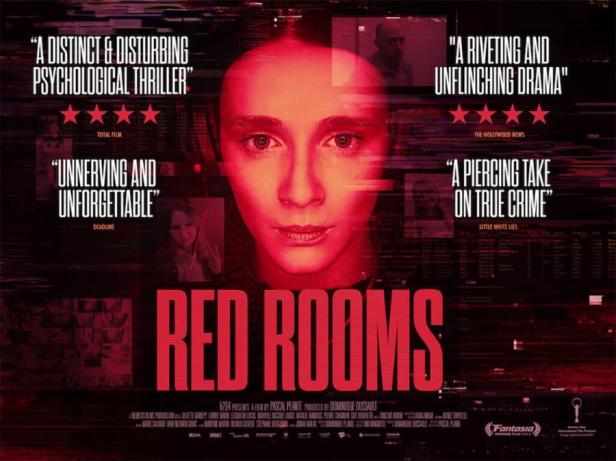
I have to thank John Hall for pointing me towards this film which has been streaming on Channel 4’s ‘catch-up’ offer. I think the promotion of the film with its poster (not the one above which is actually very good) and description as a “dark web horror” or psychological horror film had put me off when I first came across the film. With John’s recommendation, I investigated and found it was made by Pascal Plante. I had enjoyed his first two films, Fake Tattoos (Canada 2017) and Nadia, Butterfly (Canada 2020). Red Rooms is not a horror film as such but it is about the trial of a serial killer who is accused of torturing and killing three young girls and recording his horrific behaviour on video. The real story is about two of the young women who attend the court proceedings each day and who are deemed ‘groupies’ by the parent of one of the victims and also interviewed by the media. The video recordings are online on the ‘dark web’ and there is an audience prepared to pay a great deal to witness the killings. There is no evidence that ‘red rooms’ exist outside fiction but the story is plausible and well thought out. This is another fine Québécois film and deserves to be discussed alongside other Canadian films such as Denis Villeneuve’s Polytechnique (Canada 2009) and David Croneberg’s Crash (Canada 1996).
How is not a horror film? Yes, the crimes are horrific but we only hear about them from lawyers and witnesses in court. When the two videos are shown in court (the third has not been found) we experience a little of the terror anticipated by the parents and jurors (the general public are asked to leave) but all we see of the ‘action’ is a brief glimpse of the killer in a blood-soaked room, i.e. during the aftermath of the killing. Yes, there is suspense and the central character herself seems to court danger but otherwise this is a narrative about two young women and their behaviour. The central character, Kelly-Anne (Juliette Gariépy) is a photographers’ model and a highly-skilled online poker player. She is also an IT specialist who has programmed her own AI assistant ‘Guinevere’ who tells quite clever jokes as well as keeping Kelly-Anne’s computer secure. She lives alone in an up-market high-rise apartment tower and keeps herself ‘fighting fit’ with exercise, squash and a strict diet. At the start of the narrative we find her sleeping in an alley close to the Palais de justice in Montreal. Carefully dressed against the cold she is determined to get a seat in the small public gallery for the trial.
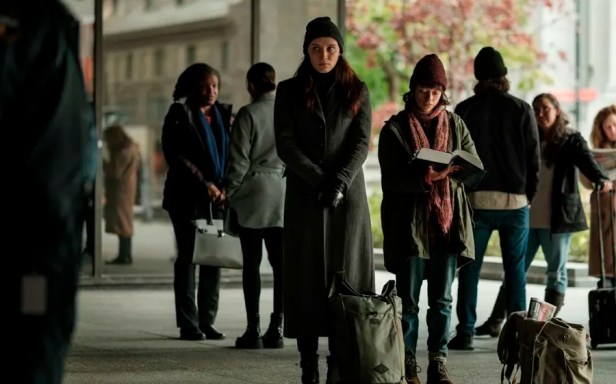
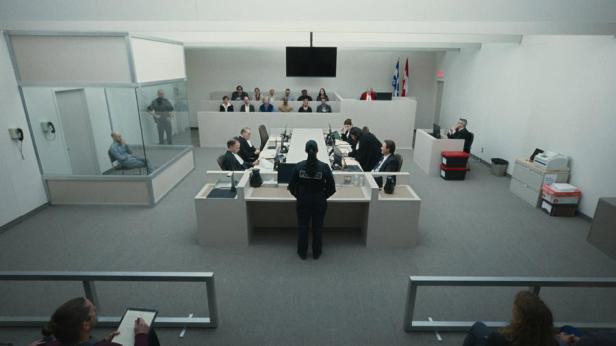
The first section of the film is an almost documentary style presentation of the opening of the trial in a modern courtroom with the accused handcuffed and on his own in a perspex/glass enclosure. There is an emphasis on the procedures of the court and the opening remarks of the prosecution and defence. At this stage there is little sense of what kind of genre film this might be. It then becomes evident that the focus will be Kelly-Anne and we are intrigued by her meeting with Clementine (Laurie Babin) after the first hearing. The two young women are opposites. Kelly-Anne is sophisticated, urban, cool, taller and older. Clementine is younger, ‘country’, shorter and seemingly naive. It’s an intriguing pairing and perhaps reminds us of the two young people in Plante’s first film Fake Tattoos. The only other character who is sketched out in more detail is the mother of one of the murdered girls. I don’t want to give away too much of the narrative but it will become clear that the relationship between the two young women will be used as an entry into a number of questions about ‘true crime’ as a modern media category. Yes the category has been around for a long time but its status seems to be rising because of its appearance in both broadcast and streaming media and because of the relatively new phenomenon of amateur investigators with their blogs and podcasts. Clementine’s fascination with the case seems to suggest a modern form of fan/groupie with an emotional attachment to the accused which she expresses in vox pops outside the court.
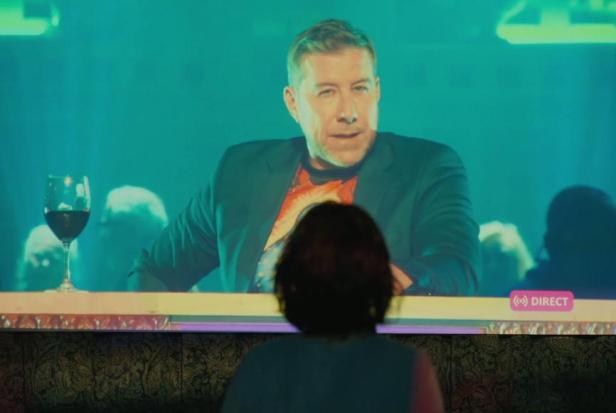
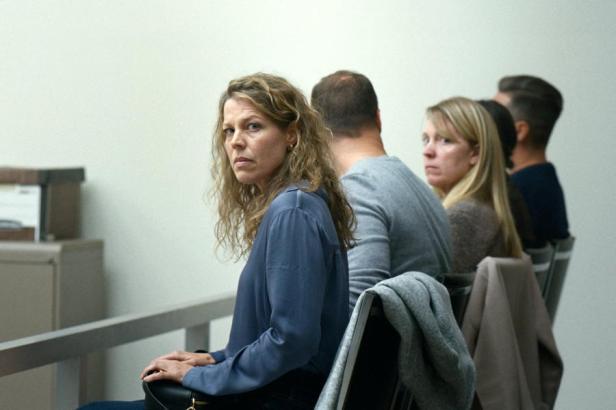
Meanwhile, Kelly-Anne has a motive that doesn’t emerge for some time. Instead she spends time in a form of mentoring of Clementine that feels genuinely helpful rather than exploitative, although Clementine still has a lot to learn as shown by her participation in a phone-in on a late night TV show which ends badly. It’s noticeable that whereas we do learn something about Clementine’s background we don’t find out much about Kelly-Anne and how she got to be who she is. There is one other key element in the story – the missing third tape – and given that the mother of the victim expected to feature in the missing tape turns in the courtroom to stare at Kelly-Anne (for the second time), we know that she will somehow be involved.
Les chambres rouges is more of an art film than a genre picture so don’t expect a nice comforting resolution or a gimmicky twist. It could be argued that the film is a ‘warning’, like the great classical horror films, about the state of contemporary society and the deleterious effects of modern media. It’s a very well made film with a great score by Dominique Plante and photography by Vincent Biron. The film is presented in ‘European Widescreen’ – 1.1.66. It was written by Pascal Plante with Dominique Dussault. I’d also like to single out the performances of the two principals. The film has now left Film 4 but it should be widely available via Apple and I recommend it highly. I’m glad Channel 4 screened the film but I think they could do much more to showcase their foreign language films rather than the endless supply of Hollywood films. Whatever happened to the channel’s remit for more diverse programming?


having watched ‘Red Rooms’ three times now, during the Leeds film festival, at Home, Manchester, and latterly on Film4, I can confirm that the character of Kelly-Anne is endlessly fascinating to me. Not so much Clementine, except as a counterpoint. Juliette Gariepy nails this part so well that I was quite taken aback when I saw her in another recent French Canadian film, ‘Two Women’, as a supporting character.
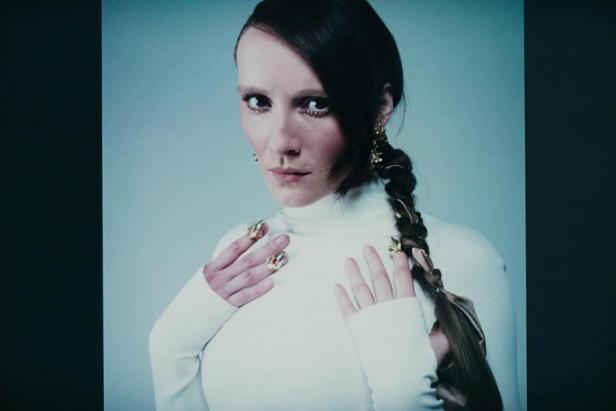
Kelly-Anne could possibly be assumed to be autistic given both her single-minded pursuit of the serial killer, and her facility with both tech and online gambling at which she is very proficient. She has few, if any friends, and they quickly desert her when she is herself exposed as taking an excessive interest in the trial. The question of whether she was herself abused hangs in the air, but not only that : she bears a distinct resemblance to the third abused girl as we see in the photo that is shown.
It could be argued that she is some more metaphysical instrument of vengeance.
LikeLiked by 1 person
That’s an interesting analysis. I’m not sure it’s friends who abandon her but the model agency/advertising photographers. We don’t really learn anything about her background so your idea about a ‘metaphysical instrument of vengeance’ is certainly a possibility. I’m not sure about autism in this case but I’m no expert.
LikeLike
one thing I forgot to mention, Roy, and something that did not really register until my third viewing of this. The selfie she took at the end when she was sitting on the dead girl’s bed when she had moved through the house like a ghost. At the least she had come to identify with the murdered daughter. Taken one step further she was the high plains drifter.
LikeLike