
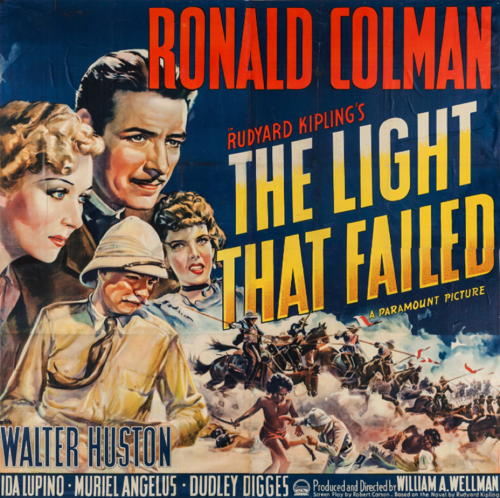
The Light That Failed is the third adaptation of Rudyard Kipling’s story with the same title published in 1891 as the first of his full length novels. There were two previous silent film adaptations. It is a largely ‘faithful’ adaptation of the full novel, including Kipling’s preferred ending to the narrative which he was pressured to change for initial publication. Although the novel was quite widely criticised on publication, this third film seems to have been well supported by critics in the US following its premiere on Christmas Eve 1939. It also proved to be a key film for Ida Lupino and gave her the chance to show that she could act in a serious dramatic part. Although she was only originally fourth-billed, her performance created a stir and caught the attention of critics. The performance won her a significant role in They Drive By Night (US 1940) at Warner Bros. and that film ushered in a new phase of her career with a long-term Warners contract. She was still only 21 when she made The Light That Failed.
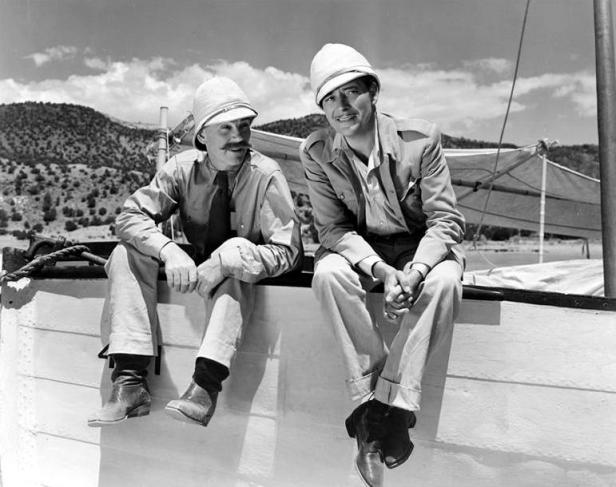
William Wellman was one of Paramount’s leading directors and he acted as producer as well as director on this picture. He was well regarded as a director of action pictures and ‘masculine stories’. Kipling’s novel, despite the poster above was more of a romance melodrama bracketed by two action sequences and not perhaps what might be expected from ‘Wild Bill’ Wellman. Initially he had hoped to have Gary Cooper as his star (the project had been on Paramount’s books for some time) but Cooper was loaned out to Goldwyn following Beau Geste (1939). Paramount went for Ronald Colman who was not really a Wellman type of player. Colman was to play Dick Heldar, a war artist with the British Imperial forces in the Sudan in the late 1880s. In a battle he rescues a war correspondent, Torpenhow (Walter Huston) and in the process receives a severe cut to the head. Later this will have serious long-term consequences. Back in London Dick finds himself popular with his paintings and ‘Torp’ provides him with a well-lit room in his house to act as Dick’s studio. The narrative will develop as a ‘masculine story’ about the strong bond between the two men. But Dick also has childhood memories of his first friendship with a young woman called Maisie (Muriel Angelus) who is also trying to develop a career as an artist. Kipling saw his novel as about the unrequited love affair between Dick and Maisie which is introduced briefly at the start of the film with younger actors playing the young teens. Torp is also responsible for making Richard see that although his paintings sell well, he is in danger of letting their commercial success overwhelm his true artistic ambitions. One day Torp takes in a young woman who has fainted on the street from hunger. This is Betsy who is quickly taken by Torp’s gentlemanly manner. Dick is suspicious of Betsy’s hold over Torp but eventually decides she would make a good model for his most ambitious painting. Maisie also reappears in Dick’s life and though the potential to rekindle the romance is there, Dick still stumbles over his attempts to help Maisie in her career – she has not attained the same level of acclaim and financial return.
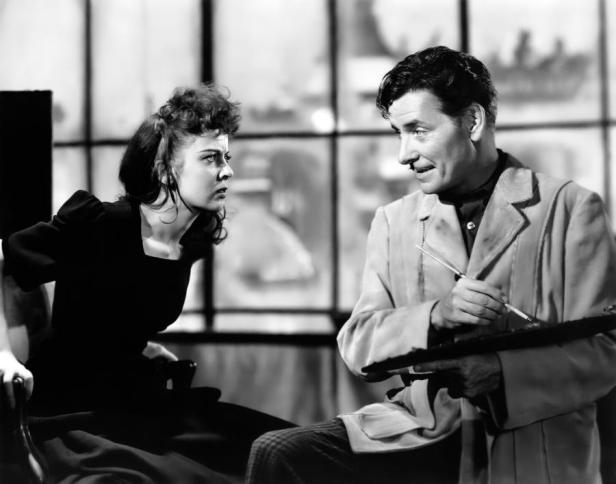
I won’t spoil any more of the narrative but the important point here is that Ida Lupino recognised very early on that the role of Betsy was made for her when she learned about the production and she stormed onto the Paramount lot to convince Wellman that he should cast her. She was ‘authentic’ as a girl born in Tulse Hill, South London and in this respect matched both Colman and Angelus as a British actor in Hollywood. Wellman recognised her qualities and agreed to give her the part. He realised later that this was the peroxided Jean Harlow type starlet he had met a few years earlier at Paramount. Lupino had been a contracted Paramount player when she first arrived in Hollywood in 1933 but she had suffered from being typecast and by now at 21 she had left the contract and restored her natural hair colour. The two freelance jobs at Columbia on the Lone Wolf Spy Hunt and The Adventures of Sherlock Holmes (both 1939) were both good pictures but in industry terms ‘ambitious Bs’ at best. The Light That Failed would help launch her into the big time.
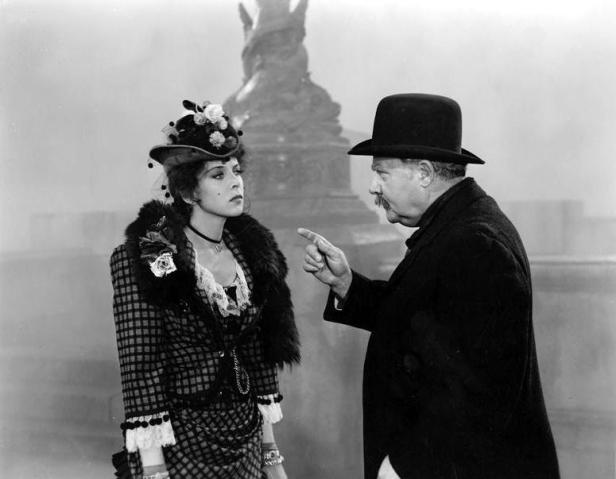
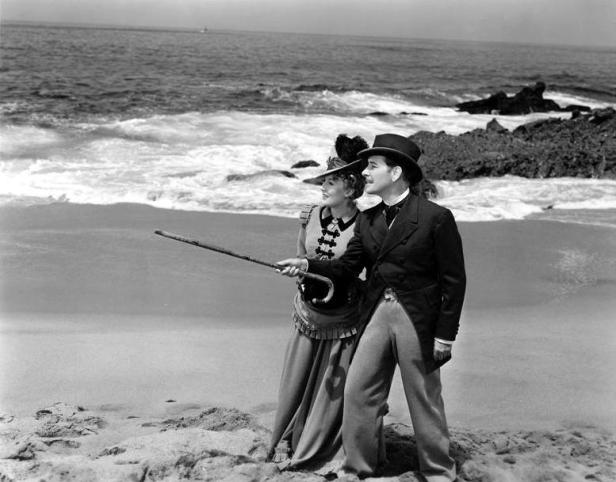
The outdoor scenes were shot in New Mexico and the cinematographer was Theodor Sparkuhl. The print I watched was not very good but I think the camerawork was impressive. This was also the view of Variety. I found the performances of Colman, Huston and Lupino convincing but I have to agree with some critics that the role of Maisie was underwritten and though she is a beautiful face Muriel Angelus does not contribute much. Many US critics were positive about the film but Variety noted that it did not hold great appeal to the women in the audience. On the other hand, it suggested that the film would do well in British Empire halls and it was indeed rolled out in Australia and South Africa later in 1940. However Monthly Film Bulletin (January 1940) in the UK was generally down on the film, finding it “badly dated and the effect is curiously flat”. The reviewer ‘EP’ suggests that Colman, though fine as a war correspondent is unconvincing as an artist and the depiction of Victorian artistic ‘bohemian life’ borders on the ludicrous. But Walter Huston and Ida Lupino are picked out for praise and Lupino “acts with immense energy and zest”. Also worth noting is that the running time in the UK is given as 87 minutes – a significant cut from 97 minutes. The BBFC gives 87 mins 30 secs but gives no indication of a censorship cut. Unfortunately I can’t find any reference to what was cut by Paramount. Possibly it was the prologue with the young Dick and Maisie, but that is only 3 minutes? Whatever else was cut might explain something about the discrepancy between US and British responses.
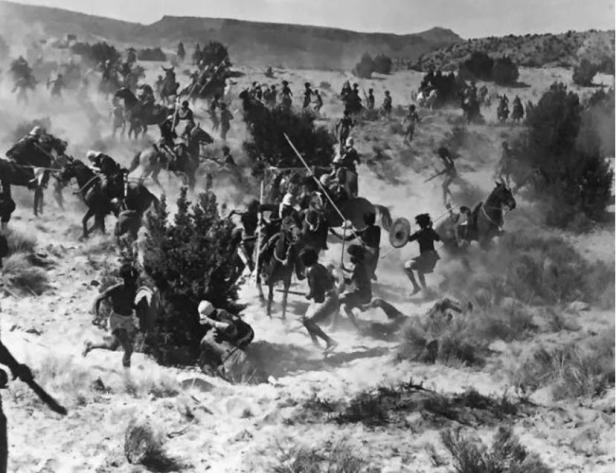
Looking at more recent comments on the film, TCM’s Andrea Passafiume in 2017 refers to the film as “a compelling period drama . . . one such gem that deserves a second look”. I suspect that TCM had a better print than the one I found. In defence of the American critical view, Kipling’s stories were popular in Hollywood in the late 1930s – Elephant Boy (1937), Captains Courageous (1937), Wee Willie Winkie (1937) and Gunga Din (1939) with Jungle Book following in 1942 were all popular titles. There were also other non-Kipling stories of Imperial ‘derring-do’ such as Korda’s re-make of The Four Feathers (also in 1939). IMDb lists a total of 128 Kipling adaptations or ‘inspired by’ productions for films and television between 1910 and 2024. I have researched Kipling a little and I had forgotten that he was the first English language recipient of the Nobel Prize for Literature in 1907. I was unaware that Kipling had spent several years in the US between 1892 and 1896 and some of his best-known stories were written in Vermont. Kipling was a major writer, born in Imperial India and writing at the time of the height of European Imperialism. Reading him today is quite a complex process, I think. The Light That Failed is certainly worth watching and I’m glad I’ve seen what was in effect Ida Lupino’s ‘breakthrough’ into front line Hollywood.

