
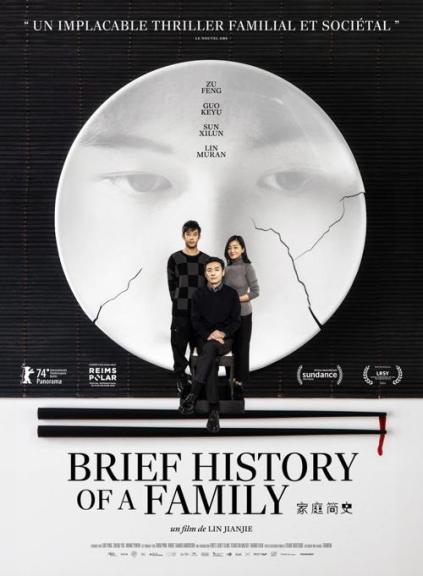
Brief History of a Family was released in the UK on just twelve screens in March 2025. Fortunately it has been picked up by the BBC and is now on iPlayer for the next three months. I read one review of the film that suggested that we rarely see Chinese art films like this. I’m not sure that is true at all. In fact in the UK it is far more likely that Chinese art films will be more accessible than mainstream Chinese films outside of certain cities. Brief History of a Family as a title perhaps first suggests that this might be a family melodrama but the limited promotional material suggests it is a thriller. Elements of the film are certainly familiar and I was reminded of Beijing Bicycle (China-France 2001) because of questions about the hothouse schooling of Chinese youth. The most popular reference among reviewers tends to be Parasite (South Korea 2019) while, re aesthetics, others mention European auteurs like Michael Haneke. Perhaps I’d better outline the plot.
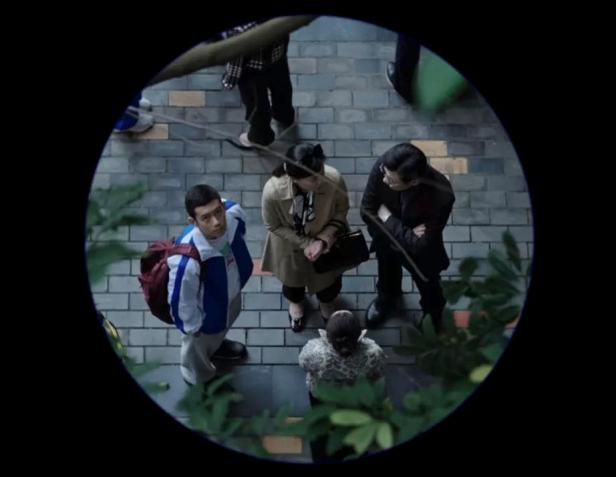
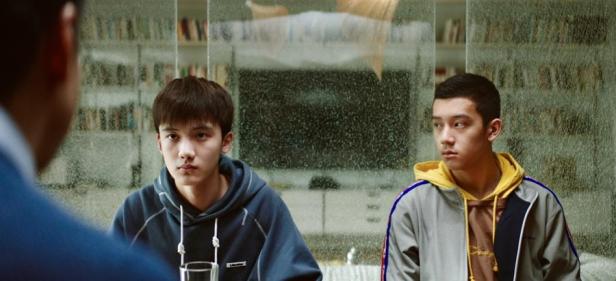
The narrative is set in an unnamed Chinese city. A gymnastics bar is presented from a restricted view. The bar is outside, presumably on a playground or court of some kind. The figure of a young person seen from behind leaps up from the bottom of the frame and grabs the bar, hanging there having pulled themselves up. They remain in position for some time until a basketball hits their head and they fall. An aerial shot reveals a young man lying on a hard surface clutching his leg. Another teenage boy comes to offer assistance. We wonder if he threw the basketball. These are two 15 year-old classmates in what appears to be a new school in a fashionable part of the city. The pair are not at this point friends and help is accepted reluctantly. A few days later the injured boy Shuo asks the other boy Wei for a lift to the metro. Wei at first refuses but then invites Shuo to play video games at his home. Before this we see a series of three images inserted into the narrative. The first two of these are masked like the view down a microscope to show organisms moving in a petri dish. The third, still with the same masking, then appears to show Wei from above while he stands with his parents talking to a fourth person (a teacher, perhaps?). This image is then revealed to be a PoV (point of view) shot from the perspective of Shuo in a window of the school. In Wei’s home Shuo meets first Wei’s mother and then his father as he is invited to join the family for their evening meal. Shuo is gradually ‘absorbed’ into the family. Shuo’s mother died when he was quite young and he explains that his father drinks heavily and provides only the cheapest food. We never see Shuo’s home properly but it is clearly in a poorer area outside the city centre.
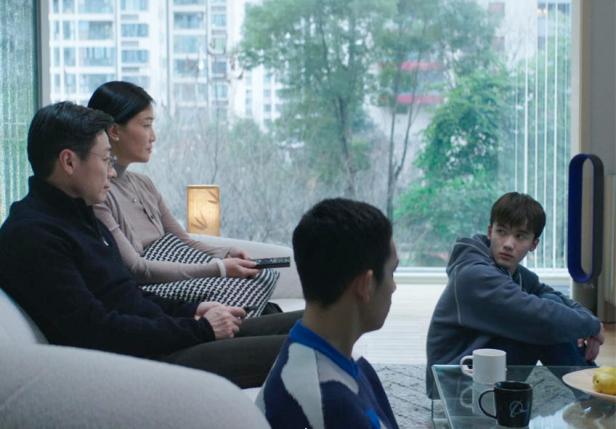
This opening sets up an enigma. Is Shuo an interloper, a cuckoo in the nest? I won’t describe any more of the plot but I will reveal that Shuo’s father conveniently disappears and Shuo’s place in Wei’s family becomes secure. The narrative device of the laboratory images reappears in different ways later on and the source appears to be Wei’s father, a senior biologist in a private laboratory. Wei’s parents want Wei to study abroad in order to improve his employment opportunities but Wei is not committed. His mother speaks several languages and she travelled abroad as an airline steward before he was born. Shuo, however, is a diligent student who has real potential as an academic. Gradually we realise that Wei has other ideas about what he wants to do, whereas Shuo is prepared to take any opportunity to ‘better himself’. Eventually a crunch point will come when the two teenagers realise that though the situation has the potential to suit both of them, it could also mean that they resent each other. This is the ultimate enigma which is handled in a subtle way in the film’s narrative resolution.
Most of the reviews of the film link it to comments on the impact of China’s one child only policy which ran from 1979 to 2015. I read somewhere today that though the policy ended a decade ago and now the emphasis is on increasing the birth rate to sustain economic development, the impact of the ‘only child’ view is still there. The children of the 1990s themselves, now starting a family, tend towards a small family unit to match their own experience. Wei’s parents can be seen as accepting Shuo into their family as a ‘second chance’ son who might more closely follow their wishes as to his future. There are two important aspects of the film’s production, I think. One is that the début feature director Lin Jianje trained first as a biologist and the second is that this is an ‘independent’ film with European co-producers. The film’s press pack is available on the Unifrance website (in French). Using Google translate, I found this extract from the ‘Director’s statement’:
Having studied biology, I have always been fascinated by the idea that the world of the infinitely small often reflects the world of the infinitely large. In this film, I study a family as a living cell undergoing various changes, but also as an entity within a rapidly changing society which inevitably shapes the mentality and feelings of its inhabitants.
Later in the same statement he reveals:
Although I did not set out to make a genre film, genre crept into my writing and directing – not to categorise the film, but to explore the characters’ mentality and their ambiguous relationships, to create a mysterious and captivating atmosphere, and to encourage the viewer not to trust appearances.
These two statements help to understand the tension and the fascination that I found watching the film. The European-influenced aesthetic is important for the look of the film and the director discusses the contribution of the Danish editor Per K. Kirkegaard and music composer Toke Brorson Odin (also Danish) as well as Margot Testemale and Jacques Pedersen, both of whom are listed as Sound Designers. Lin tells us that these Europeans helped his Chinese collaborators such as cinematographer Zhang Jiahao and production designers/art directors Zhao Zhidong and Xu Yao to create exactly the mise en scène and ‘tone’ that he wanted. But he argues that:
We let the characters and the atmosphere of the story guide the style and tone. In the narrative, each character possesses something the others lack. They form a family, certainly, but each of them is also a separate entity.
The interview in the Press Pack is well worth reading. I very much enjoyed watching this film and I recommend it highly. It reminds me of what used to be called the ‘sixth generation’ films of the early 2000s which often saw independent Chinese films co-produced with France in particular. Well done to the BBC for making it available in the UK.

