
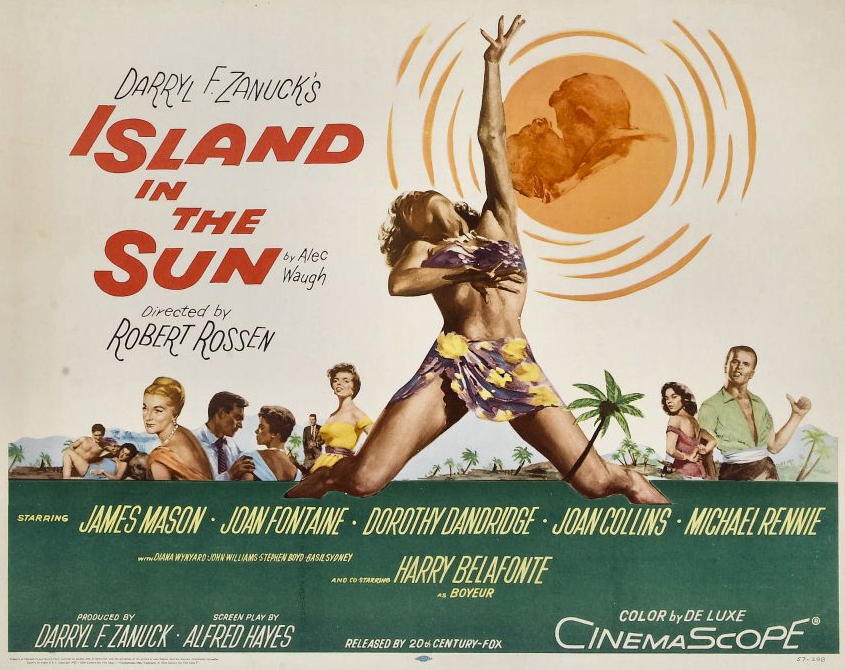
It’s difficult to be objective about this film since it was mostly filmed in what I think of as the most beautiful place I’ve ever visited. That beauty is certainly in evidence here in a sensitively photographed production presented in CinemaScope and De Luxe Color by Freddie Young. It’s a 20th Century-Fox picture but apart from Fox’s money, Darryl F. Zanuck as producer and the star pairing of Harry Belafonte and Dorothy Dandridge, it’s mainly a British picture. The remainder of the cast is British, though some of them might have been contracted to Fox in Hollywood. The director is Robert Rossen, one of the Hollywood creatives blacklisted after his HUAC hearing who later ‘named names’ but for much of the 1950s, after the blacklisting was revoked, only worked on films outside the US. The script by Arthur Hayes, a Brit in Hollywood, is an adaptation of a best-selling novel by another ‘wandering Brit’, Alec Waugh, the older brother of Evelyn who was a less celebrated but much more prolific and commercially successful author than his younger sibling. The film was mainly shot on the island of Grenada with some scenes on Barbados, both then British colonies in the Caribbean, with presumably some interiors and process work back in London at Elstree.
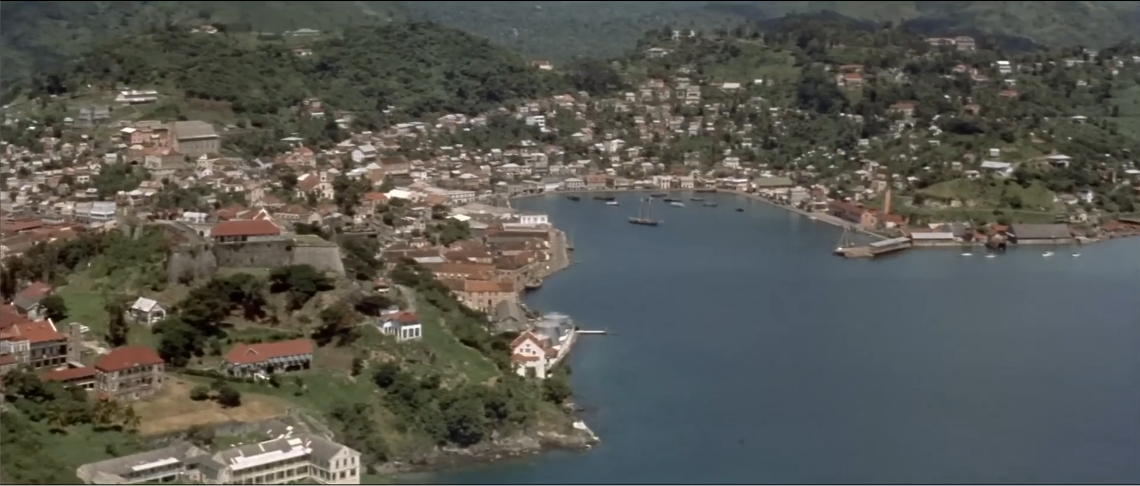
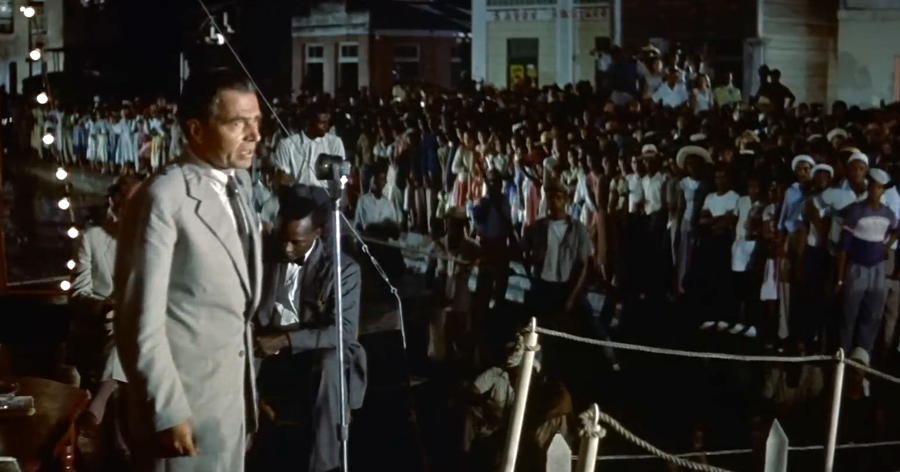
The island in the narrative, ‘Santa Marta’, is fictitious but the story is plausible enough. It focuses on a wealthy plantation family with James Mason as Maxwell Fleury who is intending to stand for election under the island’s new constitution. His rival will be an islander, David Boyeur played by Harry Belafonte. There will be an underlying discourse of both race and wealth in this election contest. When the film was made in 1956 the islands were still several years away from independence and autonomy as first they were pressurised to join a West Indian Federation in 1958 which lasted just three years and the nine main islands then gained independence in the later 1960s – Barbados in 1966 but Grenada not until in 1974.
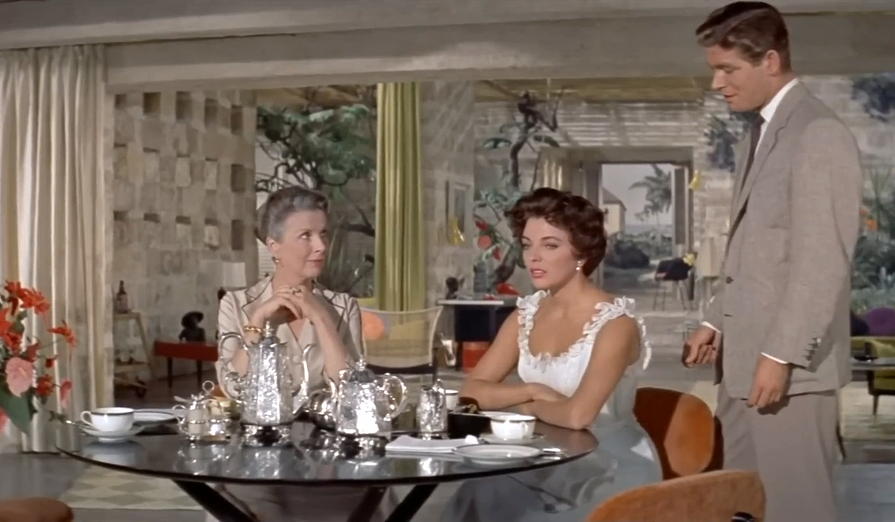
The election is one part of the story but there are also possible inter-racial relationships, one involving Maxwell’s younger sister Jocelyn (Joan Collins), another featuring Joan Fontaine and a third Dorothy Dandridge. By all accounts this caused major ructions in the US with bookings withheld in the South and an orchestrated campaign of hate mail sent to Joan Fontaine because of her on-screen relationship with Harry Belafonte. My understanding is that the script missed out aspects of Waugh’s novel and that perhaps explains why the narrative seems rather lacklustre even though it includes some potential thrills. In a promotional film in which producer Zanuck is interviewed by Robert Beatty, Zanuck makes the point that ‘the color issue’ in the West Indies is not same as in the US, but that may actually be precisely what the film gets wrong. There are a couple of points when racial tension does come to the surface but neither is followed through directly. In the first, Mavis (Joan Fontaine) is with David when they see some carnival masques on a stall. Mavis puts on a blackface masque which David angrily pulls off her face. The second incident is when Jocelyn is out with the Governor’s son Euan (Stephen Boyd) and they decide to head for Maxwell’s house which Jocelyn knows will be empty. A cutaway shows an islander in a carnival masque (one of the house servants?) watching their arrival. When they decide to leave they find their car has been tampered with and is not drivable and the telephone wires have been cut so they cannot ring for help. They even hear drums and singing from the nearest village – a sure sign of a colonial melodrama. But nothing actually happens.
Later a crime is committed elsewhere which is perhaps partially, but mistakenly, related to the ‘colour issue’. Crime mystery is another genre referenced and I haven’t mentioned Belafonte’s singing. The title song, sung by Belafonte is credited to him and co-writer Irving Burgie (‘Lord Burgess’). It plays out over the opening scenes of plantation workers and the sugar and banana crops as well as women washing clothes in a stream. The tune is worked into Malcolm Arnold’s score and serves as a form of leitmotiv for Belafonte’s character. The song itself also appeared on an LP, ‘Belafonte Sings of Caribbean’. (again, mainly written by Belafonte and Burgie). The single was a Top 10 hit in Belgium and the Netherlands and reached No. 12 in the UK charts and No. 30 in the US. There is also a diegetic performance in the film of a second song, ‘Lead Man Holler’ which occurs on the fishing beach just after the masque incident referenced above. The fishermen are singing a form of work song and David takes over singing a verse. At one other point there is a very brief reference to David’s trade union work. This comes from Waugh’s novel. The independence struggle in the ‘West Indies’ was heavily influenced by trade union figures, especially in Trinidad and Tobago (the nearest large colony to Grenada). I read Monthly Film Bulletin‘s review (August 1957) after I finished watching the film and on the whole I think I agree with it.
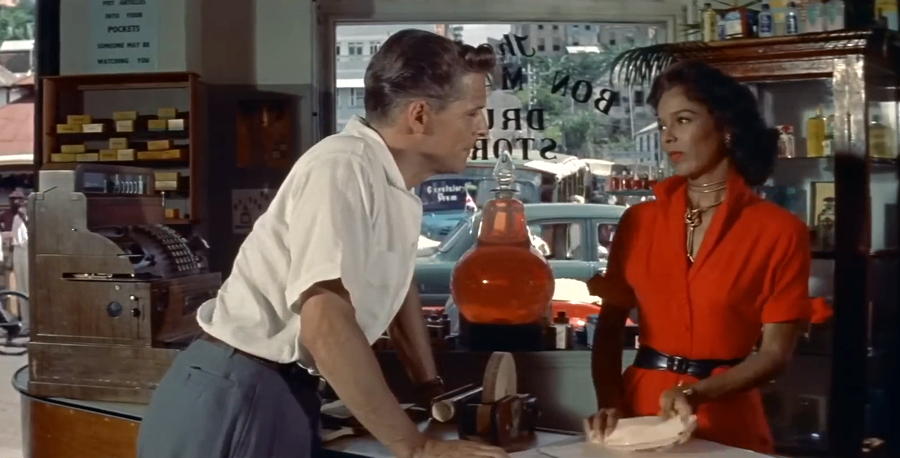
As I understand it, the novel offers two Black lead characters, one a lawyer and the other a ‘labour leader’. Presumably, Zanuck decided there were too many characters already. In that respect he was perhaps correct, but I suspect that, because he didn’t understand British colonialism, he chose the wrong character to mess with. Belafonte’s character struggles to be both the more middle-class lawyer and the ‘labour leader’. The result is that, as the MFB reviewer suggests, he seems uncharacteristically surly and riddled with contradictions. David’s relationship with Mavis doesn’t really make sense. He is supposed to have known her as a child growing up and we are supposed to think Mavis is younger than him. Fontaine is actually ten years older than Belafonte. The wonderful Dorothy Dandridge as Margot is woefully underused and she seems to have been unhappy with the script. Her pairing with the Governor’s aide Denis Archer (John Justin) is by itself quite interesting but doesn’t really add much to the narrative. The more important relationship is between Joan Collins’ Jocelyn and the Governor’s son Euan (Stephen Boyd), who arrives from military service in Egypt before taking up a place at Oxford. The narrative is in fact a form of colonial family drama. The top-billed star is James Mason and it’s through his character, Maxwell Fleury that all the different genre repertoires are brought together. Mason is very good, as are the whole cast. The problems are in the script and narrative construction.
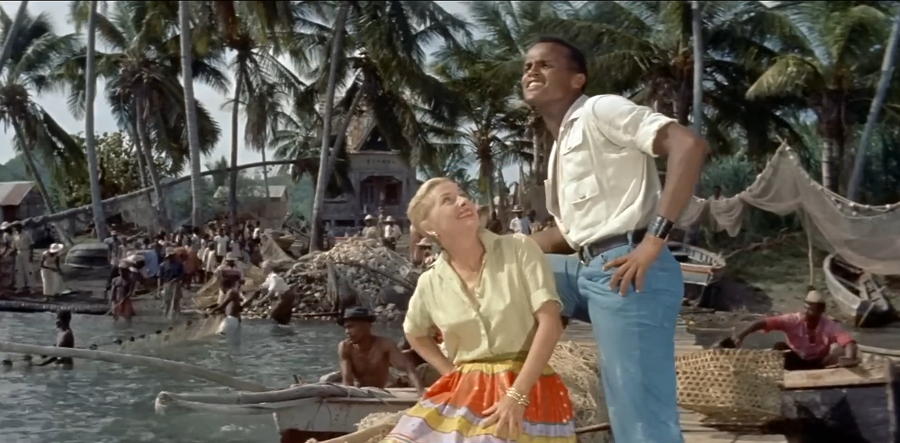
Darry Zanuck saw a best-selling book, a chance to show attractive landscapes in ‘Scope and what he deemed a controversial melodrama, something perhaps recalling his previous ‘controversial’ films such as The Grapes of Wrath (1940) or Gentleman’s Agreement (1947). (See his introduction to the trailer.) But simply inserting Belafonte and Dandridge into the production without thinking it through completely was a mistake. Zanuck’s instinct was sound, the film made money in the US. I’m not an expert on the history of British colonialism in the Caribbean, but I think that racism was arguably more institutional and perhaps more subtle than in the American South, based as much on social class as skin colour – not that it wasn’t as prevalent or as dangerous. Mixed marriages and inter-racial relationships were not that unusual in the histories of island culture (the main issue). As one commentator pointed out, however, it is also the case that Belafonte and Dandridge are much lighter-skinned than most of the other islanders and the narrative doesn’t really embed them in the community. Education in some of the Caribbean’s elite schools and trades union activity were two of the ways in which activists were able to build the independence movement – which was also helped by movement between the islands and work and education opportunities in the UK, US and Canada. More attention to this might have helped the script – and why not use some of the successful writers from the Caribbean? Belafonte himself grew up as a child in Jamaica, he would have had a lot to contribute, I would have thought. In the end, Hollywood itself was too mired in racist attitudes to make the most of this opportunity to shoot in the islands.
I would still recommend the film, which is available to watch in a reasonable print online (from which the images here are mostly taken). The photography is wonderful, the songs are good and at least it gave Belafonte and Dandridge more exposure to an international audience. But the British films from the same period, Sapphire (1959) and Flame in the Streets (1961), for all their faults, have more bite in representing the issues.


It is a long time since I saw this movie; I remember that it was great to watch on its release. And I think it contributed to Belafonte’s rise to stardom, at least through the song. I think Roy’s comments are apt; especially about the waste of Dandridge, who also looks great. The film’s poster is a study in representations as well as being pretty inaccurate.
I take Roy’s point about the other two British titles; however, I think ‘Sapphire’ is even more problematic in dealing with racism.
LikeLike