
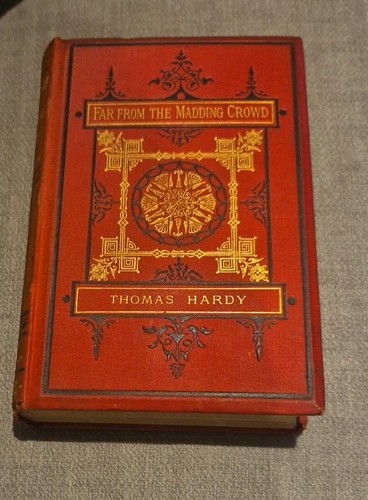
This was Thomas Hardy’ s fifth novel, the fourth to be published and his first major success. It was serialised in the Cornhill Magazine, (with at least one cut), and then published complete in both Britain and the USA. As with his other novels Hardy made several later revisions but not major ones. It was the first of his novels to be set properly in his mythic Wessex. The historical settings were in Dorchester around the areas in which he grew up and knew extremely well. Set in small country towns and amongst rural farms it is full of portraits of rural folks, including the ordinary labourers. And it is also full of Hardy’s fine descriptive passages of the countryside.
At the centre of the narrative is Gabriel Oaks, originally a shepherd, who rises with fits and starts to become a tenant farmer. He is taken with a younger country girl, Bathsheba Everdene, who inherits a tenant farm and becomes the object of admiration of two other men. One is a rich tenant Farmer Boldwood and the other is Frank Troy, the offspring of a misalliance who has enlisted and risen to the rank of Sergeant in the cavalry. Many of the supporting characters are ordinary rural folk who are well drawn and occupy important sequences in the narrative. The one who impacts most on the romantic quartet is young Fanny Robins, who works in the farm inherited by Everdene. Hardy’s picture of this world is traditional with only hints of the modernisation that is changing the farming industry and the lives of the rural labourers, frequently for the worse.
The novel has been adapted many times: for a number of stage productions: for a BBC radio version: for a BBC television version: and in three films. The earliest is a lost silent version: and then there are two versions in sound, colour and widescreen; and it seems a 2016 version about which there is little detail and another title suggests that there is also an Indian version.
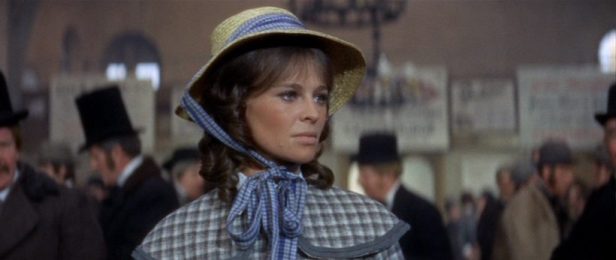
In 1967 there was a British production funded by Metro-Goldwyn-Mayer. It was released in 35mm Panavision and Technicolor; also a 70mm blow-up. It runs 168 minutes, very long for a commercial release of the period. The production enjoyed a roster of talent: the script-writer Frederic Raphael: director John Schlesinger: cinematography by Nicholas Reg: and music by Richard Rodney Bennett. The cast included stars Alan Bates, Julie Christie, Peter Finch and Terence Stamp; supported by a constellation of British actors and character actors.
Fredrick Raphael’ screenplay closely follows the novel and catches both Hardy’s fine description of Dorset [Wessex] and his tone of slight pessimism. There is an online script but it only includes dialogue. This suggests what Raphael included or excluded, but not completely. There appear to be two or three scenes that were left out the movie. One thing that is left out is the novel’s opening, which is a shame because Gabriel’s first sight of Bathsheba explains his desire. Raphael does include some additions that suggest the modernisation in agriculture that Hardy overlooks. This includes references to threshing machines and a scene of Farmer Boldwood introducing one to his workers. There is also a cock-fight attended by Sergeant Troy; a scene censored from the original British release. Schlesinger brings a fine deft touch to the rural drama. Like the novel this includes sequences away from the leading characters presenting a labouring milieu of the period. There are a couple of nice scenes involving schoolboys, one rehearsing his psalter on the way to school, the the two brothers running late for Sunday service. And the harvest supper is finely detailed.
The set pieces of the farm fire and the later storm are well dramatised. The scene with Troy’s display of swordsmanship has real elan. And the later fair entertainment with a tented drama of ‘Dick Turpin’s ride to York’ has both drama and humour. Whilst the movie is pretty long there are some sequences that are too briefly handled; one being the travails of Fanny Robins making her way to the workhouse; one of the really powerful chapters in the book. But the subsequent scene of her coffin and Bathsheba’s blasphemous act has real power.
The locations (in Dorset and Wiltshire) achieve the sense of place as do the excellent props and costumes. One really feels one is watching Wessex in the 1870s. Roeg’s cinematography, in Panavision and Technicolor, is superb. He catches the countryside in changing seasons; the rural landscape and buildings: and the moment of intense drama or romanticism. The sword display and the tented drama are especially effective. It is a real pleasure to watch the narrative unfold visually. The editing is also very well done though I think at some point the plotting moves on a little too quickly.
Overall, the cast are excellent. Peter Finch as Boldwood is an outstanding characterisation; and Alan Bates catches the character of Gabriel through both his vicissitudes and positives. Julie Christie is good as Bathsheba, bringing out her vanity, determination and impetuosity; but not quite as complex as Hardy’s version. This is also true of Stamp’s Troy, though he catches the swagger and the lack of feeling for others. The supporting cast are excellent, bringing out the character and idiosyncrasy of the labouring class and as convincing as the landscape and décor. And finally Richard Rodney Bennett composes a fine score, complementary to the visual and aural work, and with passages of folk-like themes. I remember enjoying the film on its first release. Now, having revisited both the novel and the film I think it a really fine example of adaptation, sitting alongside some fine cinematic interpretations of Thomas Hardy.
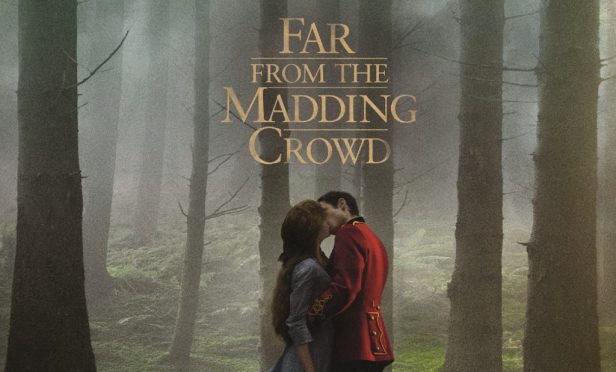
In 2015 there was a fresh adaptation of the novel. Far From The Madding Crowd, produced by Fox Searchlight and BBC Films. The screenplay was by David Nicholls and can be found online. There are a number of scripted scenes missing in the finished film. Most of these are similar to the 1967 version and follow from the narrative of the novel. The cumulative effect of this is to reduce the length of the proposed story, which likely would have approached that of Schlesinger’s version. It has a marked effect on the narrative, undermining important points of motivation. This affects the relationship between Gabriel and Bathsheba to a degree: seriously affects the relationships between Bathsheba, Troy and Boldwood: and really undermines Fanny’s character and role in the story. And it alters the rhythm of the narrative, producing an uneven feel to the plotting. The opening of the film is closer to Hardy’s novel than the earlier: and sets a proper tone to the relationship between Gabriel and Bathsheba. But the ending, reduced from the script, produces a romantic tone which does not really fit the characters or their relationships.
The film uses Dorchester locations among others: it has, moreover, carefully pre\red period props and costumes: and the cinematography is well done. But it does not have Schlesinger’s subtle references to modernisation: and it lacks the space given to ordinary characters which develop the milieu in 1967. And there are a couple of inappropriate modern touches which are totally out of keeping with a C19th tale. One in particular accompanies Troy’s first erotic kiss of Bathsheba.
All the cast characterisation suffer from the reduction in the screenplay. Carey Mulligan as Bathsheba is excellent but not all her motives are clearly presented. Matthias Schoenaerts does not fit the Hardy’s Gabriel though he more or less fits this version: Michael Sheen as Boldwood and Tom Sturridge as Troy do not have the screen time to make their characters work: Jessica Barden as Liddy is severely reduced and even more so is Juno Temple as Fanny. Even Old George, the sheepdog, loses some of his scenes.
I remember being frustrated the first time I saw the film; and in the foyer afterwards several of our audience complained about the failure to stick to Hardy. Adaptations are entitled to vary the characters and narrative of the source novel. But in this case the changes subvert the film as an effective narrative. And the Dorset or Wessex of 1870 does nor really materialise. However, I find that Thomas Hardy has fared better than several of his C19th fellow writers; there are at least five other film [including for television] of his major novels, plus several foreign language adaptations. Dickens has done pretty well as has Austen and the Brontës: less so Elliot, Gaskell or Thackeray.
There are earlier reviews of both adaptations on this blog:
 itp Global Film