
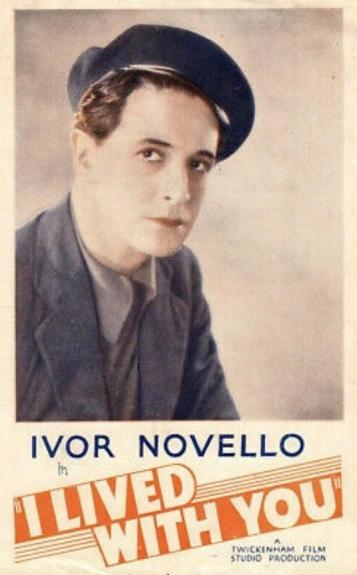
It seems incredible now but in the Summer of 1933 this film was released offering the fourth featured appearance of a young Ida Lupino. She was 15 years-old and third billed behind Ivor Novello and Ursula Jeans. The film was based on a Novello play and directed by Maurice Elvey, a leading director of the period whose 1927 film Hindle Wakes is discussed on this blog. It was clearly intended as an ‘A’ film with 100 mins running time, though it was made at the small Twickenham studio and produced by Julius Hagen but still presented as a Gaumont-British production.
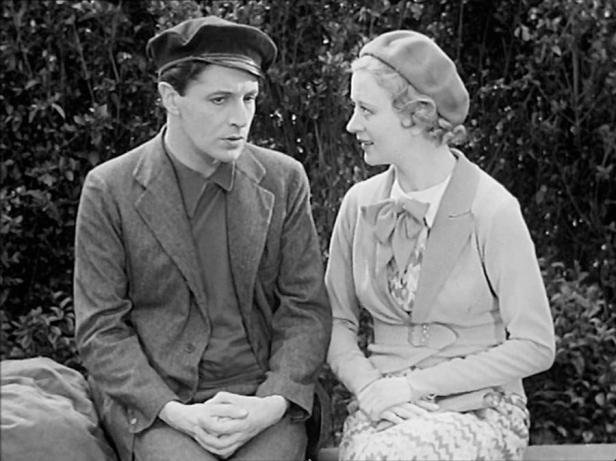
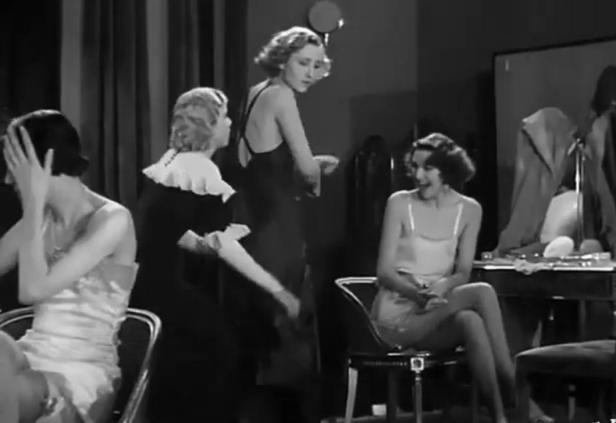
When the narrative opens Gladys Wallis (Ursula Jeans) is working on the counter of a department store and her younger sister Ada (Ida Lupino) is bossing the models in a dress shop. The sisters’ father is being propositioned by his secretary. It appears to be Saturday lunchtime and early closing (or it could be just the end of the day in the summer). Gladys and a friend catch a Green Line bus to Hampton Court where Gladys gets lost in the maze and meets a man who claims to be a Russian prince. After hearing his tale of woe she decides to take him home where his arrival causes great excitement among the family members. The Prince is Felix (Ivor Novello) and as he charms Mrs Wallis (Minnie Reyner) as well as Gladys, he also shocks them by his attitudes to money and sexual relationships. This is especially the case with Mr Wallis (Eliot Makeham). The household also includes Flossie (Cicely Oates), Minnie’s sister who appears to be the cook/housekeeper and young Albert Wallis (Douglas Beaumont). Finally, and perhaps, most surprisingly for audiences of my generation, is a young Jack Hawkins as ‘Mort’, who is courting Gladys. Hawkins was 22 at the time. He had been on stage since he was 12 and in films since 19.
This is Ivor Novello’s film so I feel I must spend some time explaining his status in 1933. Novello (1893-1951) was born in Cardiff and had a musical education eventually reaching its apogee at Magdalen College, Oxford. As a teenager he developed an aptitude for writing songs, having one published as a 15 year-old and at age 21 he wrote the music for ‘Keep the Home Fires Burning’ to a lyric by the American Lena Guilbert. At the start of the First World War this became a big commercial success and by 1916 Novello had begun a career in musical theatre, initially as a composer. As a handsome young man he also developed a career as an actor in films, then on the stage and then from the mid-1930s he became a writer-performer of stage musicals. He was a gay man and he formed a friendship with Noel Coward. The world seemed to be his oyster but there were some setbacks and he died quite young from a heart attack. He had been enormously popular and his legacy is assured by the annual UK awards in his name to songwriters and composers. He has appeared as a character in several important films including Gosford Park (UK 2001) and Benediction (UK 2021).
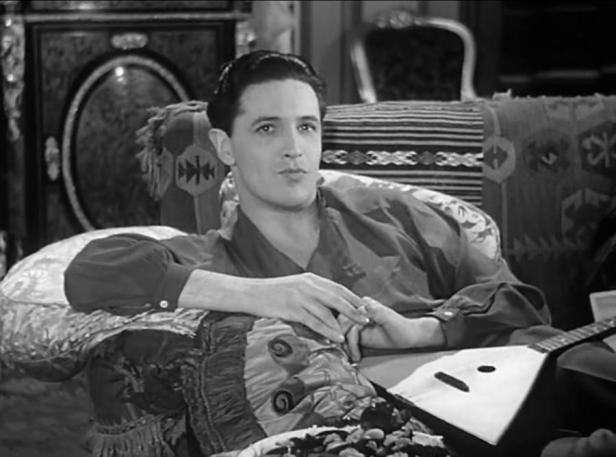
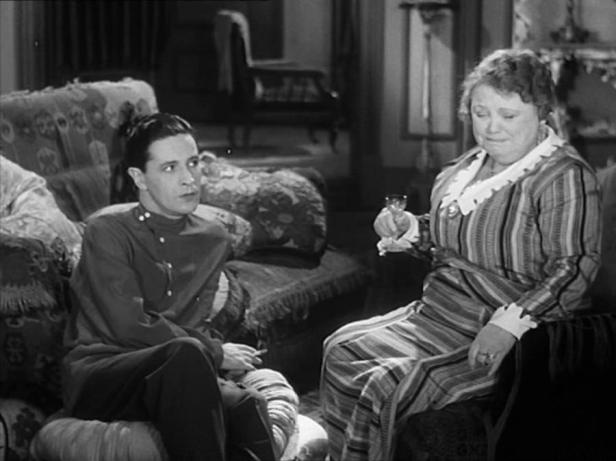
‘I Lived With You’ is Novello’s play and the title refers to the way his Russian emigré delivers a line with his slight misunderstanding of English syntax. The character is a classic disrupter of a narrative equilibrium. Once he appears in the Wallis household, everybody reacts to his presence in different ways. The relationships within the household change and the external relationships of each character are also subject to change and development. I don’t want to spoil the narrative so I’ll just pick up a number of the interesting points. The subtext of the film focuses on the British social class system. This is most evident in the way that reviewers, especially outside the UK (the film was distributed in North America) describe the family. I have found the family described as both ‘working-class’ and ‘middle-class’ but really it is a lower middle-class aspirant family living in Fulham in the kind of house which in London would originally have been seen as suitable for ‘artisans’ or ‘clerical workers’. Mr Wallis works in the diamond business as some form of clerical officer and the two daughters have retail jobs. Flossie’s character reminds me of families in the 1950s with ‘spinster aunts’ being part of the household. The aspirant aspect becomes apparent when Mr Wallis persuades Felix to ‘liquidate’ his one asset, a collection of high quality diamonds attached to his heirloom watch. Mrs Wallis uses some of the money to impress her friends with expensive purchases. The rigid social conventions of the household break down when faced with the ideas which Felix introduces into their daily routines.
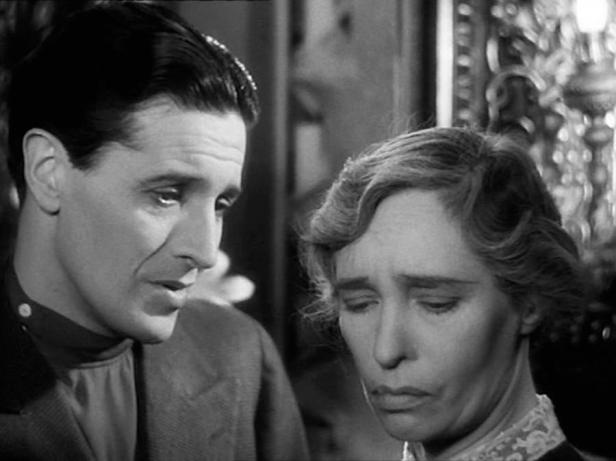
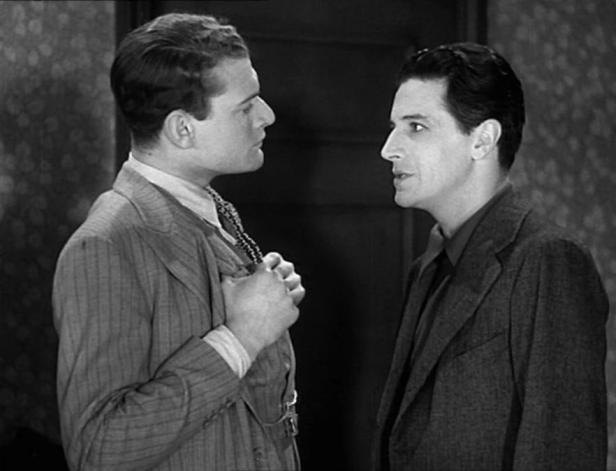
But what does all of this mean in terms of the development of the acting career of 15 year-old Ida? Unlike many of the others in the cast, Ida was not part of the original cast of the stage play but she did have the advantage of being well-known to Ivor Novello. Novello knew her father Stanley Lupino very well as another well-connected actor-director on the London stage and on film and he had become Ida’s godfather. There is a story repeated in William Donati’s biography of Ida Lupino in which he presents an anecdote in which Novello is said to have stopped the shoot after Ida’s character Ada ‘vamps’ him on the couch: “I can’t stand this . . . it’s ridiculous, what with my godchild lying on top of me trying to rape me”. The scene Donati describes wasn’t in the print on the DVD I watched, at least not as he described it and not with the dialogue he quotes. Perhaps Novello had it changed? He and Ida do kiss quite passionately though. Either way the film seems to have been a success and a few months later Ida and her mother set sail for America following a Hollywood call from Paramount. It appears the studio wanted her to play the lead in an adaptation of Alice in Wonderland. But when the studio chiefs met 15 year-old Ida they quickly realised their mistake and she would go on to appear in what were basically B movies playing roles that assumed she was, at the youngest, in her late teens. The teenage Ida became just another blonde on the roster for the next few years. At least she had her mother (another experienced actor) with her and eventually Ida fought her way into more important parts.
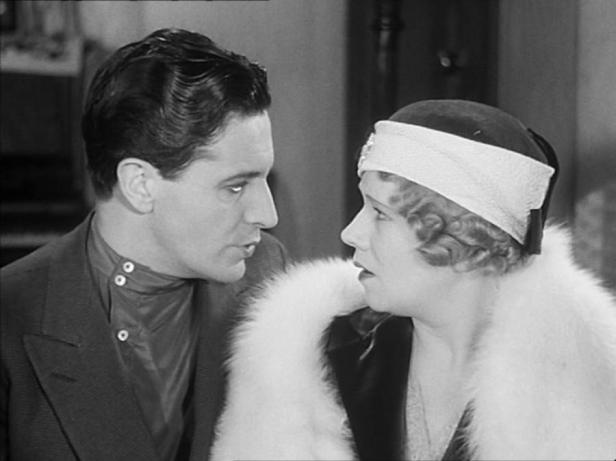
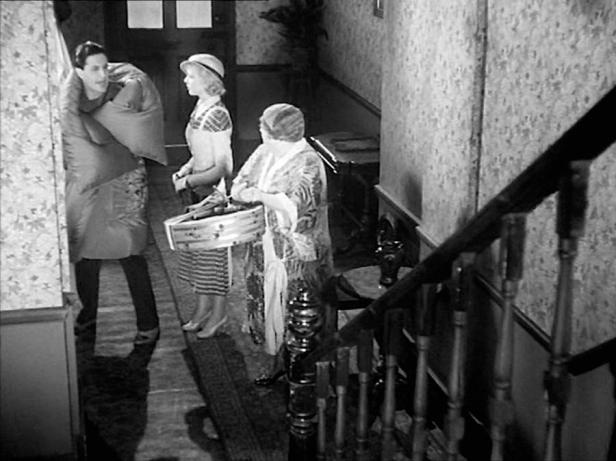
What Ida could do was well-illustrated in I Lived With You but hers is a limited role. The film has some evident flaws/goofs as reviewers have pointed out. For instance young Albert takes ten bob from his Dad and disappears to find a wireless. He also disappears from the film. Father’s dalliance with his secretary is underplayed and inconclusive but the main focus is on Gladys and the Prince. Ursula Jeans is very good as Gladys and Novello was certainly enjoying himself as the Prince. The direction by Maurice Elvey is, I think, quite interesting for a relatively early sound film. He gives us a few big close-ups and some internal scenes which make use of staging in depth. There were two cinematographers listed, Sydney Blythe and Ernest Palmer. Palmer would go on to work for Michael Powell and then on wartime pictures at Ealing with notable success. the film is available on DVD from Renown in the UK as well as online and I think it is certainly entertaining and worth a look. Here’s the end of the scene between Ida and her godfather that caused a fuss:
 itp Global Film