
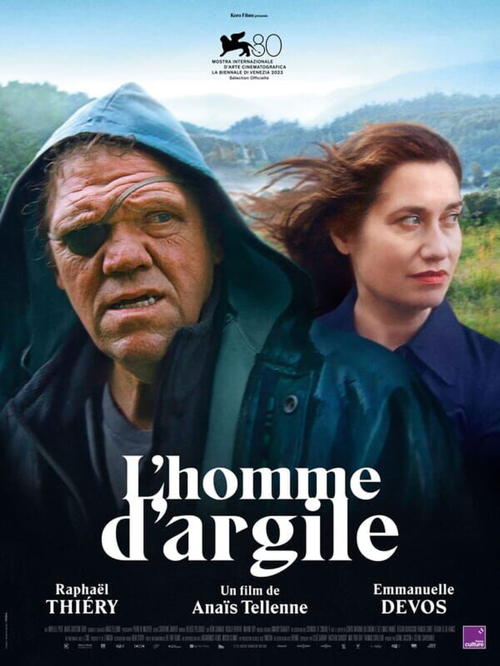
 Here is an unusual film that so far doesn’t seem to have sold to many territories outside France and Belgium. I can see that it might be a hard sell but if you can manage to find it there are several rewards. The two leads alone are worth the price of admission. Emmanuelle Devos is one of my favourite French actors who always delivers something worth seeing. Raphaël Thiéry has been mainly seen in the short films by début feature director Anaïs Tellene. Their working relationship is such that Raphaël is listed on this feature production as co-writer with his director. One way into the film is to consider it as a fairy tale and one possibly inspired by Beauty and the Beast. But if so, it is a twist on the children’s fairy tale and has a possibly slightly darker ending. Against this possible inspiration is a contemporary theme which explores the world of the artist and its social function. Yet again, the anglophone title of the film is much more enigmatic than the French ‘L’homme d’argile‘ which translates as ‘Man of Clay’ and offers a much firmer idea about the central figure.
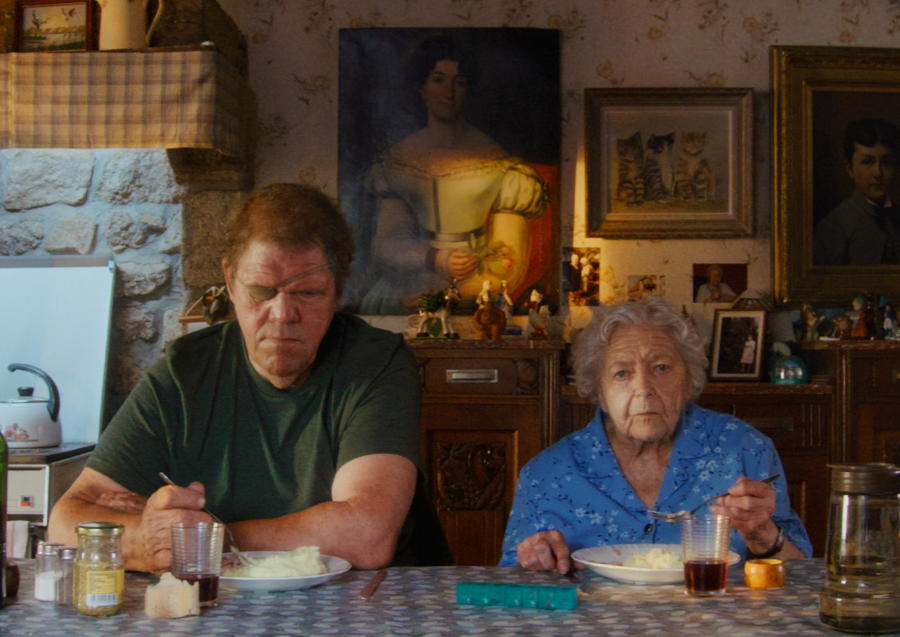
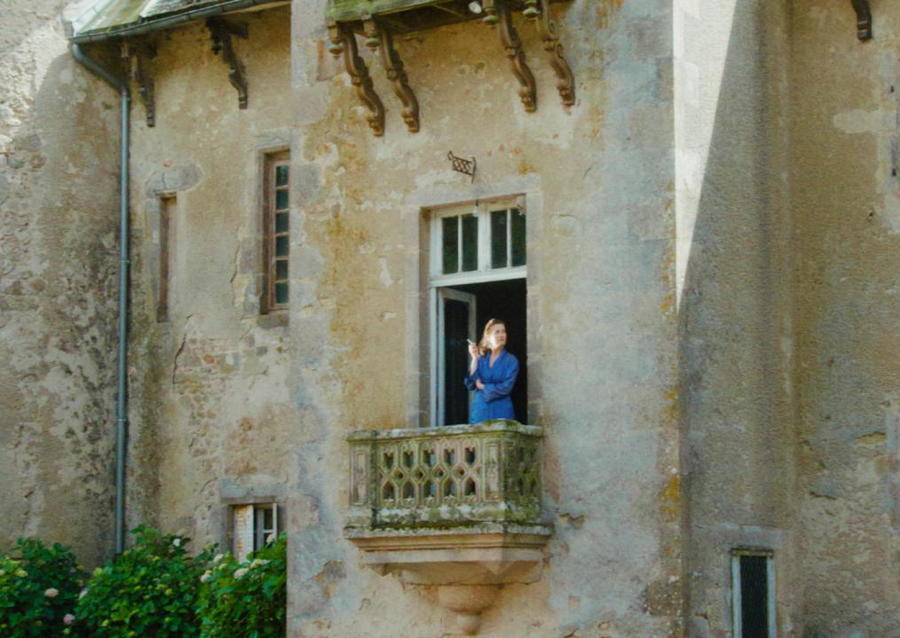
Raphaël (the character is called Raphaël as well as the actor) is a striking figure with physical qualities that do evoke the child’s notion of a monster or a beast. Approaching sixty, Raphaël is a heavy man with a gnarled quality in his facial features, his hands and arms and his torso. He has lost an eye and wears an eyepatch. He lives with his mother in a cottage close to a large chateau, which appears straight out of a fairy tale (emphasised by the credits sequence showing the chateau presented like the illustrations in a classical children’s book and eventually revealed as a watercolour painting).The chateau is deserted, the owners having died and we presume Raphaël is being paid by the estate to maintain the building, living free in the cottage. Our initial sense of the man is coloured by his choice of hooded workwear and his approach to hunting moles on the house lawns. Soon, however, he is disturbed by the arrival of Garance (Emmanuelle Devos) who appears to be an heir to the property as the niece of the owner. Initially she seems to be in need of recuperation, spending much of the time sleeping. So far, we have learned a little about Raphaël’s two leisure activities that balance his caring for his mother and his duties in the house and garden. He plays the ‘dominant’ in sex games with the local postwoman who arrives in her van and at night he practises his bagpipe-playing in the empty swimming pool at the side of the house.
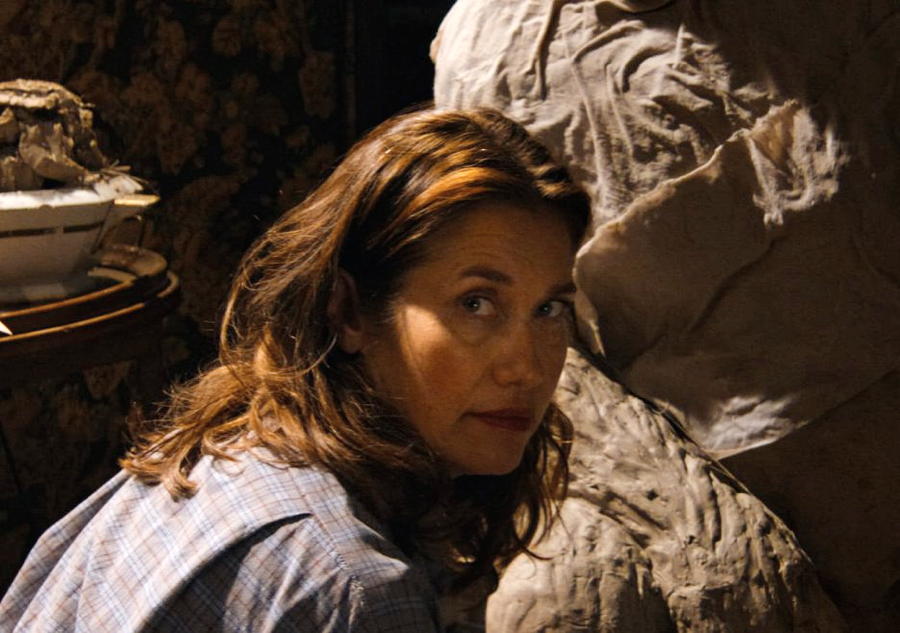
When Garance finally surfaces we realise that she is an artist and soon she seems intent on using Raphaël as her model for a sculpture in clay (which Raphaël finds in the woods around the house). I should point out that the name ‘Garance’ is believed to have originated in references to a plant used as a ‘madder’ (red) dye. This would link to the artist. However, as a cinephile of a certain age, the name means most to me as the heroine of the classic French melodrama, Les enfants du paradis (1945) who is played by Arletty. Garance is thus for me a very romantic name. In his early encounters with her, Raphaël finds her somewhat worse for wear and sleeping off her drinking, sometimes sprawled semi-naked. Later she will ask him to model nude and we might begin to wonder about how the artist and the model see each other. Raphaël certainly begins to lose interest in the postwoman. Gradually we will discover that Raphaël and his pipes are actually part of a local band playing a modernised form of traditional music – something like folk rock. I found his playing surprisingly gentle and quite beautiful as these French pipes (there are many types, I think) provide something different to the skirl of Scottish pipes. The bandleader doesn’t really want to hear Raphaël’s softer side but Garance is appreciative.
Some reviewers have referred to the film as partly a romance. I’m not sure about this. I don’t want to say much more about the plotting but what is clear is that although Raphaël and Garance are very different in terms of their experiences, they are both able to look beyond surface appearances and to see something of what lies beneath. If there isn’t a romance as such there is definitely a sexual connection in terms of a productive tension between the two. I found the ending of the film quite sad in one sense but possibly encouraging in others. If you want to know more look at the trailer below. This must have been an intimate production in the sense that there are just four principal players and some other minor characters who might appear in just a couple of scenes. The main creatives include two other women. The DoP Fanny Mazoyer seems to have invented a pairing of lenses to slightly distort and degrade the digital film image which is presented in a 1.5:1 ratio, a non-standard ratio I have noticed on another relatively recent film but I can’t remember which. The film editor is Héloïse Pelloquet who seems to have handled the sequences with strange aspect ratio images very well. The music score by Amaury Chabauty also enhances the feel of the fairy story approach. You can follow the directors ideas and explanations of how the creative team worked on the shoot in the interview below.
I enjoyed this film very much and I do hope it gets more widely seen.

