

I’m not sure how I missed this film on release in the UK in 1998. I made a big effort to see every release by John Sayles so I must have been very busy or away on holiday. Sayles is now being discussed again because his most successful film, Lone Star (US 1996) has been restored and was released on 4K as a Criterion Blu-ray in early 2024. I believe it is now being re-released in UK cinemas. Men With Guns was the next Sayles film to be released in the US in 1997 and it turned out to be an Hispanic language film set in an unnamed Central American country. Sayles has always operated on the principle that he can make whatever he likes as long as he maintains direct control over the production. He has done this ever since he fell out with Paramount over his third film, Baby It’s You in 1983. As a genuine ‘independent filmmaker’, Sayles has built his career on the basis of funding his films largely with the proceeds of his work as a writer and an actor or by doing deals with smaller funders which saw him retain control of the final cut.. As a novelist in his early career he won prizes and then as a scriptwriter, initially on exploitation films, he proved himself to be full of ideas and also to be adept at rescuing scripts and becoming known as a ‘script doctor’. This allowed Sayles to make the films he wanted to make, many of which explored history, ideas, characters and politics rarely covered in mainstream films. For Men with Guns he chose to make a film in Mexico, in Spanish and Indigenous languages, and with a leading player from Argentina, who at this point was barely known to American audiences. He did negotiate a deal with Sony Classics for US distribution and this would lead to further links to a studio which for a period proved to be an understanding partner. One of his partners on this project was the Independent Film Channel which guaranteed a TV run.
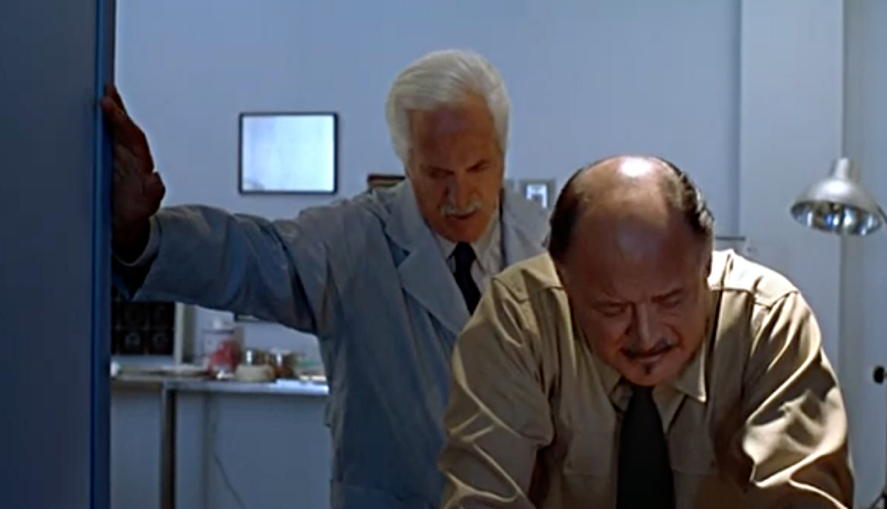
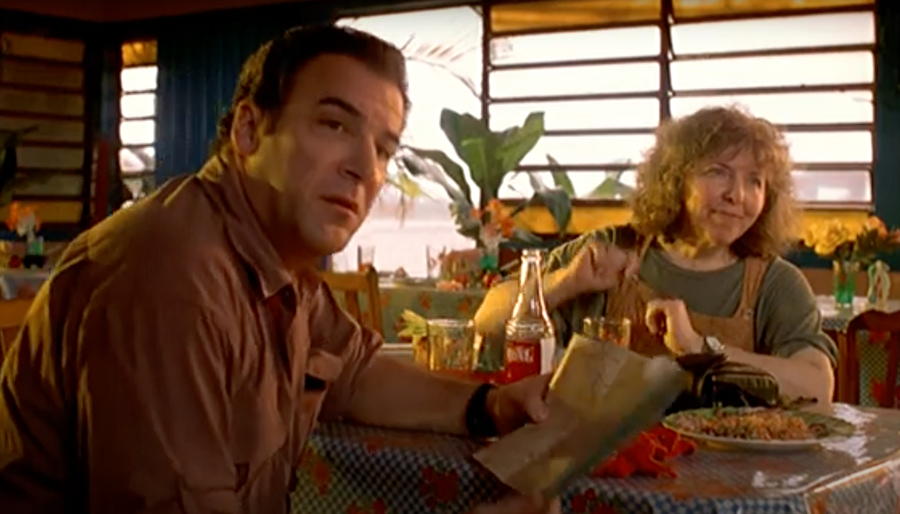
In one sense this was still a topical film, albeit towards the end of the cycle of American films that explored the struggles between repressive Latin American governments, mostly backed by US foreign policy, and guerrilla groups of various kinds which often resulted in the deaths of ordinary citizens caught between the two. The best known films of the cycle were arguably Roger Spottiswoode’s Under Fire (US 1983) and Oliver Stone’s Salvador (US 1986), although from the UK, Ken Loach made Carla’s Song in 1996 which dealt with events in Nicaragua. In each of these films there was an ‘Anglo’ central character and the narratives included the US support for right-wing interests, whether this was for guerrillas fighting left-wing governments or the opposite. Sayles chose not to include American policy initiatives or to name the country in which his narrative was set. His only concession was the appearance of an American tourist couple at various points in the narrative who seem to be touring ‘sites of antiquity’ with little interest in the war in the remote parts of the country. The couple simply represent a dramatic device which we might read as Sayles showing that this is not a Hollywood movie. In the Faber and Faber book of 1998, Sayles on Sayles (ed Gavin Smith) he refers to them as “absolutely liberals”. They know something of what is going on but it doesn’t affect them. They don’t feel the fear of the local people. Sayles actually suggests the couple are symbolic of the Monroe Doctrine, the American idea that whatever happens in the Americas is something Washington wants to control. The crucial point about the couple is that they are still more ‘aware’ of the struggle than Dr. Fuentes, the central character of the narrative, at least at the beginning of his journey, but unlike him they don’t feel any responsibility. The script was by Sayles but he seems to have based it on the experiences in Guatemala and Mexico of friends of his relatives. He had himself done research for a cable TV project in Guatemala.
Dr. Fuentes is recently widowed and on the verge of retirement from his practice in the capital city. Having dinner with his daughter and her partner he expresses his pride in what he considers will be his legacy, the training programme he ran for the government which aimed to produce seven doctors who would go to the remote communities in the mountains and help to improve the lives of villagers. His son-in-law scoffs and tells him that it won’t work because ‘los Indios’ will not accept it. Fuentes has already heard from his patient, and presumably old friend, a senior Army officer, that the guerrilla war still rages in the mountains. Dr. Fuentes really isn’t aware of what goes on. He has seemingly believed government propaganda that the war has been won. He decides to drive into the mountains to find his seven protégés. He hasn’t seen or heard from them since they graduated three years earlier. In effect he begins a road movie journey and places himself in a situation not unlike that found in Conrad’s Heart of Darkness in 1899. He soon realises just how naïve he has been. He struggles to get any information from the local people he meets. Many don’t speak Spanish. Most simply won’t speak to him at all. As he gets further into mountain country things begin to go very badly. Eventually, he will collect a small group of travelling companions who accompany him for very different reasons. One is an orphan boy who does speak Spanish as well as local languages, another is an ex-soldier and a third a former priest. Finally, the group is joined by a young woman who has not spoken since she was raped. In some cases he is told that the doctor he trained has been killed by the soldiers or the guerrillas (both are ‘men with guns’ as far as the villagers are concerned). Sayles offers an ‘open’ ending. We do find out what happens to Dr. Fuentes but the hope for the future that the fighting and the misery will end is more symbolic than real. The final and most remote village is known locally as ‘Cerca del Cielo’ or ‘Close to Heaven’ because it is on a hill top. Here the locals can hide beneath the tree cover, but it is difficult to grow food because the soldiers use helicopters to look for clearings in the forest cover. Sayles remarks that ‘Heaven’ to many in Central America used to mean ‘Mexico City’ but now probably means the US. In a sense he was right in that the next cycle of American films would deal with attempts by migrants from across Central America to get to the Mexican border and cross into the US, whatever the dangers.
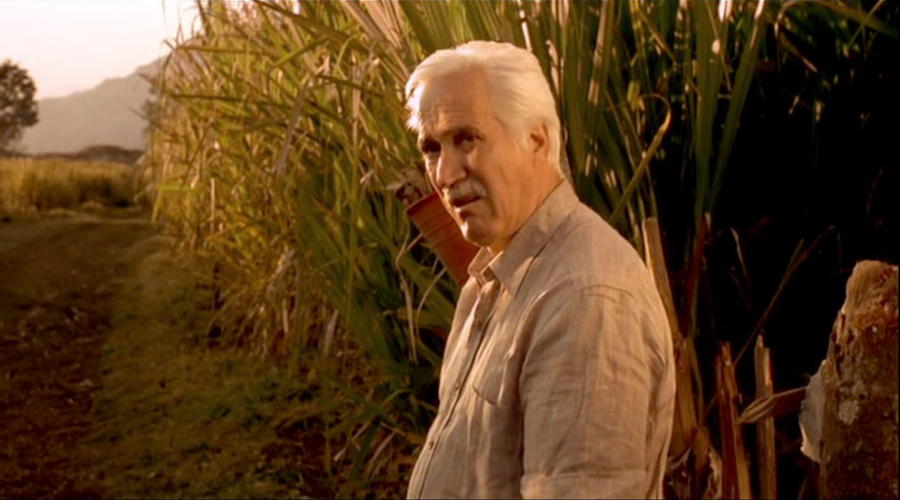

Dr. Fuentes is played by the great Argentinian actor Federico Luppi (1934-2017). He would become better known to Anglo-American audiences through his three films with Guillermo del Toro, Cronos (Mexico 1992), The Devil’s Backbone (Spain-Mexico 2001) and Pan’s Labyrinth (Spain-Mexico 2006). The third of these films was the big international hit but Luppi was a leading player in the first two and they became more popular as del Toro’s fame spread. The rest of the cast of Men with Guns were mainly non-professionals or had little experience when they were cast apart from the American couple of Many Patinkin and Kathryn Grody and the Mexican actor Damián Alcázar who plays the priest.


The film received generally positive reviews but also some familiar criticisms that have often been made about Sayles’ films. For instance, in his Sight and Sound review in the UK (September 1998) Philip Kemp makes very positive noises but then argues that Sayles once again falls into the trap of presenting a didactic narrative rather than fleshing out the characterisations. I understand the charge and it is true to say Dr.Fuentes is a character who seems to be presented in order to make points about the political situation rather than developing as a ’rounded’ character. Kemp notes that it seems odd that he has not tried to get in touch with his students for three years and that the funders of the project have not asked him about the findings of his students. I can’t argue against that observation but I would ask in return, “Why can’t we have a film which tries to teach us about the conditions in many Central (and South) American countries, without worrying about creating a conventional narrative?” I don’t mind the didacticism (I still think of myself as a teacher) and anyway I think you can be didactic and still create an entertaining narrative as Sayles has frequently demonstrated. Other common complaints about Sayles’ films are that they are too long – this is 128 minutes – and that Sayles should employ someone else to edit his work, which would make it tighter. Again I can see the argument but I don’t buy it. The film also refuses a neat ending and some kind of ‘redemption’ or ‘closure’. Yes, well I think guerrilla wars are a bit like that. The critics were right of course in one respect and the public stayed away from the film on release but it may well have found audiences on disc, TV and now streaming. It was made on a low budget (under $2.5 million) and it gave work to crew and cast from Mexico. I’ve read that Sayles did clash with his cinematographer, the Polish maestro Slawomir Idziak but the results look good to me. (Haskell Wexler was unavailable but getting Kieslowski’s DoP is not a bad deal.) Of the regular Sayles group, music composer Mason Daring does an excellent job of finding performers in different forms of local music from across Latin America and the score is a triumph. Sayles tends not to make direct political points, though he is clearly interested in political issues. I was pleased to see that the film played in the ‘New Latin American Cinema festival in Havana’ to packed audiences and I do think that the relentless American attacks on the Cuban economy for the previous thirty-odd prevented the Cubans from bringing a healthcare revolution to Central American countries.
I watched this film on a viewable copy posted on line with subtitles. Here’s a trailer for the screening on Film 4 in the UK (the film itself is in 1.85:1). It now seems to be unavailable in the UK on any commercial format (except on VHS via eBay!), so if you want to see it you need to search for it online! I think it is worth the effort.
There is more about John Sayles in my post on his first film, The Return of the Secaucus Seven (US 1980). An important film about local people ‘disappeared’ by government agencies (backed by the CIA) in Guatemala during the 1980s is The Echo of Pain of the Many (Guatemala-UK 2012).


I saw this film on release and I thought it very fine. It was intriguing in the way that it fitted, but then did not really fit, in the series of other films [like Under Fire] which attempted to frame anti-colonial struggles within a western perspective. As usual John Sayles offers a more complex perspective.
The unavailability of a version in Britain is frustrating, though, as Roy notes, it did get an airing on Film 4.
What I now note is that one of Sayles’ contributions to the production is his story, ‘At the Anarchists’ Convention’ which I must seek out.
LikeLike
The Anarchist’s Convention was published as the lead story in a collection of short stories by John Sayles in 1979. The credits of Men With Guns list it as the name of a production company (presumably representing Sayles funding share of the production which otherwise included Lexington Road Productions, Clear Blue Sky Productions and IFC). IMDb offers a list of other Anarchist’s Convention film titles (i.e. Sayles’ films) but I’m dubious about this since other sources make no mention except in the case of Men With Guns.
I’d like to read the collection but it doesn’t seem to be available to buy in the UK except as a very expensive import from North America. Perhaps there are copies in UK libraries?
LikeLike