
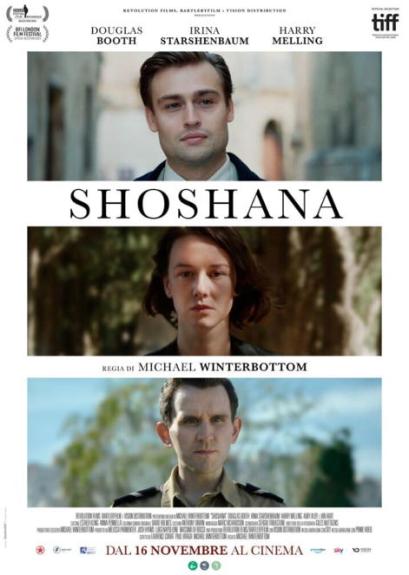
I was not surprised to be the only person in Screen 10 of the multiplex for this lunchtime showing of Michael Winterbottom’s new film. For many years between the mid-1990s to the early 2010s I watched everything made by the filmmaker who I considered to be the most interesting and the most exciting in British cinema. Since then I’ve not seen quite so much of an incredibly prolific director of material for both cinema releases and TV broadcasts. Partly it’s because some of that work has appeared on outlets that I don’t have access to (i.e. Sky channels). However, I knew that Winterbottom had been trying to make this new film (under the original title ‘Promised Land’) for some fifteen years. Since it is about one of the issues closest to my heart I couldn’t afford to let this opportunity go. I doubted it would last beyond its first week in local cinemas (in fact it is booked into the Ilkley cinema in a couple of weeks but otherwise hasn’t been shown in Bradford).
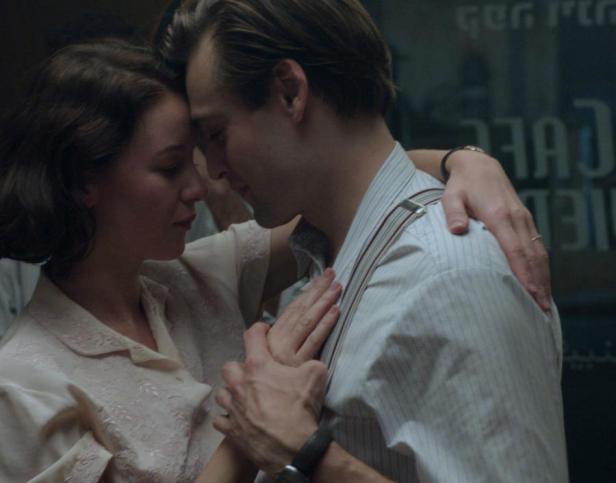
Shoshana is the name of the principal character of this ‘romance thriller’ or perhaps more appropriately, this ‘colonial melodrama’. Played by the Russian actress Irina Starshenbaum, Shoshana Borochov is a Ukranian Jewish migrant arriving in Palestine as a child in the 1920s. Her father was a leading Socialist Zionist who died when she was a small child. Now she and her brother have grown up each in their own ways attempting to fulfil their father’s dreams. Shoshana is a member of, and works as a journalist for, the Haganah, the mainstream Jewish organisation in Mandate Palestine seeking to develop kibbutzim and to protect them from possible attack by Arabs so that eventually they will become become part of a new Jewish state. By the 1930s the struggle between Arab and Jewish communities had already lasted for twenty years. Shoshana lives in Tel Aviv, the fast-growing new Jewish city on the Palestinian coast. There she meets the British colonial police officer Tom Wilkin and the two fall in love. Many of the characters in the film are historical figures and the narrative begins with Shoshana’s voiceover and a series of newsreel clips explaining the historical background. Wilkin had arrived in Palestine at the same time as Geoffrey Morton (Harry Melling) who was was eventually put in charge of the police unit in Jenin where he was tasked with quelling the activities of Arab ‘terrorists’. The two men know each other and the decisive move by the Mandate authorities is to put Morton in charge of police operations in Tel Aviv where it is hoped that he can be as effective in finding and ‘neutralising’ Jewish ‘terrorist’ groups as he was in the Arab communities.
Morton’s move to Tel Aviv was a response to the assassination in 1939 of the Head of Tel Aviv CID, Ralph Cairns. Cairns was a historical figure killed by Irgun, the armed group which formed a separate organisation from the Haganah, attacking Arabs but also British targets. Shoshana’s brother is implicated in the operations of Irgun. When the Second World War breaks out, a further splinter in the Jewish groups sees the emergence of Lehi, a small group dedicated to attacks on the British and led by Avraham Stern (thus the name used by the British, ‘the Stern Gang’). Stern went so far as to approach the Nazi Government in Berlin for support in the fight against the British. The Haganah generally sought to support the British during the war but also to prepare for the establishment of the ‘State of Israel’ when the war ended. (I should point out that approaching the Germans for support was also something attempted by the Grand Mufti in Jerusalem and by Subhas Chandra Bose, the nationalist leader in India during the Second World War.)
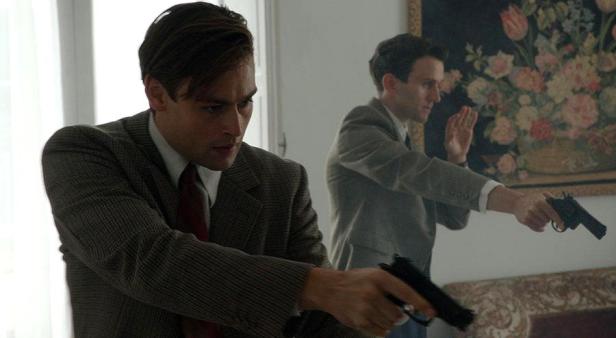
I was riveted to the events onscreen for the whole two hours. If nothing else, Winterbottom and his team do manage to cover most of the major incidents in the struggle between the British forces (which included Jewish police officers) and Irgun and the Stern Gang. However, in doing so the Arab perspective is lost. There are no Arab characters on the same level as Wilkin and Morton, Shoshana and Stern. This for me is a major weakness. The other problem with the film seems to be that some critics don’t believe in the romance with questions raised about the casting. I don’t know what prompted Winterbottom back in 2008/9 to begin work on his project – i.e. whether the romance or the guerilla war was the main subject. It appears that the original idea was Winterbottom’s and that eventually the script was written by Laurence Coriat and Paul Veragh, both with past collaborations with Winterbottom.
The narrative should be able to work as a colonial melodrama. Wilkin represents the colonial policeman who has ‘gone native’ by learning Hebrew and coming to see his future in Tel Aviv, whereas Morton is the rule-focused policeman, prepared to use any means necessary – although this is potentially undermined by the presence of his wife from England, a rather naive young woman who gushes over the Arab schoolchildren she teaches. I think that class also separates Wilkin and Morton. I’m tempted to think of Wilkin as the public schoolboy with the social graces and Morton as the grammar school boy with his eyes fixed on promotion. I don’t have problems with the casting and I should also mention Ian Hart’s appearance as the go-between the Mandate government and the police – he certainly presents the dilemma of the administrator with a thankless task. Irina Starshenbaum is very good as Shoshana but she is arguably under-used, partly because the romance and her political arguments are to some extent pushed out by the violence of the Irgun and the Stern Gang. There is a problem with the colonial melodrama of course and that is the peculiar nature of the Mandate territory. Unlike in the narratives set in India, Malaya or Kenya, there are no white settler communities or white plantation owners. The British presence in Palestine was not about economic exploitation. It was primarily strategic in relation to the route to India and the need to maintain a presence in the region to secure access to the oilfields in Iraq and Persia (Iran). The Jews in Palestine were more like rival colonialists than a native people to be suppressed. The Zionists from Eastern Europe and Russia included well-educated younger men and women. Wilkin and Shoshana meet on equal terms.
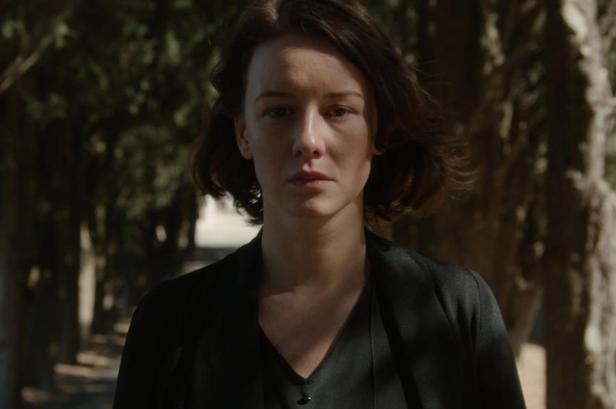
I’m baffled by a reviewer who described the film as ‘bland’. The history of this period in Palestine was desperate. As Shoshana points out, the British promised the same thing to both Arabs and Jews, creating an impossible situation which they then attempted to control with repression. Violence creates violent responses – some of the leaders of Irgun would become prominent political figures in the State of Israel after 1948. The British system found itself unable to avoid creating conflicts in Africa, India, Cyprus, Malaya, Ireland and several other territories as well as Palestine and Iraq during the ‘end of Empire’. Shoshana at least goes some way to presenting much of that history which is not familiar to modern audiences. It’s terrible to think that the current massive loss of lives in Palestine today, both Jewish and Arab, derives from that failure to find solutions in Mandate Palestine.
Michael Winterbottom always makes technically competent films and even when his films struggle to find audiences they have things to say. Shoshana deserves to be seen more widely despite its weaknesses. The whole film was made in Italy for fairly obvious reasons. Most of the time the locations work well. I don’t usually notice the cars but there do seem to be a lot of left-hand drive Citroens and Fiats (?) used by the Palestine police. The cinematography by Giles Nuttgens works well with the locations and I enjoyed the music in the film (though I can’t find a credit for it). Much as I like the Gershwin song ‘The Man I Love’ from the 1920s, it is used several times in the film in different versions as if trying to bolster the romance between Shoshana and Tom Wilkin. The Ella Fitzgerald version dates from 1959, I’m not sure if that is an intentional ‘look back’. It was difficult to find images and a comprehensive cast list of the film – Shoshona appears to have been released with little fanfare as if the distributor didn’t really have faith in it. I hope it has a future on disc and streamer as the story does need to be told.


Annoyed to have missed a press show for this; Winterbottom is a great director, even if he seems out of step with today, and I’ll make a point of catching this in your recommendation. Thanks.
LikeLiked by 1 person
The distributer, Altitude Film, has page showing current screenings:
https://www.altitude.film/shoshana – there is a singular lack of northern venues.
Some lucky Londoners actually have Michael Winterbottom introducing the movie.
LikeLike
Thanks for this. Interesting that it’s gone to the Odeons rather than Curzon/Picturehouse cinemas which is where as a London film goer I normally see films. Must try and catch it.
LikeLike
I think Altitude developed working arrangements with the multiplex circuits during the pandemic when the studios withheld films from distribution. Altitude was founded in 2012 by people associated with Optimum Releasing and other companies from the ‘Independent Cinema’ sector, but not necessarily the arthouse sector. I would have missed this release altogether if it hadn’t been reviewed in the Observer. Bradshaw’s review might have been online only, I didn’t see it in the Guardian and it only appeared in the Sight and Sound that landed through my letterbox at the weekend.
LikeLike
Roy notes that Manchester HOME has already screened the movie; and that the Ilkley Cinema is screening next week; the latter unfortunately looks more like a video lounge than a cinema.
I inquired from the Hyde Park Picture House and received the following:
“Thank you for getting in touch. I have discussed Shoshana with our programming team and, unfortunately, we currently do not have plans to screen Shoshana. This is due to the volume of current new releases, as well as being in the middle of awards season we have been unable to fit it into our programme for March.”
How depressing, especially as all sorts of venues are screening ‘award’ titles.
LikeLike