

Goodbye Julia is currently favourite to win the Audience Award at the Leeds International Film Festival, 2023. It’s easy to see why. This was quite a busy screening and there were seemingly a fair number of people from the West Yorkshire Sudanese community in the audience. The film narrative covers two specific periods in the recent history of Sudan. The narrative opens in Khartoum in 2005 when ‘Southerners’ (the mainly Black African population from South of Khartoum) are protesting on the street following the death in a helicopter crash of the Vice-President John Garang, a prominent figure from South Sudan. Later the narrative switches to 2010-11 and the build-up to the vote on partition and the eventual establishment of South Sudan as a separate state.
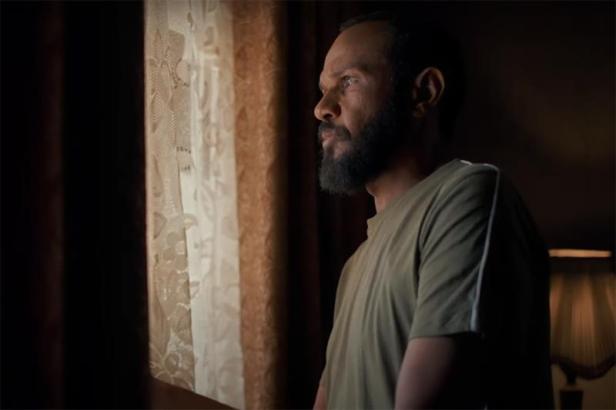
Mona (Eiman Yusif) is a middle class woman, married to Akram (Nazar Goma) who owns a furniture manufacturing and joinery business. Mona seems distracted and not really interested in ‘keeping house’. Later we will learn that she used to be a singer in a band and that when she married she gave up singing but has so far not been able to become pregnant. The riots create considerable disturbance and the next-door neighbour’s car is burned. Foolishly, Mona ignores the danger and drives into the city centre to hear a band play. But the gig is cancelled and driving back a different way to avoid demonstrators, Mona has an accident, carelessly knocking over a small boy outside a compound. She wasn’t going very quickly and the child is not seriously injured but Mona panics and calls her husband. She drives home but is followed by the boy’s father on a motorbike. The father is clearly a southerner and when he arrives at Mona’s house he meets Akram with a rifle. Akram gives a warning and then shoots and kills him.

It occurs to me that I have seen similar narrative openings and that often they become like morality plays. I’m thinking of the Italian film The Dinner (Italy 2014) in which two wealthy brothers (a lawyer and a doctor) have to decide what to do about the actions of their teenage children. Just as in the Sudanese situation, a wealthy person can cover up actions, even to the extent of bribing the police. Akram does this effectively and the father on the motorbike literally disappears into an unmarked grave. The neighbour takes the motorbike in ‘reparation’ for his car that was burned. This leaves the boy and his mother completely in the dark, not knowing where the father has gone. It also leaves Mona feeling distraught and deeply guilty. She resolves to help the mother without revealing what she has done. I don’t want to spoil the narrative so let’s just say that one thing leads to another and Julia, the mother (Siran Riak), ends up as Mona’s maid and her son is eventually enrolled in a private Christian church school, paid for by Mona. What is important here is that Julia and her son are poor, Black and Christian. Mona and Akram are wealthy, Arab and Muslim. In short they are on opposite sides of the divide in Sudan. This ‘difference’ shows up in many ways but perhaps most visibly in the way in which Mona marks the crockery that Julia and her son use in the house – because it would be ‘unclean’ for Mona and Akram to use.

Goodbye Julia is the début film of Mohamed Kordofani who also wrote the script. It is produced by Amjad Abu Alala whose own début feature was You Will Die at Twenty (Sudan-France-Germany Egypt-Qatar 2019) discussed on this blog a few years ago. Kordafani lives in Bahrain and Abu Alala in Dubai. Kordafani was born in Sudan and has had a career as an aviation engineer. He is largely self-taught as a filmmaker, but he has followed the standard route of contemporary filmmakers and first produced shorts that have won prizes. He chose to shoot Goodbye Julia in the traditional squarish shape of the Academy ratio and I haven’t found any explanation of this. I can only say that the story is so riveting that I barely noticed the screen shape. It is noticeable though that in comparison with You Will Die at Twenty, Goodbye Julia is less obviously ‘cinematic’. In other words we are carried along by the actions and interactions of the characters rather than the landscapes/cityscapes or mise en scène. This is not a criticism, simply a comment on the visual style. The film does have a visual trump card though. The two actors playing the women at the centre of the narrative are very beautiful and accomplished. Mona does get to sing. I’m not sure if she is dubbed or if it is her own voice but the performance is very good. At one point in the film, watching Siran Riak move gracefully through the scene, I thought to myself ‘she could be a model” and it turns out that she is a former ‘Miss South Sudan’ and has done some modelling. I think both women were acting for the first time –remarkable!
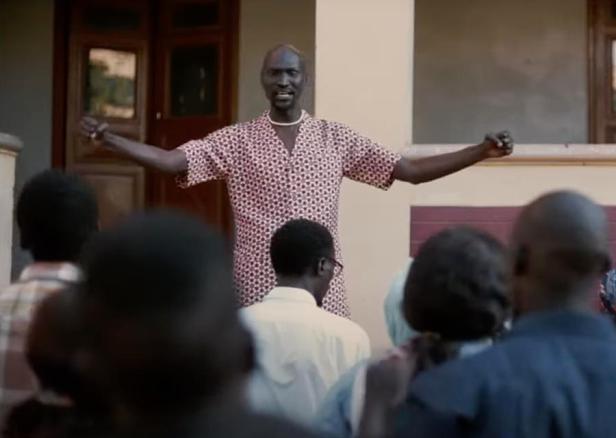
The second part of the narrative moves forward five years and things have moved on in the lives of all concerned. Julia is back in school, her son Daniel is now eleven and Akram who was previously not in favour of Mona’s employment of Julia has now taken to treating Daniel like a young apprentice joiner. But perhaps the biggest change is that Julia has persuaded Mona to think about singing again. But there is also a sense that all this is just too good be true and when Julia meets a young man, a Black African Christian, even taller than her and supremely confident, we wonder if he will prove to be a major disruptive force. The vote on the potential separation of North and South Sudan is imminent and the young man is a leader of the ‘Yes’ campaign. The film ends as a full-blown melodrama. On reflection it is perhaps not entirely plausible i.e. secrets seem to have been kept for a long time and the last section of the narrative is very much about the morality of lying. On the other hand, it works for an audience. I also want to praise the way in which the script delivers a complexity in the motivations and the emotions of the characters which to some extent challenges assumptions. I had a group next to me of what I assume were Sudanese women, animated in their appreciation and one sang along with a song on the radio. I was in tears by the end and that’s always a signal that I felt the film to be a melodrama. The film’s title tells you the final resolution. Julia and Daniel get on the boat going down the White Nile to the new South Sudan.
Goodbye Julia screened at Cannes in the ‘Un Certain Regard’ programme and it is the Sudanese Oscar Entry for 2024. I feel confident that it will get a wide distribution if the Leeds audience is a guide, so I hope you get to see it. Unfortunately, however, in 2023 there is trouble in Sudan again and the director has had to abandon his next project in the country for the moment.
 itp Global Film
Not seen this but very impressed by LIFF this year and most impressive for me was Canadian film and another courtroom drama, with some twists, Red Rooms. At Cottage Road last Sunday. The hero of this is very enigmatic.
LikeLike
That’s interesting. Just like last year, I’ve been only able to see four films in LIFF 2023 and my impression from the programme was that the festival was somehow smaller and less high profile, so I’m glad to hear that your experience was very positive. I did enjoy all four films I saw, two more posts coming later this week.
LikeLike