
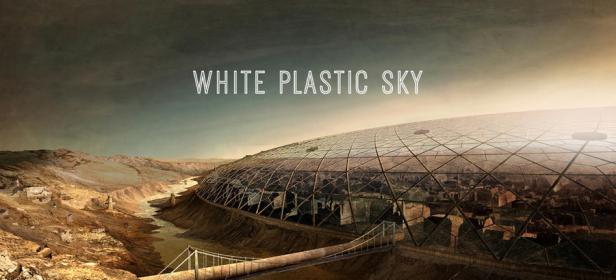
This rotoscoped animated feature offers familiar elements of dystopian science fiction draw from several well-known novels and films. The most obvious inspiration is Soylent Green (US 1973), based on a story by Harry Harrison. Other elements are communities living in domes, transport technologies that might remind us of Snowpiercer (South Korea 2013), state sanctioned, quasi voluntary euthanasia like Plan 75 (Japan-France-Philippines 2022) and a romance a little like that in Solaris (USSR 1972). And yet the scenario in this film is fresh.
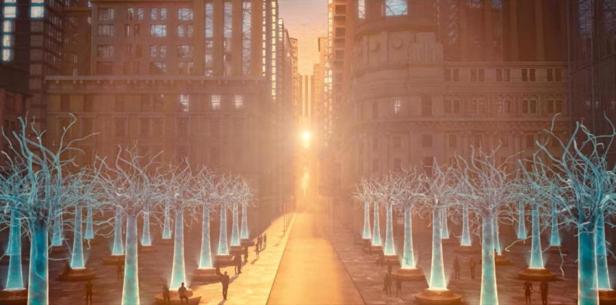
It is 2123 and a community in Budapest has survived under a massive dome. We don’t know if there are other communities elsewhere, but in Budapest, the citizens have agreed that human life should be limited to 50 years. Outside the dome all animal and plant life has died (presumably from climate change, pollution and other ecological disasters) except for a genus of trees. Since natural food has disappeared, the population can only be nourished by the bodies of the dead. Citizens are taken for a form of recycling when they reach 50. They can agree to an implant which automatically begins the process. I wasn’t clear on what happened to those who refused to comply, but presumably the process can begin under duress. Living humans are slowly transformed into hybrid ‘tree humans’ in the ‘plantation’ (under another dome). The trees grow leaves which can then be harvested by machines to become the basic food resource which can be made into different kinds of foodstuff.
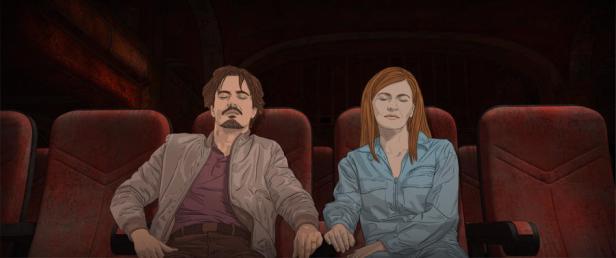
The narrative disruption begins when Nora, a woman of only 32 secretly has the implant. She is suffering trauma from a family tragedy. Her husband Stefan (who is four years younger) only finds out when there are just a few hours before she will be taken to the plantation. He is too late to halt the process so he attempts to find a way into the plantation. If he can find Nora before the process has gone too far, he believes there is someone who could surgically remove the implant. I won’t spoil the narrative pleasures from that point on.
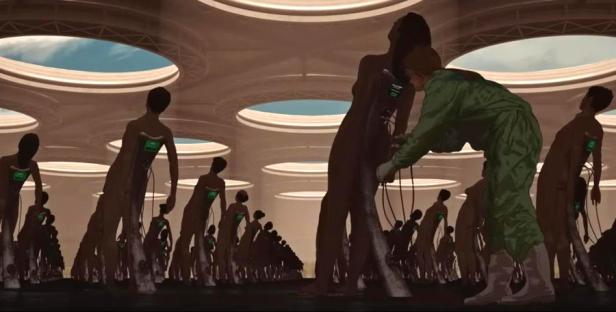
The film project which has taken several years is the product of the imagination of Bánóczki Tibor and Szabó Sarolta. I’m not sure if they are a formal couple but they are both credited as writers, cinematographers, art directors and directors. They also have a veritable army of animators working for them. At 110 minutes, the film is quite long for this form of animation. I haven’t seen work like this for a long time and the last rotoscoped science fiction film I remember is the Phil K. Dick adaptation, A Scanner Darkly by Richard Linklater (US 2006) but I think this new film is less ‘graphic novel-like’. White Plastic Sky felt to me, more detailed. The leads are played by Keresztes Tamás as Stefan and Szamosi Zsófia as Nora.
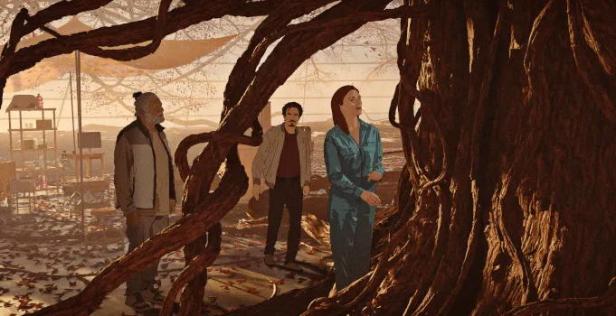
I found the film to be very impressive, especially the first half before we got into the race against time to get Nora’s surgery. But wait, what if she doesn’t want it? There is, as some reviewers note, a discourse about selflessness and selfishness. The last section does, I think, become more generic and moves into something akin to Forbidden Planet (US 1956) territory with an old man who has escaped an implant and might carry out the surgery. On the other hand the ‘tree-hybrid’ idea is quite well thought through and I found the ending of the film to be quite satisfying.
I think that an animation of this quality ought to do well on release, but the subtitles might be a problem. Foreign language animation is routinely dubbed in the UK, as in many/most European countries. This seems to a product of the view that animation is for children. I don’t think White Plastic Sky is aimed at children, but I wouldn’t want to put them off. Insensitive dubbing could ruin the film, however. If this does get a release subtitled in cinemas or even on a streamer, I recommend it. Thanks to the Leeds International Film Festival for the opportunity to see it.

