
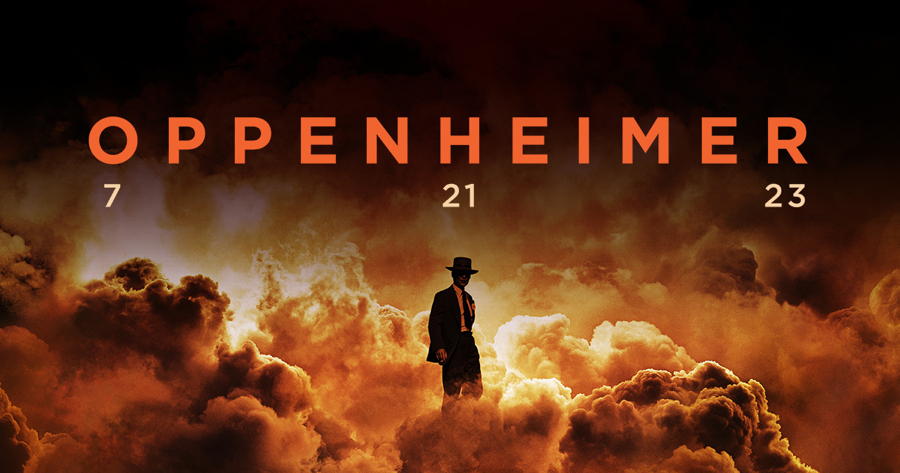
So, finally to Oppenheimer in 70mm splendour. A couple of weeks ago I discussed the two Oppenheimer narratives currently on BBC iPlayer. I then had to wait to see Christopher Nolan’s version of the story. Before I entered the cinema I was still unsure what I would see – why did it cost an estimated $100million to produce and why did it need IMAX and various other technological devices? I guessed we would at least see the Trinity test detonation in July 1945, but what else? There are plenty of bangs and whistles but the dialogue exchanges are more interesting, I think.

I should confess that I’m not a Christopher Nolan fan and I’ve only seen two or three of his earlier films. It didn’t take long before I recognised similar flaws to those I found in Dunkirk. I hesitate over the use of the term ‘flaws’ but I think Nolan over-extends himself with the complexity of his storytelling. He appears beholden to that advice so often given to filmmakers to ‘show and not tell’. When you take a major historical event with a large cast and very complex relationships between important individuals, it does demand a lot to tell a coherent story without the use of captions or expositions. Nolan appears to have opted for an approach in which he wants us to understand the kinds of things that go on in a top physicist’s head when he thinks about quantum mechanics, so we have images of the night skies and we have explosions of light and so on. We also have a storytelling approach which switches between the 1930s, the 1940s and the 1950s with most sequences in colour, but some in black and white. I couldn’t always follow the logic of these temporal dislocations – i.e. sometimes the black and white images referred to ‘older’ scenes, but not always. The cutting was sometimes too quick for me and I struggled with the narrative flow – and this despite the fact that I’d seen two versions of the same story events only a short time before.

I will say that 180 minutes flew past and I never felt the story dragged, so it worked in that sense. I will also say that the large cast was very good. But, of course, I was always comparing Nolan’s take with those of the other two films and I was also comparing actors and casting decisions. I don’t really want to compare the three films directly since they are each very different but there are a few interesting points. Presumably, as a big Hollywood production, the studio wanted to downplay Oppenheimer’s smoking. By all accounts he smoked incessantly. It is there in Nolan’s film but not foregrounded in the way it is in the BBC/PBS docudrama. Of the major roles in the film, I thought General Groves (Matt Damon) was underwritten and I missed his long exchanges with Oppenheimer that featured in the BBC serial. But perhaps Nolan’s biggest change was in the presentation of Admiral Lewis Strauss. Nolan presents Strauss (pronounced ‘Straws’ in the Southern manner apparently) in such a way that we cannot tell if he is a ‘good guy’ or a ‘bad guy’ in relation to Oppenheimer’s status – until the ‘real’ Strauss is finally revealed.
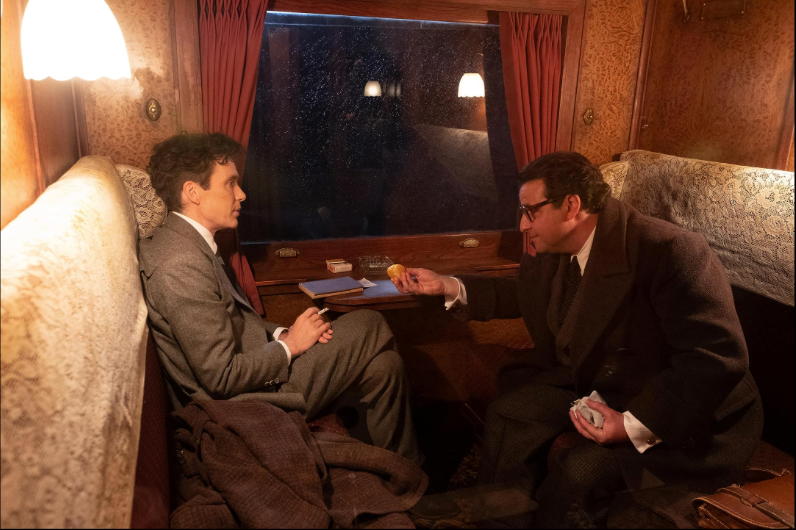
Overall I think Nolan focuses on aspects of Oppenheimer’s personality more than on the story of the Manhattan Project. That’s fair enough given the film’s title, but I’m not sure what it is that we learn. On the other hand, I feel that, as with Dunkirk, younger audiences will not necessarily know the history and may not understand the importance of many of the dialogue exchanges. I’m intrigued, as I was with Dunkirk, as to Nolan’s sense of whether his US-UK production is more American than British. Oppenheimer was American but the history of nuclear research here is more nuanced. Many of the scientists are European. The Manhattan Project was actually an American-British-Canadian venture with the British-Canadian research ahead of the American before American money and resources took over. I think there might have been one mention of Montreal but otherwise nothing Canadian. The Brits are mainly represented by the spy Klaus Fuchs (I remember as a child getting confused between Klaus Fuchs and Vivian Fuchs, the British scientist and Antarctic explorer). But while the British scientific work is under-represented in the film, Nolan has cast several British actors in Hollywood in some of the main American roles in the story. It struck me that if this film had been made in the 1960s, we might have seen more European actors in significant roles (i.e. as the scientists).

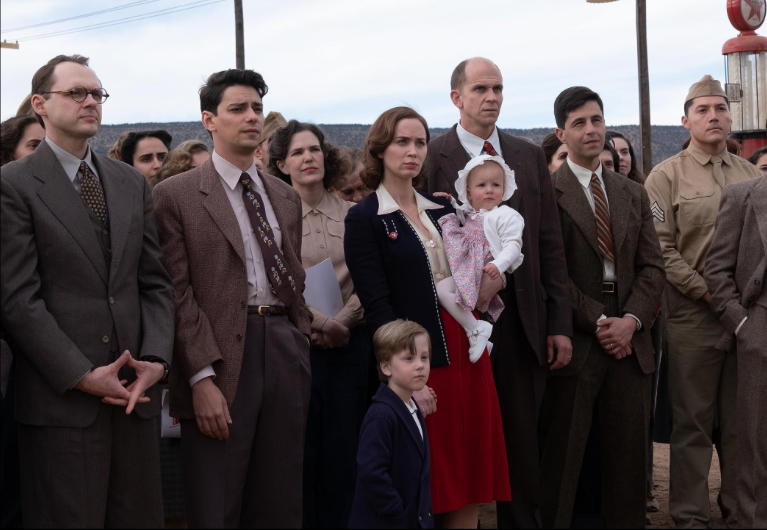
There are several other issues that the film raises. One concerns the relatively few roles for women in the story. Nolan has less time available to explore Oppenheimer’s relationships with Jean and Kitty than the BBC serial had and they felt more peripheral here. I don’t know enough about the other scientists at Los Alamos, but given the history of academically gifted and brilliant women who achieved so much in other aspects of the Allied war effort I’d be surprised if there weren’t some stories about nuclear research that have been marginalised. In the same way, Oppenheimer’s Jewish identity and his commitment to fighting the Nazis is an important feature but is not perhaps explored as much as it might be. Many of his fellow scientists are also Jewish and the Jewish anti-fascist struggle also permeates the American Communist Party. I think another issue is the film’s approach to what happened in Hiroshima and Nagasaki when the bombs were dropped. Oppenheimer’s concerns seem to be treated with some contempt by various figures and I found the script confusing on this point.
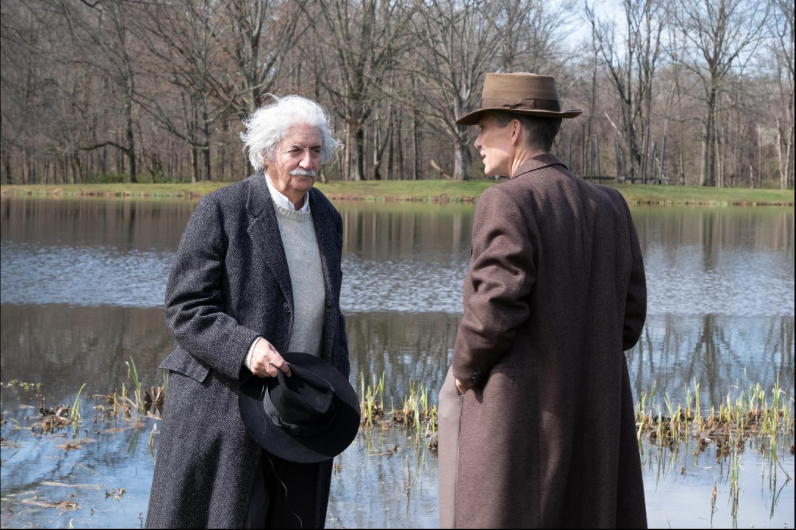
If you don’t know the Oppenheimer story, it’s a story in three parts. Oppenheimer’s early academic career from the late 1920s and into his years at Berkeley is the first part, his leadership of the Manhattan Project during the war is the central part. His attempt to prevent nuclear proliferation in the early 1950s prompted the hearings which eventually led to the removal of his security clearance and the end of his quasi-governmental role re nuclear weaponry. Nolan makes use of two important characters in this third stage of Oppenheimer’s career. One is William L. Borden who becomes the agent of Oppenheimer’s fall when he claims that the scientist has in effect been responsible for security leaks. David L. Hill, by contrast was one of the leading scientists who supported Oppenheimer and in the film performs a role which I won’t describe because Nolan uses his actions in presenting a narrative ‘twist’. Neither of these two characters appeared in the earlier films I saw (or at least I don’t remember them), so I’m grateful for discovering their roles in the story.

Nolan doesn’t seem to have much interest in the US Communist Party in the 1930s. Personally, I would like to know more about this and it’s one of the big differences between Nolan’s film and the BBC serial – which of course has more than six hours running time so can afford to give it more time. Oppenheimer was certainly a complex figure and sometimes his own worst enemy, but he was badly treated by the US state during the worst periods of the anti-communist witch hunts in the late 1940s and early 1950s.
I’ve saved my strongest criticism of the film to the end. After about 10-15 minutes of the film I said to myself: “This the worst music score and sound design I’ve ever experienced in a major screening”. I have every faith in the projectionists at the National Media Museum’s Pictureville cinema so I can only blame Nolan and his music composer Ludwig Göransson for the incessant pounding score and the sound mix that made it difficult to focus on the dialogue. My viewing companion had exactly the same reaction. Göransson has amassed many awards and I note that I enjoyed his score for Creed (2015), but I thought the music for Oppenheimer was awful.
Christopher Nolan is clearly a talented filmmaker but I do wonder if he needs a bit more self-restraint enabling him to take more control over his narratives. Oppenheimer has been a major box office success with claims that it has restored a sense of serious grown-up cinema in a Hollywood production ecology far too wrapped up in super-hero franchises and re-boots. I’m not sure about that but any shift in that direction is welcome. I think anyone interested in American politics and society should watch the film and also seek out the two iPlayer narratives. The story of Oppenheimer and of the Manhattan project is important. Nolan’s version of the stories is a starter for a popular audience but there is a great deal more to discover.
One last moan. Films as long as this used to have a carefully structured ‘Intermission’. It’s time the practice was revived.
This trailer promotes Nolan’s approach fairly accurately, I think.
 itp Global Film
I have not seen the Oppenheimer documentaries, though I do plan to watch them. Some of Roy’s criticisms are valid but I do not share his general problem with Nolan as a film-maker. I always find his films fascinating and it is a reel treat to see visual imagery of this quality at a cinema.
And, at least in the mainstream English language cinemas, there is a lack of really adventurous film-makers.
Whatever the limitations of the film I really enjoyed it and I did not feel that it was over-long; and I managed without an intermission.
LikeLike
Interesting to compare this to the BBC serial, which I have fond memories of and will return to. But I do want to support your cry for the return of the intermission; 180 minute films do need one!
LikeLike
Perhaps Oppenheimer is a metaphor for Nolan’s public renown which has burgeoned to such an excess that it is overwhelming. About ten years ago I had a big birthday and went to Orlando where I caught ‘Interstellar’ on an IMAX screen. It was a ‘Tideland’ moment for me, so-called after the Terry Gilliam film I walked out of and vowed to watch no more of his oeuvre. Several directors have had the same effect on me and, sadly, on their once avid public following, such as Ken Russell and Nic Roeg. Did it need to be IMAX ? Did it need to be three hours duration ? Maybe only because that is what the director’s reputation currently demands. I haven’t seen Oppenheimer, and may yet do so, but I have to say I would go into it more than half expecting to be disappointed.
LikeLike
How odd. As well as Nolan I am a fan of Terry Gilliam and Ken Russell, especially the latter. I find Roeg variable.
As for ‘Oppenheimer’, I have watched average length movies that seemed longer. And I was fortunate enough to see ‘Dunkirk’ on reel IMAX, 70mm, great.
LikeLike