
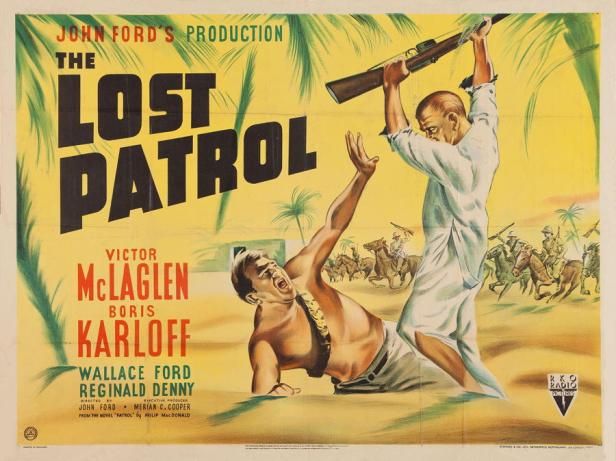
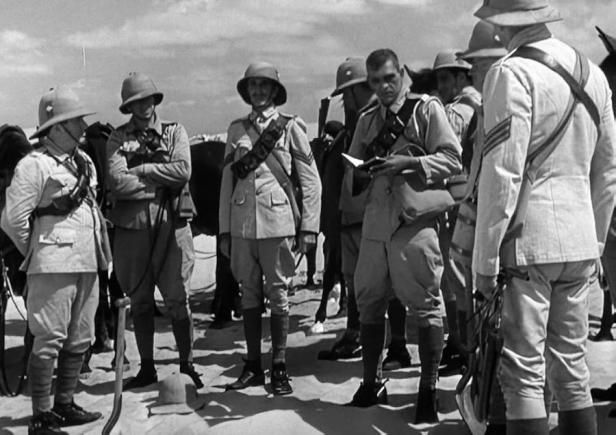
In 1934 John Ford made The Lost Patrol for RKO. The film was a remake of a British picture from 1929 which was in turn an adaptation of a 1927 novel, Patrol by Philip MacDonald. The same original property was then partially used in three further productions. MacDonald had served in the British Army in Mesopotamia in the First World War (he must have been 17 or 18). The narrative is set in Mesopotamia (present day Iraq) and the focus is a British Army cavalry patrol which is ‘lost’ because its young officer is shot by a sniper in the desert and because he has not passed any information to his sergeant, the group as a whole don’t know where they are or what their objective is. The sergeant (Victor McLaglen) attempts to keep the men safe but gradually they are picked off by the unseen enemy. The sergeant believes them to be ‘stinking Arabs’, one of several phrases that mark both the period of the story and the time of its production. I assume that the Arabs could be rebels resisting the British mandate after 1920 but they could be Arabs who sided with the Turks in the 1914-18 conflict. This doesn’t seem to concern Ford or the American critics much. The American Ford scholar Tag Gallaher refers to the soldiers as in effect ‘ours’ (he uses ‘we’ when he identifies with the soldiers).
The novel was adapted by Dudley Nichols, whose long association with Ford started with his first screenplay for Men Without Women (US 1930), running through a further ten titles and ending with The Fugitive (US-Mexico) in 1947. Nichols often seemed to work on ostensibly ‘action’ narratives that often found a handful of divergent characters learning about each other as they battled an unseen enemy outside their circle. This is certainly true of The Lost Patrol in which the Arabs aren’t clearly visible until the end of the narrative, but who prove adept at shooting the soldiers with eventually fatal results. Nichols is said to have removed the Hindustani slang used by British troops in Iraq, although mentions of fighting in India remain. In fact the majority of British Empire forces in Mesopotamia in the First World War were Indians and there were also Australians. There is no mention in the film of the real enemy, The Turkish troops often with senior German officers (see our posting on The Lighthorsemen (Australia-US 1987) for more on the British Empire campaign against the Ottoman Empire). The British aircraft that appears in the film is a single-seat fighter with a top-wing-mounted Lewis machine gun which seems a little unlikely as the main British use of aircraft in the campaign was for reconnaissance and bombing. Overall I’m not sure this American film convinces as a representation of British action in the First World War but in general terms it works very well.
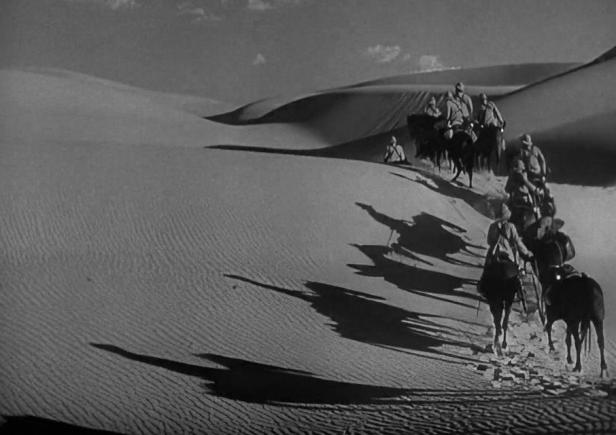
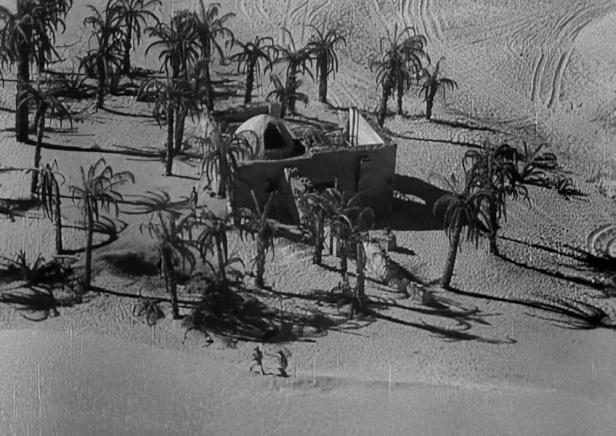
The production is interesting in that at this point Ford was carefully playing Fox against the larger major and independents with short-term contracts and clauses that allowed him to work for other studios. A year or so later Fox would ‘merge’ with 20th Century to create the fifth major studio and Ford would enter into a long relationship with the new company but on The Lost Patrol he was able to exert a fair degree of independence. As the poster above announces, this was a ‘John Ford production’ with the studio executive who might rein him back kept firmly in the background. But this was also the shoot on which Ford met Merian C. Cooper recently appointed at RKO and with whom Ford would later form Argosy Pictures. Cooper was the joint director of King Kong in 1933 and with his partner Ernest Schoedsack he had made the documentary Grass in 1925 filmed in Persia and had produced fiction films on location in wild places.Ford too had plenty of location experience and The Lost Patrol was shot largely in the Algodones Dunes which at that time ran continuously from South Eastern California and through Arizona and into Mexico. An oasis with a building and artificial palm trees was built for the shoot. Ford always worked closely with cinematographers. This film was shot by Harold Wenstrom. I’m not sure he had worked before with Ford but his experience with the US Navy’s photographic division in the First World War and his subsequent work on Hollywood features probably impressed Ford. His work on the film is very good. Two other significant names on the credits list are the music composer Max Steiner and art director Van Nest Polglase. These two were still early in their careers but they would go on to become legendary in Hollywood at RKO and their presence was one of the bonuses for Ford.
During this period Victor McLaglen was very important for Ford. On this film he became top-billed only after the withdrawal of the studio’s first choice Richard Dix but McLaglen had already starred for Ford in the lead for The Black Watch in 1929. In all, McLaglen appeared in twelve films for Ford including The Informer (1935) for which both he and Ford were awarded Oscars. In his later years he was a supporting player opposite John Wayne in Ford’s US Cavalry trilogy and The Quiet Man in 1962. McLaglen was not a ‘handsome leading man’. He was well-built, a one time heavyweight boxer.Two odd coincidences were that his brother Cyril played the Sergeant in the 1929 British version of the story and that, in the First World War, Victor had been a soldier in Mesopotamia rising to the rank of assistant provost marshal. Perhaps because of The Informer and his closeness to Ford, McLaglen was often thought of as Irish. In fact he was English, born in the East End of London into a family with Scottish and South African roots.
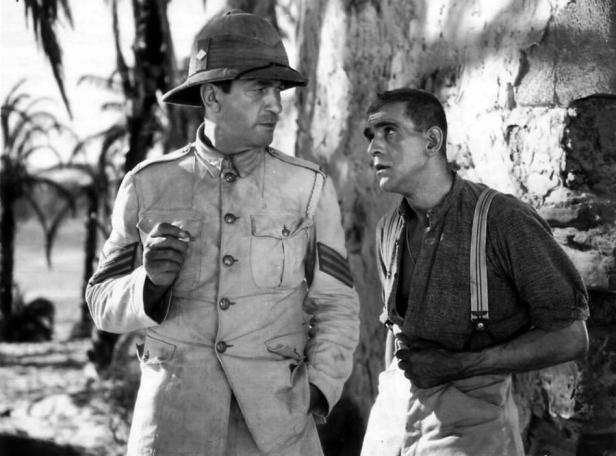
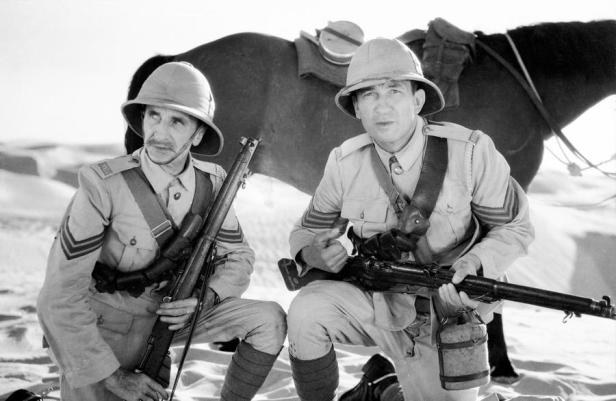
The film is relatively short at 69 minutes on the PAL DVD I watched. IMDb quotes 73 mins for the original US film release. The narrative is straightforward in the sense that the patrol finds an oasis but then has its horses stolen overnight as the enemy picks off guards. Apart from the brief moments of fighting, the main interest is in the dialogue between the survivors. This was Nichols’ speciality. Ford was able to recruit supporting players who were mainly drawn from the British (and Empire) community in Hollywood. These included the three actors on the credits alongside McLaglen. Boris Karloff plays a shaven-headed Sanders whose response to danger is to resort to his Bible and to warn the others about their loose morals. He is also seemingly the medical orderly. He is a striking presence, already well-known for his roles in Frankenstein (1931) and The Mummy (1932) for Universal. Wallace Stevens plays Morelli, a stage performer entertaining his fellows with stories of his music hall shows and Reginald Denny is Brown, a handsome hunk boasting of his amorous activities in Malaya and Java. There is also an Irishman named Quincannon (the name of the Victor McLaglen character in Ford’s She Wore a Yellow Ribbon, US 1949 and Rio Grande 1950), a Scotsman, a young boy etc. Nichols’ dialogue exchanges point towards later Ford films.
The Lost Patrol received generally good reviews and despite some negative takes it was a hit. I researched parts of the production process using Lea Jacob’s book John Ford at Work: Production Histories 1927-1939 (John Libbey Publishing 2005). I’ll be making more use of this excellent book in future posts. I noted that in the midst of all his negotiating with different studios in this period, Ford accepted a deal at RKO to forego a fee in exchange for a share of the profits and that he was well rewarded in this case. There doesn’t seem to be an original trailer for the film available so I’m going with this modern trailer designed to look like an RKO trailer from the 1930s. Notice, however, that the desert is unfortunately named as ‘the Sahara’:

