
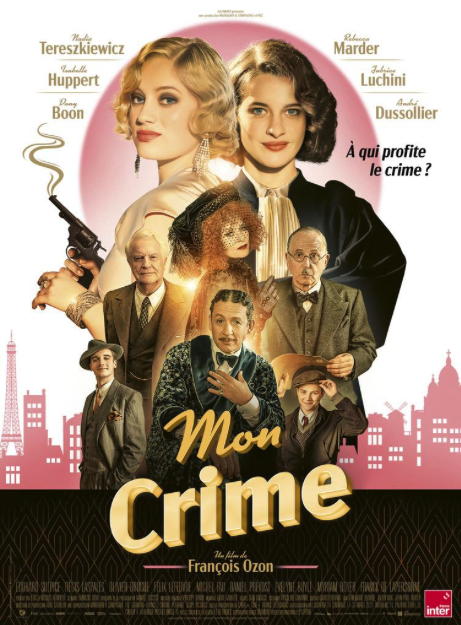
François Ozon is one of the most prolific directors in contemporary French film. He also arguably has more fun than most with the projects he chooses, switching happily between comedies and melodramas on the one hand and more ‘serious’ dramas on the other. He therefore runs the risk of being undervalued by some reviewers and critics, although some of his supposedly ‘lighter’ pieces have actually scored highly on IMDb or Rotten Tomatoes and other similar ratings sites. Mon crime is very much a comedy. I found it delightful and very entertaining. The subject matter might perhaps appear inappropriate to some but I think Ozon and his cast and crew carry it off with aplomb.

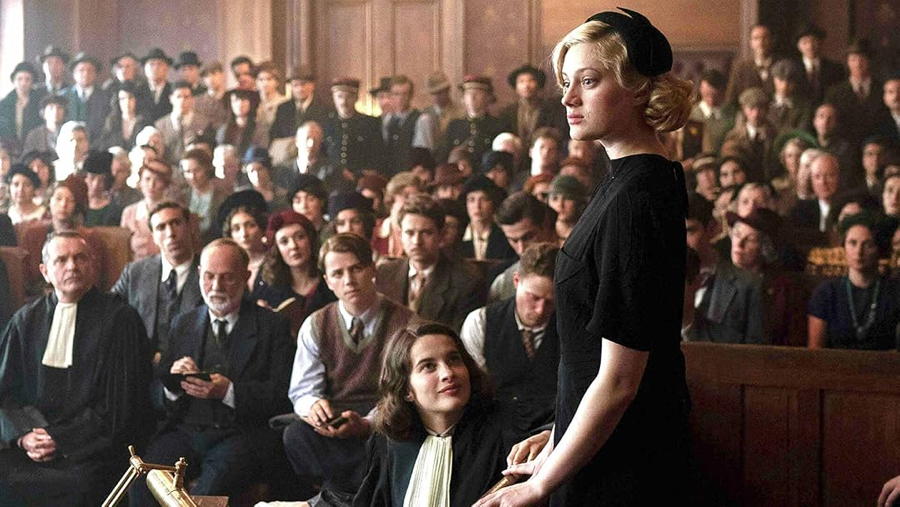
As some reviewers have pointed out, the contemporary world is beginning to resemble the 1930s with an obsessive interest in celebrity and a celebration of the arts but in the background the growing resurgence of fascism in many countries. The difference, it is argued, is that the position of women in society has generally changed for the better and the #MeToo movement has emerged to fight the sexual abuse of young female players, especially in film production. The source material for Ozon in this case is a 1934 play by Louis Verneuil and Georges Berr that was re-worked into two Hollywood films of the studio era, True Confession (1937 with Carole Lombard and Fred MacMurray) and Cross My Heart (1946 with Betty Hutton). Ozon sets the narrative back in 1934 and presents a beautifully realised period piece with great costumes, cars and architecture. It’s stunning to look at in ‘Scope and the cast is very strong with Fabrice Luchini (an Ozon comedy regular), Dany Boon and André Dussollier in supporting roles. In this sense he draws on the French élan as applied to costume or ‘heritage’ pictures. For many reviewers, Isabelle Huppert, who appears in the second half of the film, steals the show. Of course, it’s always good to see Ms Huppert and she’s terrific as the star of silent cinema known to all the men of a certain age. But she shouldn’t distract us from the two leads played by Nadia Tereszkiewicz and Rebecca Marder who get the narrative underway and sustain it with style.

The idea behind the original play is that the position of women in French society in the 1930s is such that court cases involving attractive young women can produce unusual results as decided by juries and judges, all of whom are men. Madeleine (Tereszkiewicz) is a young penniless actress who goes to an audition at a grand house to see a great producer but emerges a few minutes later having been sexually assaulted. She returns to her rooms after a long walk to gather her thoughts and is met by her room-mate Pauline (Marder), a young lawyer also unemployed. A little while later they are surprised by a police detective who announces that the producer has been killed by a gunshot and Madeleine is soon the prime suspect. Fabrice Luchini plays the hopeless investigating judge brilliantly. Madeleine and Pauline then concoct a plan to use the accusation to create a sensational trial in which Pauline will present the actress as a woman defending her honour against a powerful man bent on sexual conquest by force. In the best traditions of French farce, there must be a sub-plot in which Madeleine is pursued by a rather silly young man who is heir to a tyre company fortune. He hopes to convince Madeleine to become his mistress when he marries for money to help the firm. But the big question is, of course, who actually murdered the producer? It’s not difficult to work out from the cast list.
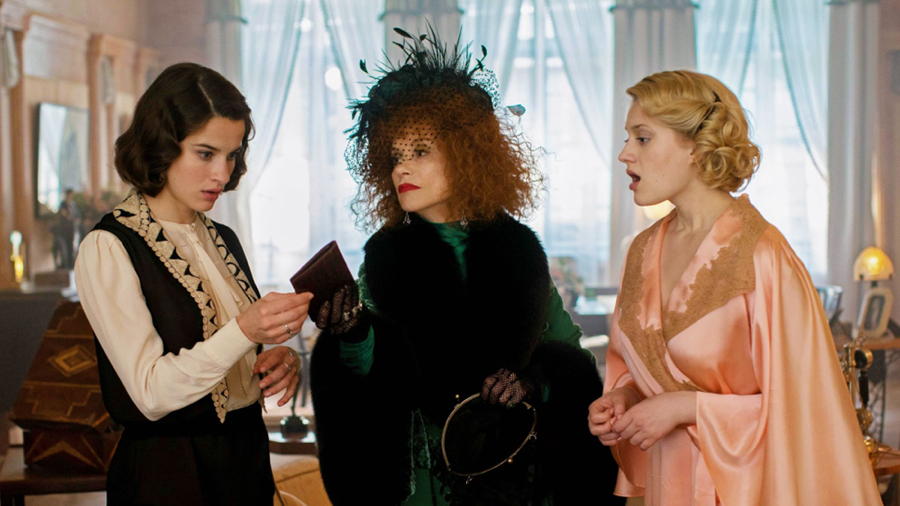
I’m not going to spoil the pleasure of the narrative, even if it is a little predictable. It’s still wittily scripted and delivered with panache. The script includes references to the problems of left political parties in France which would be temporarily solved by the Popular Front in 1936 and the fears about Hitler in Germany. In terms of cinema history, this was the time when many of the directors who had fled Germany in 1933 were working in France and when Madeleine and Pauline go to the cinema it is to see the Billy Wilder-directed Mauvaise graine (Bad Seed 1934) starring Danielle Darrieux. Ms Darrieux also provides two songs for the soundtrack. The film won’t be for everybody but I recommend it. If you know Ozon, there are some subtle touches but it remains an all-out comedy triumph. It may be the 1930s with its sexism but his female leads power through to a satisfying conclusion. I watched the film on BFI Player but it is widely available on all the usual streamers.

