“Our mission is to develop an open, challenging and thriving film sector. We are the UK’s national body in support of independent cinemas, film festivals and exhibitors of all forms. We want everyone to have access to cinema that nourishes the soul and changes lives. “
Among their regular events are screening days and weekends that assist exhibitors in accession and evaluating film and digital titles for their programmes. A few years back I attended one such weekend at the Tyneside multi-screen venue in Newcastle-upon-Tyne. It was a very full weekend with a varied selection of films and a lot of supporting events materials.
The ICO screenings include Archive events for titles from earlier periods, both from Britain and from further afield. Their recent screening day was held at Leeds Hyde Park Picture House, together with a virtual online event; the latter on Tuesday January 27th with the in-person event on Thursday January 29th.
I went along to the in-person day and I have viewed recordings of the virtual events made available to participants. Both were full of interest and included actual titles and supporting materials. The breaks were as important as the sessions as people meeyt, chat, and exchange ideas and experiences.
The day at the Picture House started at 1030 [after registration]. We had an introduction and then a talk by our host, Wendy Cook, head of the Picture House. She had, at an earlier screening event, presented the Picture House’s successful development of the venue with support from the Heritage Lottery Fund. This included a second screen, used on the day, and a remodelled main auditorium with both 35mm projectors and a laser digital projector. This morning she talked about the history of the Picture House, which dates back to 1914. During the development the staff had uncovered a lot of memorabilia lodged in odd places in the venue and also researched further the history of the Picture House. Some of this is on the Hyde Park Picture House web pages, and some is also on the blog of the Friends of the Hyde Park Picture House.
The first event in the second screen was a digital transfer of a Czech title, Murdering Mr Devil / Vražda ing. Čerta (1970), the only film directed by Ester Krumbachová, who also worked as script writer, art designer and costume designer. She worked as a costume designer, production designer and writer in the Czech industry during and after the New Wave. This film was a satire shot in colour and academy running 82 minutes minutes with English subtitles. The title is distributed by the Czech Film Archive.
Kate (Jiřina Bohdalová) is putting the finishing touches to a sumptuous dinner for her beau, Mr Devil. But he is a dyspeptic sort, apt to run away when Kate expresses her own needs and forcing her to make ever grander meals to fulfil his culinary whims. As the parable plays out, we see Kate’s skill and creativity, but also her patience wear thin, as she designs a final meal that’ll leave him fit to burst . . .
The title was fairly sardonic and followed a pretty unconventional form. One could see that it was a mainly solo and independent production. It was not as avant garde as the films of Věra Chytilová, with whom Krumbachová had worked. Krumbachová herself worked on in the industry though she was not able to direct another film. And she was banned in the 1980s for her involvement in a controversial film critical of the authorities.
How to Frame Archival Genre and Exploitation Films
Erin Wiegand, Film Programmer & Scholar; Sean Welsh, Matchbox Cine; Lee Bentham, What the Film Club; chaired by Duncan Carson, ICO
When we show archival and repertory films, we provide context for audiences. But when it comes to genre and exploitation films – including horror, science fiction, action, and low-budget ‘trash’ – it can be especially difficult to figure out how to position them in a way that is both enticing and ethical. Are they just amusingly ‘bad’ movies, or is there something more to them that we can bring out through the curatorial process? How do we address problematic aspects of representation that may be present, such as racial stereotypes, homophobia, and sexism? Moreover, accessing and screening archival exploitation films may pose particular problems due to unavailability or poor print or scan quality – given that they have historically not been thought valuable enough to preserve in national film archives – as well as tricky issues around certification and the absence of theatrical rights holders. In this session, film programmer Erin Wiegand will be in discussion with independent curators who are grappling with these issues and providing incredible experiences for audiences.
The Panel members presented four case studies illustrating how the had programmed these type of films, either as single screenings or part of a series. There was Ed Wood Jnr’s trans movie Glen or Glenda (1953): a series of ‘trash’ movies: two Welsh horror movies: and part of a US Erotic Film Festival. The general emphasis was on ‘fun for the audience’ but still allowing the films a status. There was quite an amount of emphasis on clearing copy right. Two sources that got several mentions were the online American Film Genre Archive and Arrow Films. There were a number of questions / comments from the audience, primarily directed the rights issues.
Film is the New Vinyl
Robin Baker, former Head Curator, BFI National Archive; Chaired by Catharine Des Forges, ICO
First there was the vinyl revival. Now it’s the turn of film – real film with sprocket holes. Audiences love it, with venues reporting a c.25% uplift to box office when they project film on film. Robin Baker, programme director of the 2023 BFI Film on Film Festival, will discuss the opportunities and challenges of screening film on film whether in a cinema or a community venue. He will also offer insights into how you can engage audiences – from creating ‘event’ cinema to maximising engagement through social media – by exploring successful examples from across the UK.”
Robin Baker started by talking about the ‘vinyl come back’. In the USA in 2023 40% of physical albums sold were vinyl; and 8% from all music revenues came from vinyl. He had not found equivalent figures for Britain but clearly there was similar uplift here. Listeners liked both the audio quality, the ambience and the physicality of vinyl.
However, vinyl is a domestic format whereas film [on 35mm or 16mm] mostly requires venues. Even so, as noted above, there has been a comeback for ‘analogue film’. He noted that there were between 74 and 87 venues in Britain with 35mm projection, out of a total of approximately 1087 venues: 27 of these were in London and only one in Wales. He specifically mentioned the Sindon Cinema in West Sussex which only screens from 35mm prints. Not all of these venues have working projectors or trained projectionists. [See a listing of venues internationally with 35mm].
Note, in Leeds the Picture House has two working 35mm projectors, though they have been having difficulties in accessing spares. Also in Leeds the Cottage Road cinema has a single 35mm projector. The Media Museum in Bradford has both 35mm [in two auditorium] and 70mm projection. The Parkway Cinema in Barnsley has both 70mm and twin 35mm projectors. All these venues have trained and skilled projectionists. The Showroom in Sheffield has 35mm projectors but at least one is in need of repairs. The nearby Abbeydale Cinema has 35mm but is having problems with the owners of the building. And in York the City Screen has both 35mm and 70mm projection, but the projectors are all in need of repair. Hebden Bridge Picture House still has a single 35mm projector but there does not seem to have been any screenings of the format since the senior projectionists died a couple of years ago. And the Projected Picture Trust in Halifax has an archive of equipment including a range of projectors; they do occasionally organise screenings with local organisations in Yorkshire and Lancashire. They were also involved in the 35mm sequences in the British film Empire of Light (2023).
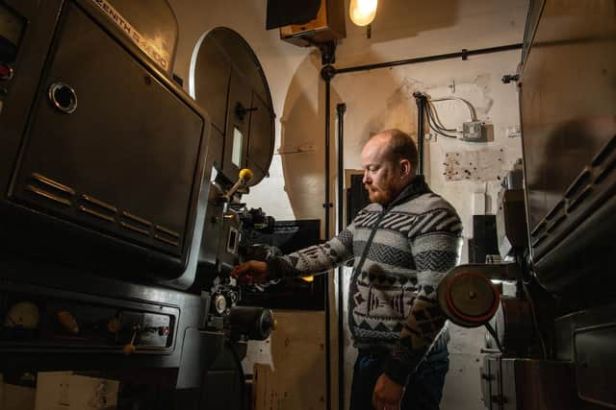
Mike and the 35mm projectors
Robin continued by presenting some of the experiences and findings of the BFI ‘Film on Film’ Festival in 2023. He gave examples of some of the methods of presentations. Over three days the single venue had 8,000 admissions with 40% of the audience under 34. There was a lot of evidence that there was a strong interest in actual film print screenings among young age groups.
He talked about the differences between digital formats and celluloid film; neither being necessarily superior but both have distinctive characteristics. Digital was brighter, with more vibrant colours. Note, the Picture House has laser digital projector which is even brighter and with an larger colour spectrum and sharper contrast. He noted that titles shot on analogue film and transferred to digital frequently show detail not apparent with analogue projection. Film prints are softer, richer and more nuanced and they have grain. Prints also change over their shelf life, [including scratches and wear and tear] whereas Digital Cinema Packages tend to look the same time after time. He mentioned The Afterlight (2021) which is a single print film gradually wearing out as it is screened time after time.
He also talked about projectionists. This was skilled profession, [see the Projection Guide from George Eastman]. But they have been downsized in the change over to digital. He recommended drawing attention of the audience to the projectionists.
Note, both the George Eastman Nitrate Festival and the Silent Programmes at Il Cinema Ritrovato encourage audiences to recognise and acknowledge projection. Reel Stories: An Oral History of London’s Projectionists (2022) is a documentary which has working projectionists [between the 1950s and early 2000s] talking about their work and experiences; it turns up on Talking Pictures (Freeview 82).
Robin talked about accessing prints. The largest holding is the National Film Archive and there is the BFI Collections which lists all the titles and in many cases offers a print description. He recommended looking beyond the well known titles and gave examples of lesser known films where the quality of the print was exceptional, one example being Broadway Rhythm (1944) which was an original Technicolor dye print. There are both distribution prints, available generally to exhibitors, and archive prints which are only loaned out to cinemas whose equipment and projection have been vetted. 35mm prints could be expensive since there was the added cost of transport.
Note, The BFI have been known to send out the older rather than the best available print. In 2017, as part of the celebrations of The Great October Revolution, two prints seen in Yorkshire were Battleship Potemkin / Bronenosets Potyomkin (1925) and The End of St. Petersburg / Konets Sankt-Peterburga (1927). In both cases what we saw were 1970 prints which had had music sound tracks added. This meant that the prints had been step-printed and the image frame cropped to accommodate the sound track.
Robin also talked a little about 16mm, 9.5 mm, 8mm and Super 8mm. He did not though really talk about 70mm and or analogue IMAX.
There were a number of questions after the talk. One person raised the ‘dwindling stock of film prints’. Robin noted that the BFI furnished both new prints and restoration every year and that currently they were creating 100 new prints of classic films with Lottery funding.
Training for projectionists came up, though this did not really exist at present. And there was an issue about equipment. A register was one suggestion. Other audience members gave examples of issues and experiences in this field.
Robin’s final point was that networks of exhibitors could band together and bring pressure to bear on particular issues, like training. Catherine Des Forges added that the ICO was working on research for presentations in the area to the BFI.
100 Years of 16mm – Still the Most Accessible Film Format?
Louise Conway, Artist Facilitator; Geoffrey M. Badger, LOST REELS; Will Rose, Pavilion; chaired by Becky Padley, ICO
2025 marks the start of the second century of 16mm in the UK. Designed to be accessible (“you press the button, we do the rest”) it is still in use today, both by film-makers and by exhibitors as a pull for audiences wanting to experience the joys of analogue film projection. Looking at case studies, facilitator Louise Conway will explore how 16mm and its ethos has survived 100 years of developments, and continues to democratise who can make, project, and exhibit film on film.”
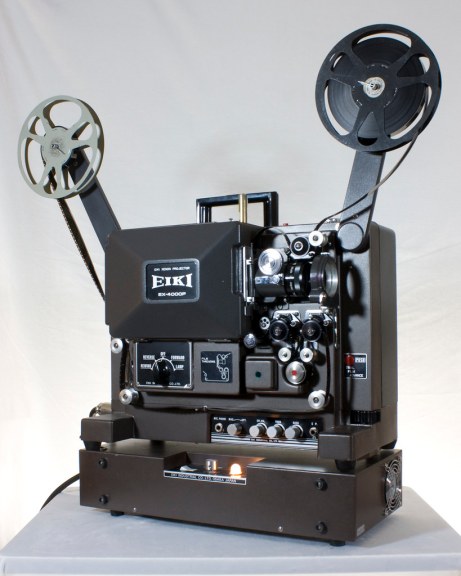
Louise started by giving a brief overview of 16mm format. It was developed just over a hundred year ago and became a popular amateur film gauge. It was available in black and white academy, a reel running about four minutes. Prints were reversal stock, which meant there was not the necessity for both negative and positive prints as will 35mm. It later adapted to sound and colour. Later it became a source for copies of commercial films for rental through the Kodascope Library. It also became a format for newsreel and location based filming: a format used by TV stations for copies of commercial films: and a distribution format for film societies, schools,museums and other community venues.
The industry support for film and equipment, [like 35mm] has diminished considerably. But there is an amount of equipment available second-hand; also film prints though their rights status can be ambiguous: the BFI collection still retains an amount of 16mm prints. She added that were were often cases where the only surviving copy of a film was on 16mm
The two panel members gave examples of using 16mm for exhibition. Geoffrey had developed programmes, most often based at the Cinema Museum in London, which has the proper equipment, screening facilities and 16mm prints. Will, based in Leeds, had worked with community venues like the Picture House in exhibiting artist/experimental film on 16mm. He noted that access to such material is often prohibitively expensive.
There were a variety of questions from the audience on issues around using 16mm prints. It was pointed out that the BFI Collections did not allow searches under 16mm to scan titles. Will suggested that copies of old Distribution Catalogues could provide information possible prints.
On equipment he pointed out that 16mm, like 35mm, has a long shelf life. Both panellist agreed that image quality was generally good, [depending on the prints] but that sound could be an issue, usually mono and frequently low fidelity. They did not mention ‘vinegar syndrome’, which can affect acetate prints and needs to be considered by anyone buying and/or storing prints.
The issue of the environment was raised with the amount of plastic, gelatine and chemicals involved in 16 prints. It is a consideration but digital formats frequently involve plastic and nearly always involve large amounts of computer and internet usage which have a high energy component.
The issue of training came up. Will had some experience in this and he pointed out that projection was relatively straightforward, certainly less demanding than 35mm. A BFI representative made the point that they were becoming stricter in checking would be exhibitors of 16mm prints, since many of the prints were not replaceable. One person asked about ‘close captions’ on prints; Will thought this was unlikely but it was possible to provide these with a computer and second projector.
We were getting instantaneous translated titles on screen from a pair of translator provided by the ICO for each session.
Virtual:
How to Screen from the UK’s Hidden Moving Image Archives
Andy Robson, BFI Film Audience Network; Amanda Rogers, Cinetopia; Imruh Bakari, June
Givanni Pan African Film Archive; chaired by Becky Padley, ICO
Our histories are held in film archives and it only takes us to go digging and share them with audiences. But if you want to tell a broader range of stories, you may need to access archives off the beaten path. To highlight a brand new resource produced by Film Hub Northern Ireland and BFI FAN Screen Heritage Champion Andy Robson, we offer case studies of exhibitors who have worked with some of the UK’s best non-traditional archives and reached local audiences with stories that speak to their lives and histories.
Andy Robson explained about a research project into what he called ‘hidden archives’. He offered a set of categories for this; you can get a sense of the range and variety by downloading the Screen heritage resource guide at BFI FAN. He gave a range of such collections and what they offered. The results are to be published, hopefully, in March.
The we heard to case studies. Amanda from Cinetopia talked about her work in Scotland. The main part of this was a series of ‘screenings on buildings’ to mark 100 years from the city’s expansion in t 1920. The events were organised together with the city’s archives and in coordination with local communities.
Inruh Bakari talked about the June Givanni Pan-African Archive base din London. He related it to such development as events as Third Cinema: the British Workshop Movement: and the Black Film Bulletin, 1992 to 2000. The archive had a collection and also organised events and film clubs; both treating the British experience in relation to the wider world, especially Africa.
With questions the availability of formats was one issue raised; ranging from VHS, analogue and digital video to different film formats. And, once more, the issue of copyright was seen as ‘complex’.
Telling Authentic Disabled Histories On-screen
“Florence Grieve, Accessibility Advocate, Film Programmer & Writer; Alex Day, North West Film Archive; Storm Patterson, Festival Manager & Film Archive Consultant; Mathy Selvakumaran, Creative Producer & Disability Activist; chaired by Charlie Little, Matchbox Cine
Should we shun or showcase archive films that portray inauthentic, or even offensive, representations of disability? How can we build a canon of historical films about and by disabled people? How can curators and cinemas access the films and show them to audiences with appropriate accessibility materials? In this session, led by Film Programmer and Accessibility Advocate Florence Grieve, we’ll hear from speakers who have brought disabled stories from the past to contemporary audiences, offering insight and context in support of a future where disabled people’s stories are valued by all.”
The panel talked about their experiences in archival work, distributing and programming. Representation was a key issue as was the pitfalls of language. The film Freaks (1932) was one example mentioned. And the issue regarding access affected all of these. They gave examples of the inertia that often frustrated their efforts.
There was a question about championing disabled programmes to venues. The panel gave some examples of films that they recommended. Is There Anybody Out There? (2023): My Disability Roadmap (2022). How do archives involve disabled people in their work, which can include material likely to distress, i.e. safeguarding. ‘Reclamation of slurs’ was an issue about which there was an ongoing debate.
My Disability RoadmapScreenings:The Camel Revolts: The Films of the Sudanese Film Group
Distributor. Arsenal – Institut für Film und Videokunst. Sudan | 1964-1989 | 82 mins | Arabic
In the late 1970s and 1980s, a vanguard group of Sudanese film-makers founded a collective to steer their artistic endeavours, to give voice to the realities of living in Sudan riven by successive waves of political turmoil. Against this backdrop, the films manage to be reflective, experimental, amusing and speak to issues within Sudan and far beyond its borders. Before falling into abeyance following the 1989 coup and threats against cultural organisation, they produced a stunning collection of short films, some of them final film school projects produced in Soviet film schools that were then welcoming African film-makers.
As Sudan continues to suffer the world’s largest humanitarian crisis, this is an urgent time to consider the brilliant cinema of the country. These four films from group members Ibrahim Shaddad, Suliman Elnour and Eltayeb Mahdi – some of whom featured as subjects in the charming and thoughtful documentary Talking About Trees (2019) – capture the crest of a wave of film-making that was never allowed to break.
Africa, The Jungle, Drums and the Revolution
Director: Suliman Elnour | 1977 | 11 mins
Suliman Elnour’s film examines representations of Africa in Soviet society. Children’s drawings that deal with Africa, interviews with inhabitants of Moscow, and archival material depicting Africa from Soviet archives broach the issue of those representations and the stereotypes connected to them.
A Camel
Director: Imbrahim Shaddad | 1981 | 14 mins
A report from the life of a camel, most of which plays out in a dreary, small room: a sesame mill. Blindfolded, the camel runs in circles, driven to do so by it owner. For a short while it is allowed to relax in the courtyard – where it dreams a radical redress of the master-servant dynamic – before it reluctantly returns to its work in the dark room.
The Station
Director: Eltayeb Mahdi | 1989 | 16 mins
Sudan, in the late 1980s. People cross the desert on foot or cover long distances by car and truck. In The Station Eltayeb Mahdi shows encounters at one of the large crossroads between the capital Khartoum in the centre of the country and Bur Sudan in the Red Sea.
Hunting Party
Director: Imbrahim Shaddad | 1964 | 41 mins
Hunting Party is Ibrahim Shaddad’s graduation film. It uses the format of the Western, which he transposes into a German landscape – a forest in Brandenburg – for a transnational investigation of both the murderous violence of and everyday complicity in racism.
This set of films transferred to digital was screened at the Picture House on the Wednesday evening; a joint venture between the ICO and the Picture House.
Chameleon Street
Director. Wendell B. Harris, Jr. Distributor. Revenante Films. 1989 | USA | 94 mins | English | DS. Cast. Wendell B. Harris Jr, Timothy Alvaro, Dave Barber
One of the most singular independent films to emerge from the hotbed of 1990s Sundance, Wendell B. Harris Jr’s Chameleon Street defies categorisation but is undoubtedly a work of genius that begs to be seen more widely.
A modern trickster tale, based on extensive interviews Harris conducted with real life con artist William Douglas Street, Harris – playing the lead role himself – shows the wild lengths Street took to avoid the marginal life allotted to an African American man in 1980s America. Street conducted numerous surgeries while posing as a surgeon; inveigled his way into the circle of sports superstars by posing as a journalist, faking his way from job to job.
Scabrous and uncategorisable, Chameleon Street was awarded the Grand Jury Prize by Sundance in 1990 (in a jury led by Steven Soderbergh). Yet it languished with minimal distribution, held back by a remake deal (reportedly with Will Smith!) that never materialised. Luckily this new 4K restoration shows Harris’s subtlety and mastery for all to be beguiled by in this century.
This title treated the institutions exploited by Harris in a satirical manner but with what seemed exaggerated style. Whilst critical of the institutions the movie failed to critically examine the lead character and his exploits.
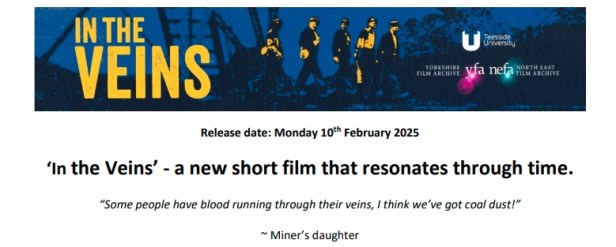
In the Veins
Director. Various. Distributor. Yorkshire & North East Film Archive. 2024 | UK | 24 mins | English | DS
A short film that resonates through time, In the Veins uses over a century of archive footage to shine a light on the mining heritage of Yorkshire and the North East of England.
A story of hardship and hope, division and defiance, perseverance and pride; this is not a history lesson, it’s an emotional journey that digs deep into the heart of a community built on coal.
From villages, towns and communities that grew from the industry, the bonds and friendships fostered, to the formation of activist groups such as ‘Women Against Pit Closures,’ In the Veins celebrates on the success and commiserates the demise of coal in the UK, four decades on from one of the longest industrial disputes of the 20th century.
This was a very effective compilations taken from several decades of archival material. It presented both the strikes to defend the miners as well as the State attacks on their organisation. Alongside this were the more personal records and other public events like the Durham gala. The documentary used both overlapping and asynchronous sound to good effect creating a powerful testimony.
Stella
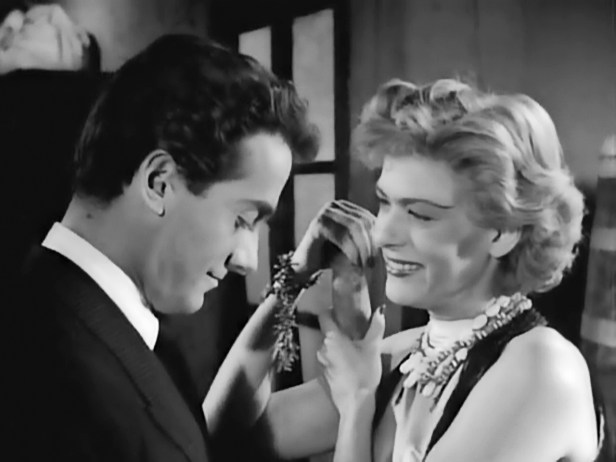
Director. Michael Cacoyannis. Distributor. Karagiannis–Karatzopoulos. 1955 | 100 mins | Greece | Greek | PG. 35mm black and white print in academy from the BFI National Film Archive with English sub-titles. Cast. Melina Mercouri, Giorgos Foundas
“Melina Mercouri blazes on the screen as a defiant singer in Cacoyannis’ ‘neo-realist’ melodrama, a reworking of Carmen set in post-war Athens.
Stella works at the Paradise Taverna where a notice advertises ‘Songs of Love, Life and Death’ – a promise of what lies ahead. She lives by her own rules, a fearless, sexual force of nature, flirting with customers and insisting that men ‘take me as I am’. But even when her head is turned by footballer Miltos (Foundas), Stella refuses to play by the rules.
A classic of Greek cinema, Cacoyannis’ film is hugely confident, with moments of brilliance in both camerawork and editing. It thrums to the sound of the bouzouki and the glorious songs of Manos Hatzidakis, but it’s Mercouri you remember most in a performance so wholly realised the screen appears barely able to contain it.”
The film is very well one and at the climax creates a distance reminiscence of a film-maker like Francesco Rosi. Only one song, sung by Mercouri, is translated in sub-titles but the ICO provided translations for the several other songs. Robin Baker explained that he had selected this film partly because the print, an original release one, was an example of a median quality print in the archive. Note, on its release in Britain in 1956 it was awarded an X Certificate, along way from the current PG.
Online:Badnam Basti
Director. Prem Kapoor. Distributor. Arsenal – Institut für Film und Videokunst. India | 1971 | 83 mins | Hindi. Cast. Nitin Sethi, Amar Kakkad, Nandita Thakur
Originally believed lost and only rediscovered in 2019 (by accident!) in the archive of Berlin’s Arsenal Institute for Film and Video Art, Prem Kapoor’s pioneering melodrama was India’s first queer film. A key work of the Indian New Wave, it recently screened in the Barbican’s ‘Rewriting the Rules: Pioneering Indian Cinema after 1970’ season curated by Omar Ahmed.
Adapted from a 1957 novel by Kamleshwar Prasad Saxena, Badnam Basti (‘neighbourhood of ill repute’) revolves around a complex love triangle between two men and a woman – truck driver and ex-bandit Sarnam (Nitin Sethi), Bansari (Nandiat Thakur), a beautiful woman Sarnam saved from assault, and Shivraj (Amar Kakkad), who works in a temple. Defying norms, the story subtly but daringly addresses the characters’ bisexuality, a progressive theme that had to be smuggled into the narrative to pass through the strict censorship laws of the time.
Emerging at a time of profound political turmoil and cultural change, Badnam Basti reflects a shift towards modernity in Indian cinema, and points to the iconoclasm of Parallel Cinema and its ground-breaking representations.
The film was produced in Uttar Pradesh and funded by the Film Finance Corporation; it uses the popular songs as in mainstream dramas. The gay aspect is implicit rather than explicit; and the Censorship Board required some aspects of the novel deleted. It was described as ‘no-realist’ but uses some of the techniques found in India’s alternative films, not always that effectively.
Phantom Beirut
Director. Ghassan Salhab. Distributor. Revenante Films. 1998 | 120 mins | Lebanon | English
At the end of 20 years of conflict, rumours spread across Beirut that Khalil (Auoni Kawas) has returned. A ghost, missing presumed dead ten years back, he was thought to have absconded with his troop’s cash box. Now we follow Khalil as he picks over the bones of a city full of contradictions, friends and enemies haunting him anew.
To tell the story of a nation at a crossroads, director Ghassan Salhab (in his feature debut) fittingly called on an array of genres and techniques. Ghost story, noir and war film all blend with documentary, as Salhab interviews the lead actors about their direct experience of the conflict that defined their lives. Poignantly relevant once again, this stunning new 2K restoration is a beguiling portrait of a city where anything can happen but the possibilities are tragically foreclosed.
The film has a challenging narrative and it is only gradually that the actor’s direct address to camera fit in with the narration of a sequence of events. And the title is ambiguous on the period and on the different forces in conflict here. The group at the centre are obviously left-wing and sympathetic to the Lebanese resistance to Zionist threats and attacks.
[Note; the notes for the session include the anachronistic ‘UK’ for Britain and ‘northern Ireland’ for the occupied part of the the republic of Ireland].

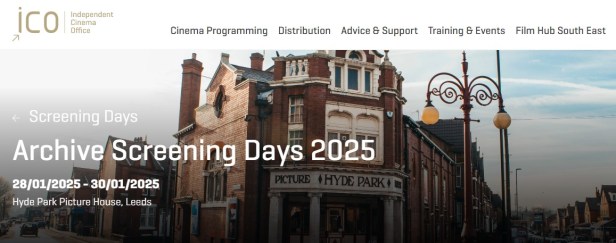 The Independent Cinema Office is a charity that supports independent exhibitors.
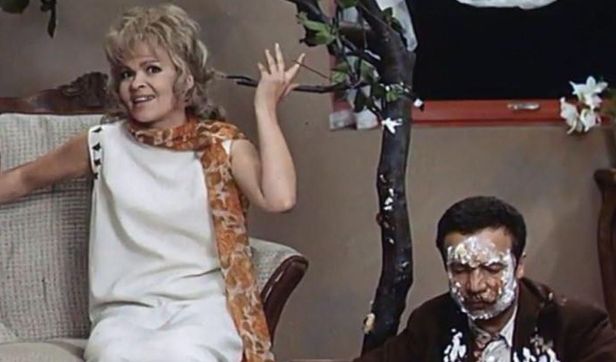 The first event in the second screen was a digital transfer of a Czech title, Murdering Mr Devil / Vražda ing. Čerta (1970), the only film directed by Ester Krumbachová, who also worked as script writer, art designer and costume designer. She worked as a costume designer, production designer and writer in the Czech industry during and after the New Wave. This film was a satire shot in colour and academy running 82 minutes minutes with English subtitles. The title is distributed by the Czech Film Archive.
 There were a variety of questions from the audience on issues around using 16mm prints. It was pointed out that the BFI Collections did not allow searches under 16mm to scan titles. Will suggested that copies of old Distribution Catalogues could provide information possible prints.
On equipment he pointed out that 16mm, like 35mm, has a long shelf life. Both panellist agreed that image quality was generally good, [depending on the prints] but that sound could be an issue, usually mono and frequently low fidelity. They did not mention ‘vinegar syndrome’, which can affect acetate prints and needs to be considered by anyone buying and/or storing prints.
The issue of the environment was raised with the amount of plastic, gelatine and chemicals involved in 16 prints. It is a consideration but digital formats frequently involve plastic and nearly always involve large amounts of computer and internet usage which have a high energy component.
The issue of training came up. Will had some experience in this and he pointed out that projection was relatively straightforward, certainly less demanding than 35mm. A BFI representative made the point that they were becoming stricter in checking would be exhibitors of 16mm prints, since many of the prints were not replaceable. One person asked about ‘close captions’ on prints; Will thought this was unlikely but it was possible to provide these with a computer and second projector.
We were getting instantaneous translated titles on screen from a pair of translator provided by the ICO for each session.
Virtual:
There were a variety of questions from the audience on issues around using 16mm prints. It was pointed out that the BFI Collections did not allow searches under 16mm to scan titles. Will suggested that copies of old Distribution Catalogues could provide information possible prints.
On equipment he pointed out that 16mm, like 35mm, has a long shelf life. Both panellist agreed that image quality was generally good, [depending on the prints] but that sound could be an issue, usually mono and frequently low fidelity. They did not mention ‘vinegar syndrome’, which can affect acetate prints and needs to be considered by anyone buying and/or storing prints.
The issue of the environment was raised with the amount of plastic, gelatine and chemicals involved in 16 prints. It is a consideration but digital formats frequently involve plastic and nearly always involve large amounts of computer and internet usage which have a high energy component.
The issue of training came up. Will had some experience in this and he pointed out that projection was relatively straightforward, certainly less demanding than 35mm. A BFI representative made the point that they were becoming stricter in checking would be exhibitors of 16mm prints, since many of the prints were not replaceable. One person asked about ‘close captions’ on prints; Will thought this was unlikely but it was possible to provide these with a computer and second projector.
We were getting instantaneous translated titles on screen from a pair of translator provided by the ICO for each session.
Virtual:
 Director. Various. Distributor. Yorkshire & North East Film Archive. 2024 | UK | 24 mins | English | DS
 Director. Michael Cacoyannis. Distributor. Karagiannis–Karatzopoulos. 1955 | 100 mins | Greece | Greek | PG. 35mm black and white print in academy from the BFI National Film Archive with English sub-titles. Cast. Melina Mercouri, Giorgos Foundas
 itp Global Film