
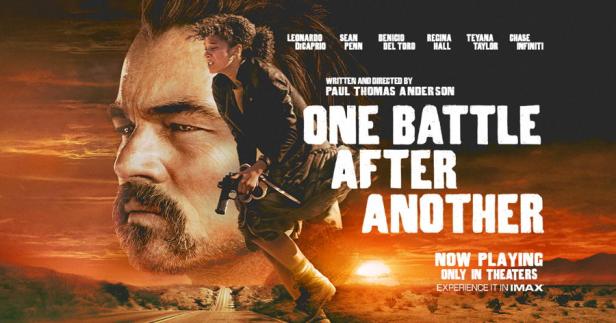
After the joy of watching Holy Cow I ventured out for another rare cinema visit to see the hyped-up latest film from Paul Thomas Anderson. This was a very different experience and one I’m still digesting. The hype didn’t work for my local cinema. I sat in the third row of a near 300 seat cinema and there were a group of three women behind me. As far as I know we were the entire audience and when I left at the end of the credits the auditorium was empty. One Battle After Another (a terrible title I think) is a loose adaptation of (i.e. is ‘inspired by’) Thomas Pynchon’s 1990 novel Vineland. It’s a hugely expensive movie funded by Warner Bros. with Leonardo DiCaprio receiving a $20 million fee. I feel I should point out that I’ve always known about Pynchon, the ‘invisible man’ of American fiction, but I don’t remember reading his work other than a few pages. I do respect Anderson’s skill as an auteur director but I haven’t seen his earlier Pynchon adaptation Inherent Vice (US 2014). I have blogged about The Master (US 2012) supposedly ‘inspired by’ Pynchon’s novel V. Finally, I’m not a fan of DiCaprio. So I guess what persuaded me to buy a ticket for this was the promise that it was somehow commentating on the state of America ‘now’.

The plot for this long film (162 mins) splits into two parts. In the first part we are shown the operations of a group of armed activists known as ‘French 75’ who attempt to disrupt the immigration controls on the US-Mexico border, freeing migrants from their cages. They also bomb buildings used by right-wing political agencies and they fund their activities by staging bank robberies. This is around 2008 and there seems to be a reference to the Black Panthers or Black Power more generally. The leader of the actions is Perfidia Beverly Hills (Teyana Taylor) and the group of bank raiders includes other Black women. In a more ‘backroom’ role is Bob Ferguson (Leonardo DiCaprio) who appears to be in an ‘open’ relationship with Perfidia. On the Immigration Control facility raid Perfidia has a run-in with Captain Lockjaw (Sean Penn). There is some form of connection between the two and they will meet again later in very different circumstances. In the second part of the narrative, 17 years later, Perfidia is not in the picture and Bob is looking after Willa (Chase Infiniti), his 16 year-old bi-racial daughter. Bob has ‘fried’ his brain with dope and alcohol. When an emergency message reaches him warning that his cover has been blown he can’t remember essential codewords/passwords but Willa is able to escape, at least initially. Lockjaw is leading the search for all the ex-French 75 members. He has also in the meantime become involved with a secret society of powerful right wing white supremacists who are having second thoughts about his past and his connection to Perfidia. I hope I’ve avoided any major spoilers.

I found the opening section of the film loud and spectacular but not particularly involving but as the narrative developed I became more engaged. The film is always watchable but the main problem is the mix of violent action and satirical comedy. I understand that the Vineland novel deals with 60s revolutionaries who find themselves trying to fight back twenty years later in Reagan’s second term following the 1984 election. Pynchon ‘s novels have been noted as having a ‘light, comedic touch’ but not everyone agrees. Film critics have perhaps been less inclined to push down on Anderson. As I see it, most of the comedy in One Battle After Another is focused on DiCaprio and Sean Penn. For me, DiCaprio seems to be playing the same kind of character as Jeff Bridges in The Big Lebowski and I didn’t like that movie either. I just don’t find stoned characters comic any more. For the second half of the narrative I was pitching for Willa throughout. More than one reviewer refers to Kubrick’s characters when considering Penn’s portrayal of Lockjaw which is certainly cartoon-like with a silly haircut, bulging muscles and popping veins – and yes I’m not that fond of Kubrick either. There is a sense that many of the scenes in Anderson’s film remind me of many other films. The white supremacists remind me of the set-up in Jordan Peele’s Get Out (US 2017) and in a different way the mysterious figures in Pakula’s The Parallax View (US 1974). Bob lives in ‘Sanctuary City’ in a house in the forest which immediately reminded me of Michael Caine as the dope-smoking father of Clive Owen in Alfonso Cuarón’s Children of Men (UK-Japan 2006) – except that Caine is actually funny. Finally I’d like to remember Sidney Lumet’s film Running on Empty (US 1988) about a family living under the threat of exposure because the parents were activists in the 1970s responsible for bombing a napalm factory. It was not a big commercial success but was praised by many critics at the time.
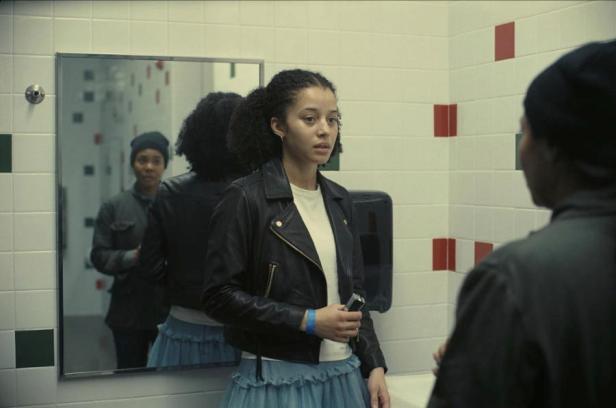
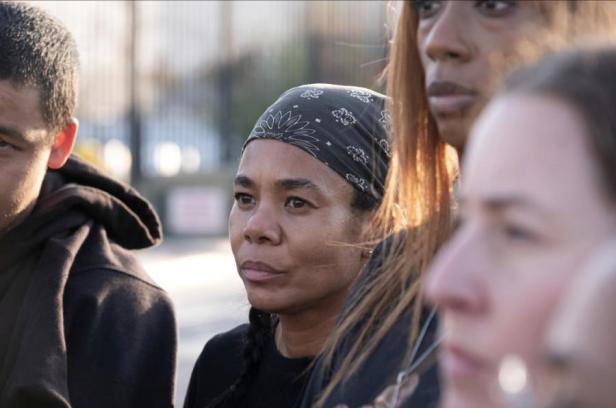
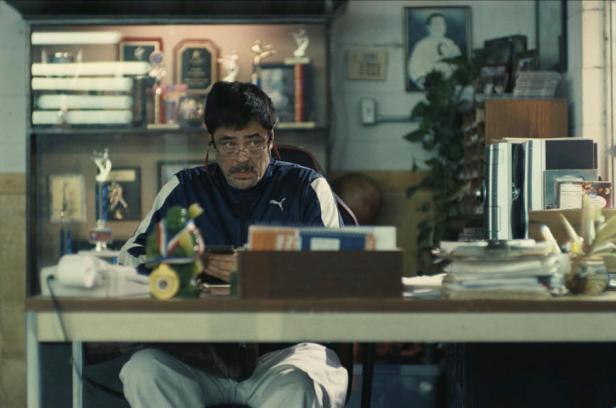
What to make of the film overall? I suppose I should say that I watched a standard digital print. The film was shot on film using a VistaVision camera and is also available in IMAX cinemas (IMAX, like VistaVision began as a film format which created a larger negative image by running the film horizontally through the camera rather than vertically). It could have been presented in ‘Scope (2.39:1) but Anderson settled for the standard 1,85:1 – I’m not sure why. It is an action picture not an intimate drama for more of its time. I personally don’t like IMAX because the ratio of 1.43:1 doesn’t seem right for a giant image. But perhaps the spectacle and the high definition add a great deal? It’s possible, but I don’t feel I missed out. What I have missed here is the music score by Jonny Greenwood (an Anderson regular) and the use of songs. I recognised all the old ones and that gave me pleasure, although it was distracting to think about them and check I was right as in the case of Steely Dan’s ‘Dirty Work’. There were three or four songs over the closing credits, including two Ella Fitzgerald carols (the white supremacists are called the ‘Christmas Adventurers'(?)). The songs are cleverly chosen but they work in a way that puts them into dialogue with the narrative. For instance, Steely Dan is actually quoted by Bob, I think, and for all those who wondered where the codewords and phrases came from, most of them appear in Gil Scott-Heron’s ‘The Revolution Will Not Be Televised’ again played in full over the end credits. Finally, I must mention the film’s other two stars. Benicio Del Toro who plays Willa’s ‘Sensei’ in her karate gymnasium is very good. He’s calm and funny and a perfect foil for DiCaprio. Regina Hall is also good as Deandra, the woman who rescues Willa, but I thought she was under-used.
But what about the politics? Some reviewers claim to be astounded by the relevance of this film to 2025 and the move to autocracy in the US. It’s probably true that Anderson never imagined the events surrounding Trump when the film went into production but let’s be serious about this. There has always been a powerful right-wing presence behind the scenes in every American administration. Trump is in many ways more frightening than other leaders because he is unpredictable and at least gives the impression of being dim, so is hard to read. The lack of significant organised resistance to Trump’s action is worrying but the fascists and racists have always been there. ‘French 75’ are allegedly ‘left-wing’ but they don’t talk politics. Yes they act against immigration abuses, anti-abortion agencies and other social evils which are abhorred by people of many political persuasion but they don’t seem to have any coherent ideology beyond ‘being revolutionaries’. I can only remember two images in the film that really made me a little optimistic. One was the TV playing Battle of Algiers (Italy-Algeria 1966) – a film about a real revolution – in Bob’s room before it is raided and the other is to see a Native American freelance agent suddenly change sides after working for Lockjaw because he is disgusted by the racism of the fascists.

After its three-day opening worldwide One Battle After Another had made $48 million of which $22 million was from 3,600+ screens in North America. It sounds a lot but to make a profit given the estimated $140 million+ production budget there is a long way to go. Takings dropped from $9 million on Friday to $5 million on Sunday. I’m not sure the film will have ‘legs’ to reach the $400 million worldwide it needs. I don’t think it is a ‘bad’ film and it is watchable the whole way through. And it has a sort of happy ending. I guess it simply isn’t my kind of film.


Thanks Roy, very interesting. I have read quite a lot of Pyncheon, though Vineland is very long . . . I also like a number of Anderson’s previous films including Phantom Threads, Magnolia and Liquorish Pizza. He is a very surprising director who often gets really good cast. As a major treat, I saw this in VistaVision at Leicester Sq’s major Odeon at 11am with almost no-one else there! Perhaps because of all this, and despite your very legitimate caveats, I really enjoyed it. I am not sure we can make too much of the politics which are pretty crude (the Christmas Club!) but I found much of it funny and cinematically engaging. I loved the car chase in the mountains and the whole sets of co-incidences and accidents which drive the plot. I was rooting for Willa, entertained by the revolutionary Bob’s failure to remember the code words, loved the music and was happy with the ending. Your comment about whether it will find enough audiences to pay off the budget is probably right, though.
LikeLike
I can’t disagree with any of your comments. It always used to be a pleasure to watch films in the Leicester Square Odeon. That was an audacious choice. I think I was simply hoping for something with more of a political edge but simply watching it for the filmmaking creativity and skill makes sense.
LikeLike
I saw this on the opening weekend on the biggest screen at Cineworld Wakefield. I was similarly surprised by how little business it was doing early doors – there were about eight of us for that screening in a big auditorium. The film maintained a kinetic energy that mostly kept us involved for the long chase sequence, but it was hard to work out what audience it was pitched at. I cannot say I didn’t enjoy it but it was not dissimilar to other, better films I have seen in the past like ‘The Parallax View’.
Unlike yourself, I have a great fondness for Lebowski and rarely pass up the opportunity to watch again the bowling group’s encounter with ‘the Jesus’ when it pops up again on my Instagram feed. John Turturro was never better.
LikeLike
Yes, The Parallax View is hard to beat. I know that many, many people really love The Big Lebowski. I only mentioned that I’m not a fan to help explain the difficulty I had to engage with DiCaprio’s character. I really don’t understand why he is so praised (on the other hand I really like Jeff Bridges in nearly all his other pictures).
LikeLike