
This is the last silent film directed by John Ford and is one of the finest of these. The story is sourced from the novel ‘Over the Border’ by Herman Whitaker and adapted by John Stone, a fairly prolific writer and producer. The title cards in the film are by Malcolm Stuart Boylan and Ralph Spence. The setting is the Dakotas in 1877, supposedly Indian land by U.S. Treaty it was opened up for a land rush by settlers by an Appropriation Act in 1876. The appropriation had been preceded by the War with the Sioux nation including the now famous Battle of Little Bighorn. In fact George Armstrong Custer’s expedition in 1864 led to the discovery of gold. After forcing the Sioux out of the Black Hills through a policy of ‘sell or starve’ the U.S. Government opened up the territory to settlers able to make both land and gold mining claims. This started with a race, supervised by the U.S. Army and commencing at 12 noon on the 25th June 1877. The film’s narrative follows characters who become involved in the race for land or gold and the stampede of settlers racing each other is the epic climax of the film. A parallel narrative is found in the earlier silent feature with William .S. Hart, Tumble Weed (1925) which depicts the Cherokee Strip land rush of 1893.
The film opens with titles about the opening up of the Dakota Hills and President Grant’s Proclamation. There follow short scenes of migrants sailing to the USA. At the Custer trading post an old prospector (Jay Hunt) announces a gold find. Indians are only onlookers. Then we see the wagon train of migrants seeking either land or gold. On the train we meet Irish immigrant Dan O’Malley (George O’Brien), who plays a harmonica and sings a song about the Dakota Hills. Dan makes the acquaintance of Major Carleton and his daughter Lee (Olive Borden) when he helps them replace a fallen wagon wheel. Dan is immediately attracted to Lee. Meanwhile the Major is leading a string of race horses which he plans to use in the coming race for land.

Olive Borden, George O’Brien
A series of wanted posters introduces the 3 Bad Men, led by “Bull” Stanley (Tom Santschi): with his two sidekicks Mike Costigan (J. Farrell MacDonald) and “Spade” Allen (Frank Campeau). They are wanted for bank robberies and horse theft. But Bull himself is driven by the a search for the man who has seduced and led away his ‘little sister’. They first appear riding out of the setting sun. Then they espy the wagon train, which is also watched by Indians as their lands are invaded. Bull decides to follow the train to Custer as he may find the man he seeks there.
Now we move to the town of Custer, developed from the trading post. It is crowded with migrants come to take part in the land grab. The town is run by Sheriff Layne Hunter (Lou Tellegen) but he also secretly leads a gang of criminals. They attempt to steal the Major’s Horses. Bull, Mike and Spade drive them off but the Major is killed so they take care of Lee and shepherd her into Custer.
In Custer a confrontation develops between Bull and Hunter. The old prospector is shot by one of Hunter’s gang but, dying, bequeaths a map to Lee and her guardians, which now includes Dan. Meanwhile a minister arrives and works with a community of homesteaders, come to seek land rather than gold. They build a wooden church for the Minister.
On the eve of the Land Rush, Hunter and his gang attack the homesteaders’ church. This is in order to create chaos and sneak across the boundary ahead of the opening. This is a dramatic night-time sequence. Bull leads a counter group who drive off the gang. But Bull finds his dying ‘little sister’ and discovers that Hunter is the man who seduced her.

The day of the Land Rush arrives. Hundreds of migrants jostle at the boundary line, guarded by a contingent of US calvary. At noon they race across the land s towards the hills, and the prospect of land or gold claims. Lee and her quartet race ahead on the thoroughbreds. But they are followed by Hunter and his gang and the 3 Bad Men have to bar the way as Lee and Dan ride on.
The early part of the film establishes the characters and settings. The conflicts rise to the surface when the leading characters arrive in Custer. The film really catches fire on the eve of the Land Rush. There is excellent black and white cinematography with dynamic editing, notably in the nigh-time sequence and the opening of the land rush. Here Ford and his cinematographer, George Schneiderman, present an exciting race combined with cameos of the many minor characters. The 3 Bad Men dominate the film especially Tom Santschi’s Bull. Lee and Dan, along with Mike and Spade, are supporting characters to him. Lou Tellegen’s Hunter is presented as something of a dandy but also a ruthless character. Even before the land race the minor characters fill out the narrative and add to the film’s strong sense of time and place. The people who are left out, rather in the cold, are the Native Americans / Indians. The film does acknowledge the theft of their lands but does not really address the genocidal policies of the US government. And the Indian presence is only in the opening of the film.
The night-time eve of the land grab is dramatic. Scenes are lit by the burning torches of the riders and smoke whirls round the action. The cutting between the horsed gang and their opponents are intercut with the panic among the congregation in the church. At the climatic moment the minister kneels and begs in front of a burning cross which presents a strong religious symbolism. He is joined by Millie who is shot in front of the burning cross. Bull finds the dying Millie and carries her to a bed. This is when he discovers that Hunter is the villain and he chases him but Hunter escapes. Bull, after he death, carries her body out into the darkness. Here were find the impressive funeral procession, including the riders with burning torches. Then we see, in the morning light, Lee and Bull and the other three standing by her rocky grave as the minister conducts the burial service.
This dark passage then changes into the exciting and brightly lit opening of the land. rush John Ford recalled,
We used over two hundred vehicles – stages. Conestoga wagons [a distinctive covered wagon of German origin common in the western trains], buggies, broughams, every blasted vehicle there was – and hundreds of men riding horses, all waiting for the signal to cross over riding like hell. (Quoted by Andrew Sinclair and Joseph McBride).
There is even a man on a penny farthing bicycle.

Schneiderman must have used a number of cameras to record the rush. There are even low angle shots which were presumably in specially dug pits. There are crashes with vehicles losing wheels. A couple fix their wagon but leave their baby on the ground. Several writers record that a horsemen snatching a baby from under the hoofs of horses was actually staged for the film, though the child was picked up into a wagon rather than a horse. The wagon is that of the ‘Custer Pathfinder’ with the editor involved in the race and receiving reports from riders as he prepares his printing press, also in the wagon.
The most moving sequences in the film are the farewells between the 3 Bad Men as, one by one, they hold off the pursuing gang. Ford had a tendency to privilege outsiders in his films. Here, criminals with hearts of gold, redeem themselves by sacrificing for the young couple. The story has parallels with ‘Three Godfather’s’, a novel by Peter B. Kyne. This was adapted as a fine film, in both silent and sound versions, in 1929 at Universal Pictures, directed by William Wyler. Ford himself directed a version in 1919 as Marked Men with Harry Carey, now lost. In 1948 he directed a version in colour and starring John Wayne. And there are other versions from 1916 and 1936. In Kyne’s story three outlaws rescue a baby in the desert and sacrifice themselves to bear him to safety.
The film was shot in Wyoming with the land rush sequence opening shot in the Mojave Desert. The setting and action differ from the source novel which was set in the north of Mexico during the revolution of 1910. Fox produced another adaptation of Whitaker’s novel in 1931 under the title Not Exactly Gentlemen. That film was directed by Benjamin Stoloff and starred Victor McLaglen and Fay Wray.
The film privileges the homesteaders seeking land over those seeking gold. In an earlier sequence the minister blesses their ploughshares. At the start of the race a couple of wagons take out their ploughshares in order to the lighten their load, but the minister persuades them to re-instate them. Then in the race, a couple’s wagon loses its wheel. As the couple contemplate failure the wife scoops up the soil, exclaiming on its richness and they decide to settle and farm right there. When the race is finally over, several years later, we get shots of ‘golden wheat’, emphasising a farming rather than a mining outcome.
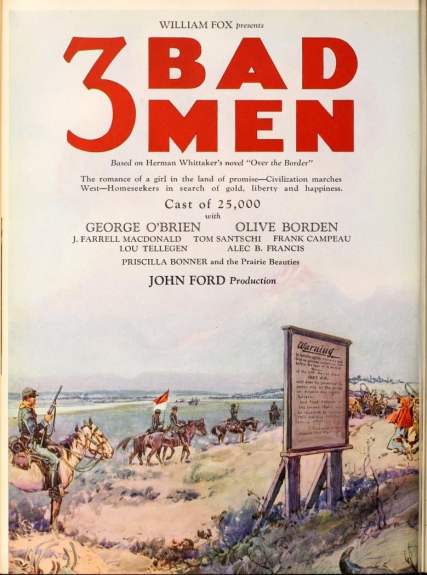
Ford’s earlier epic The Iron Horse [1924, about the building of the trans-continental railway] had been a great success. But this was not the case for 3 Bad Men. The western had diminished in popularity since then and Ford’s next western was not until the end of the 1930s. After a poor preview screening Fox made extensive cuts. What these were is not clear but it is reckoned some were examples of Scheiderman’s fine camera work. The surviving version is 8230 feet, shorter than the original release 8710 feet. What is recorded is that one character who suffered from the cuts was Priscilla Bonner as Millie. She recalled,
I was told that Ford got very angry about what was done to the picture and wanted his name taken off it. I went to the first Hollywood screening and I was astonished. Where was I? I worked on it for months. I got rich, but I wasn’t in the picture. I don’t think I had more than three scenes, just a good-sized bit. There was one scene in which Lou Tellegen beat me with a large bull-whip, a really brutal scene, It wasn’t in the picture. (Quoted by Joseph McBride.)
Tellegen carries such a whip around I his many scenes but we only see him use it on gang members.
It seems that Ford had relative autonomy for filming during the production and was involved to some degree in the scripting. Apart from the sympathy for outsiders other themes common in Ford’s films appear. There is the Irish connection: the importance of land: and the emergence of a community. The actual presentation of the land rush was based on that of the Cherokee Strip rather than that in the Dakotas.
John Ford had started out in films as an actor in 1913, originally credited as Jack Ford. He took up direction in 1917. By the time of 3 Bad Men he had already directed 58 films, though the early ones were shorts, one and two reelers. Many are lost or only survive partially. In fact, a lost Ford film has just been rediscovered, The Scarlet Drop (1918). Ford had worked in a variety of genres including a number of western, several of these with the star Harry Carey. As well as emerging themes Ford had developed the style that graced his later masterpieces. The pictorial representation, especially of the West, is one of his notable achievements.
The presentation at Le Giornate del Cinema Muto was a digital transfer from a surviving print at the Museum on Modern Art in New York; I have seen the print on an earlier occasion. There was an orchestral accompaniment composed by Timothy Brock who also conducted the Orchestra di Camera di Pordenone.
Books addressing the movie include:
John Ford by Andrew Sinclair, George Allen & Unwin Ltd. 1979
John Ford The Man and His Films by Tag Gallagher, University of California Press 1986
Searching for John Ford by Joseph McBride, Faber and Faber, 2003.
 itp Global Film