
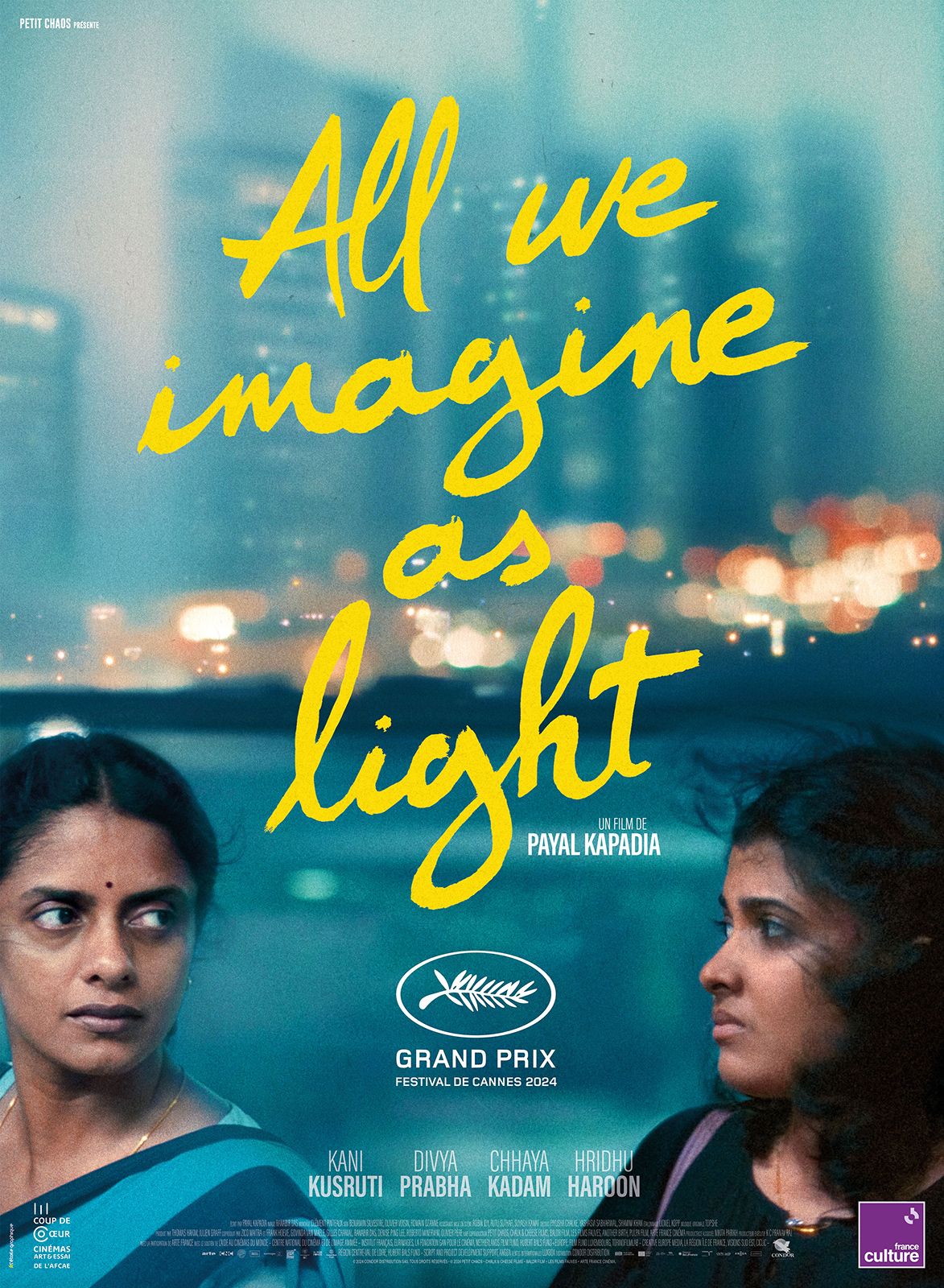
In an all too rare moment this Indian film won the Grand Prix at Cannes in 2024 and has gone on to secure further rewards at festivals and, because of its co-production with European companies, has gained a release in many international territories. In the UK it is being distributed by the BFI and Sight and Sound have made it their No 1 film of the year. All this made me a little wary going in to see it in case it didn’t match the build-up. I needn’t have worried, by the end of the film I was completely blown away. I hadn’t realised that this was a story about characters I felt some kind of connection with, simply because they come from one of my favourite parts of the world. Prabha (Kani Kusruti) and Anu (Divya Prabha) are migrant workers from Kerala in South West India who have travelled north to Mumbai to work as nurses in a hospital, living together in a tiny apartment. Their story is on one level a simple tale but it is multi-layered in meanings that speak about the unique status of Mumbai within modern Indian culture.
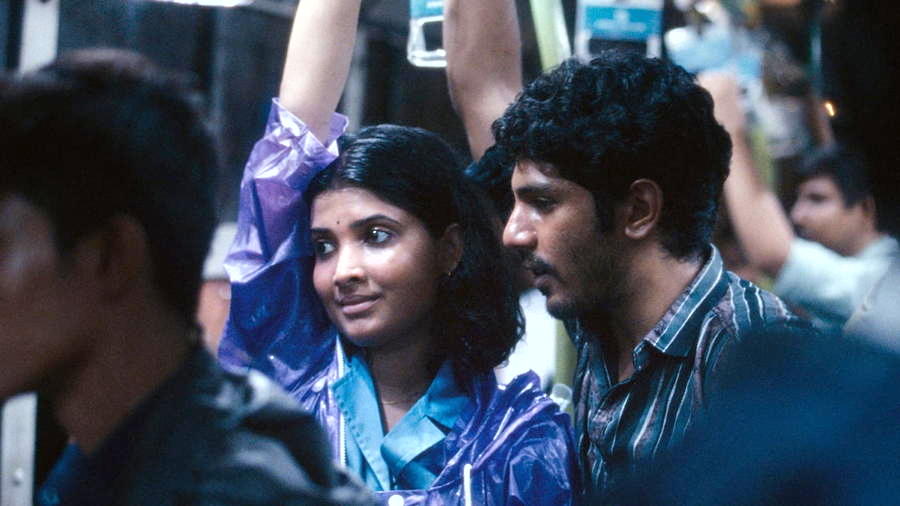
The film’s writer-director Payal Kapadia was born in Mumbai and attended the Film and TV Institute of India (FTII). This is her first fiction feature after several shorts and a documentary feature, A Night of Knowing Nothing (France-India 2021). She wanted to make a Mumbai movie and decided on the cultural questions which underlie migration. Mumbai is similar in many ways to London, Paris or New York. It doesn’t perhaps attract as many migrants from overseas but it does attract people from every part of India, not just because of its job opportunities but also the possibility of ‘social freedoms’ that can’t be found in conservative village and small town cultures. Prabha and Anu work in the same hospital but Prabha is a senior nurse who seems to be the ‘go to’ person for many of the others. There are not that many years between the two women, but sufficient to distinguish their overall behaviour and approach to life. Both have made friends with a man who is also a migrant in the city. Prabha meets Dr. Manoj (Azees Nedumangad) who is finding aspects of his job in the hospital difficult, partly because of the need to speak different languages to some patients and other professionals. Prabha tries to help him with Hindi. She speaks Hindi and the local language Marathi as well as her native Malayalam. Her relationship with Dr. Manoj is professional but we get the sense he might want more. Anu develops a romantic relationship with a young man, Shiaz (Hridhu Haroon) who I think is a student (I had to glean facts about who did what from dialogue exchanges and I might have made mistakes).
What I should explain is that all four of the actors mentioned here are Malayalam speakers but the director is not fluent in Malayalam so she relied on Kani Kusruti as the most experienced actor to help her manage dialogue scenes. Actors working across different forms of Indian cinema (i.e. different language industries as well as the commercial/independent distinctions) become used to working in different languages but directors are perhaps slightly less able to switch easily. I’m not able to understand any Indian languages (and films might use up to any of thirty or more languages) but I can generally note the difference between Northern and Southern Indian languages. People from Kerala, ‘Keralites’, enjoy the best education provision in the country and are therefore generally well-equipped as economic migrants. Most professionally trained Indians and those with higher education will be expected to know Hindi as a national language and possibly English as well as their ‘regional’ language. Nursing and medicine/pharmacy lends itself to the migrant experience of seeking work. I believe there is a small community of Malayali nurses in my local district of West Yorkshire in the UK. The main route for Keralan migrants has been across the Arabian Sea to the Gulf states and this is referred to in a comic scene in the film.

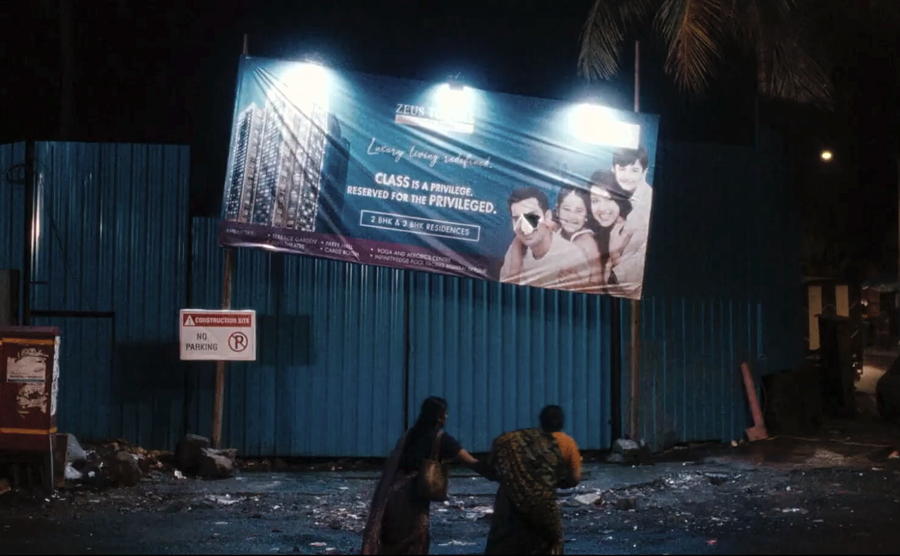
The fifth main character in the film is Parvaty (Chhaya Kadam) who works as a cook in the hospital and has a close relationship with Prabha. Through her we are introduced to another aspect of Mumbai – the housing crisis in a ‘mega city’. Prabha lives in a former cotton mill that is now part of what is known as a chawl in Mumbai, a form of low rent tenement style housing, some of which dates back to the migrant housing of the 19th century. A developer has bought the building and plans to demolish it and build housing for the wealthy – what in the UK is called ‘gentrification’. Most of the residents have some form of paperwork referring to their right to live in the building and the developer will re-house them. However, Parvaty has nothing. She is a widow and her residency was based on verbal agreements that carry no weight in the courts and she risks being simply thrown onto the streets. Prabha will help her of course, but there is little that can be done. I’m reminded of the terrific film Court (India 2014) which exposed the fate of the poor in Mumbai when faced with their lack of paperwork and the legal backlog of cases. Parvaty decides not to fight but to return to her village. She is also a migrant worker but her journey is relatively short. She comes from a coastal district South of Mumbai known as Ratnagiri. This is still in the state of Maharashtra and the local language is, I assume, Marathi, although the area also forms part of the Konkani-language belt that runs down the Western coast of India. There are films made in Konkani as well as Marathi. Payal Kapadia explains that it was common at one time for the men of Ratnagiri to migrate to work in the Bombay cotton mills and when the mills closed, the women replaced the men as migrants seeking different jobs in Mumbai. (See the Press Pack Notes.)

Pravaty’s move back to her village forms the second part of the film when Prabha and Anu decide to accompany her on the bus journey and to stay overnight after enjoying a day on the beach. This offers the director the chance to show a different India, away from the bustle of Mumbai and to explore the problems facing Prabha and Anu. Earlier we learned that Prabha is actually married but that she has hardly ever seen her husband who is also a migrant, but in Germany. We learn this when a mysterious large box is delivered to her flat. Anu excitedly helps her open it to reveal a rice cooker with the label ‘Made in Germany’. (I remember that a rice cooker was a heavily symbolic possession in another migrant community, the West Africans of Paris in 35 Rhums, France 2009.) Prabha had an arranged marriage and didn’t meet her husband before the wedding. Even for an educated woman from Kerala, the conventions are powerful. She remains ‘married’ despite the separation. Anu risks the same kind of conflict with convention through her relationship with a young Muslim man. She worries that her parents will arrange her marriage and will be very angry if they learn about Shiaz (and already there is gossip among the other nurses). I won’t spoil the narrative by revealing what happens in the final section by the sea, except to say that Shiaz follows Anu and meets her in a romantic spot.


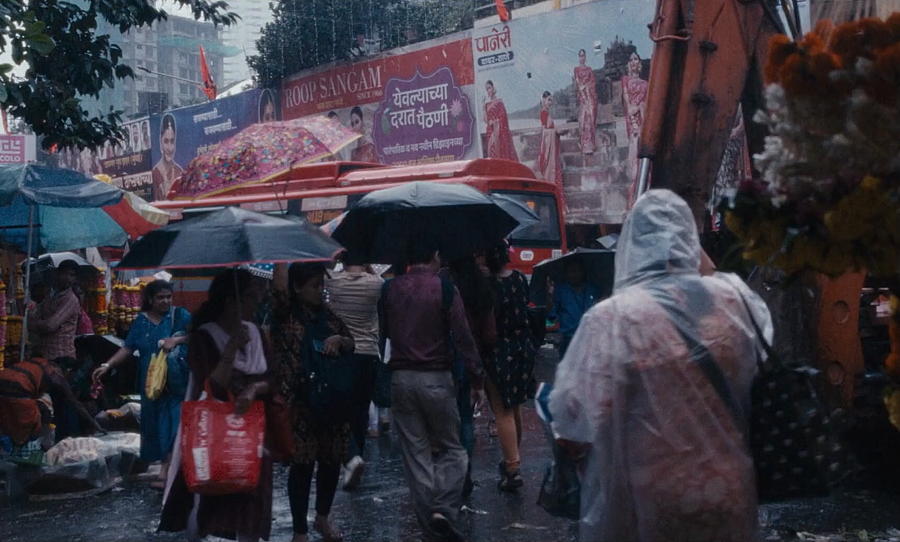
The final sequences include what we might think of as a moment of ‘magic realism’ or perhaps simply a fantasy moment. The feel of the film changes at this point. Mostly the overall aesthetic is realist in the bustle of Mumbai but the last section is on the beach in Ratnagiri. Music is important in signalling a change. Throughout the film there are different forms of music used very effectively in short bursts but in the final scene the music appears to be a form of orchestral synth/electronic music which is powerfully emotional, at least for me. The narrative does not have a conventional ending as such but the music creates a moment of heightened awareness on the beach. The music credits list two composers Dhritiman Das and Topshe. The cinematography is by Ranabir Das and the two sections of the film are shown differently. Mumbai is dark and in the monsoon season wet. It shows the characters often caught in crowds or confined spaces. The documentary experience of the director is evident in some scenes. The coastal village is open and light. The one aspect of the film which I haven’t worked out is exactly what the title means – apart from the general sense that Mumbai is a city of the imagination, of illusions but also of promise. I do find it a difficult title to remember, but that is my problem. As 2024 comes towards its close I think this film competes with Alice Rohrwacher’s La chimera as my favourite of the year. I do hope people everywhere get the chance to see it. It’s already out in the US through Slideshow/Janus and opens in more territories over the next few weeks. Here’s the original trailer from Unifrance:


A very fine movie. I especially liked the sense of Mumbai as this bustling, crowded city. The movie feels very much like social realism for much of its length, but, as Roy suggests, the end is closer to magic realism. The final shot is a great one. And the ending is one of those identified by Michael Walker in his book on ‘Endings in the Cinema’.
LikeLike