

I’ve been trying to watch this film for a while. I first rented a DVD in the UK but the quality was so poor that I sent it back without attempting to watch it. Now I’ve acquired a Blu-ray from Indicator and I can watch in HD. It’s a film with several talking points. First it’s an early Nick Ray film, his third production but one that in the US came out before his first film, the celebrated They Live By Night (released in Mexico and the UK in 1948). I’ve already covered some of the problems that Ray experienced at RKO in my posting on the second of his RKO films, A Woman’s Secret (1949). They Live by Night was shown privately around Hollywood before its general release and Humphrey Bogart got to see it when he was looking for the right director for the first production by his new production company ‘Santana’ which had a contract with Columbia.

Santana made six pictures at Columbia including Bogart’s second outing for Ray, the adaptation of a Dorothy Hughes novel, In a Lonely Place (1950). This suggests that Bogart was happy with Ray’s work on Knock on Any Door. The second aspect of note about Knock on Any Door is that it focuses on what would later become known as a ‘juvenile delinquent’. This is ‘Pretty Boy’ Romano played by the definitively ‘pretty’ John Derek. This young actor would feature again for Ray in Run for Cover, a 1955 VistaVision Western in which Derek was paired with James Cagney as another older surrogate father figure. Derek’s career as an actor was never fully realised but the juvenile delinquent type would reappear in different guises in some of Ray’s later films, most prominently in Rebel Without a Cause (1955) featuring James Dean. In the film, Nick Romano repeats the line that he is determined to “live fast, die young and have a good-looking corpse”. Dean repeats this in the later film but some suggest that the phrase goes back much further to the 1920s.

‘Knock on Any Door’ is a phrase that suggests a story involving a commonplace set of circumstances that might be found anywhere. The story actually came from a novel with the same title by Willard Motley who had experience of the tough lives spent on the streets of the slum districts of Chicago in the 1930s. Some commentators have seen this as Bogart going back to the ‘socially aware’ crime stories of his own career in the 1930s. The narrative begins with a shoot-out in an alley between a police officer and a young man. The police officer is killed and later on a young man is arrested for murder. This is Nick Romano and he calls Andrew Morton, a lawyer with a reputation for helping street kids. Nick Ray came to Hollywood with experience of ‘progressive theatre’ in the 1930s (he was born in 1911) and left/’liberal’ ideas underpinned his attempts to work in the film industry at a time when the communist ‘witch hunt’ was beginning and the studio which held his contract, RKO, fell into the dangerous clutches of Howard Hughes. Ray’s progressivism also extended to formal questions about story construction, mise en scène and the use of melodrama. He was clearly not a director who was likely to turn out formulaic genre pictures. Instead he would find himself ‘inflecting’ familiar elements of genre narratives and characters in new ways. Knock on Any Door, with a script by Daniel Taradash (also with a theatre background) and John Monks Jr. (another experienced writer – with recent credits on Henry Hathaway pictures) becomes an interesting mix of genres and approaches.

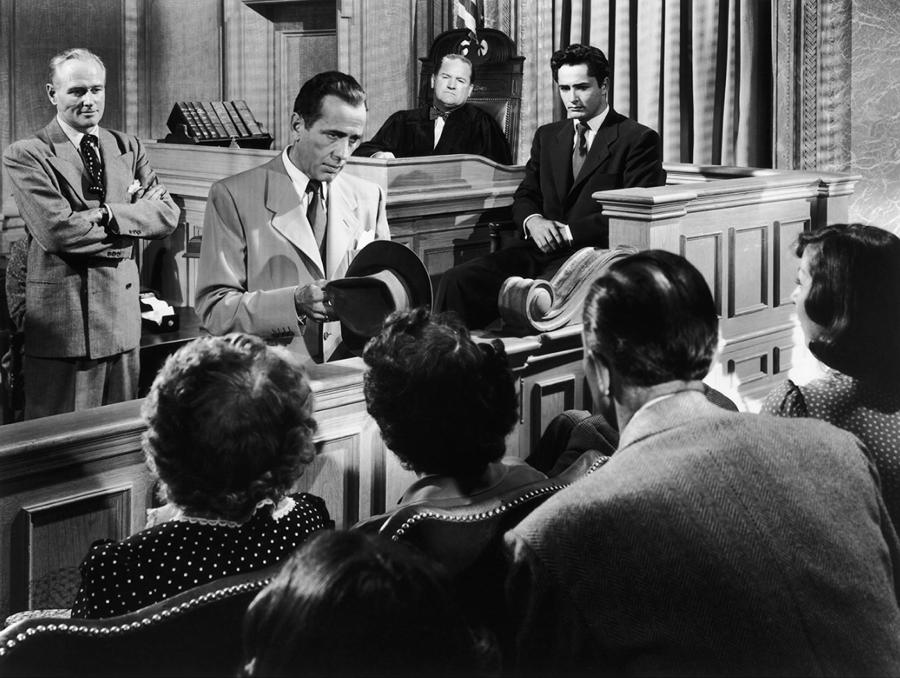
The Bogart character Morton eventually agrees to represent Romano in court, partly because he started on the same streets and understands Nick’s ways but also because he knows that Nick’s father went to gaol because his case was badly handled by one of the lawyers working for the same legal practice as Morton himself. Morton appears to be a junior partner in a firm run by more conventional/conservative lawyers. Morton doesn’t take on the case without a lot of persuasion. In court he decides to tell Romano’s story to the jury as part of his opening statement. This then leads into a series of flashbacks and has been argued to push the film into film noir territory. This is intensified by Burnett Guffey’s photography which uses lighting and some framing ideas from the more obvious crime noirs he worked on at Columbia as one of the leading house cinematographers. But noir is also suggested by the sense that Nick Romano is from the start a ‘doomed’ young man who once started on his life of crime will inevitably be destroyed by it. However, there isn’t a femme fatale in the narrative, at least in the usual sense. Nick will meet a young woman (played by Allene Roberts). This is Emma, a rather naive young woman struggling against a difficult background like Nick but without his anger. Bogart/Morton has a wife, Adele (Susan Perry) but her role is minimal apart from providing ‘moral support’.
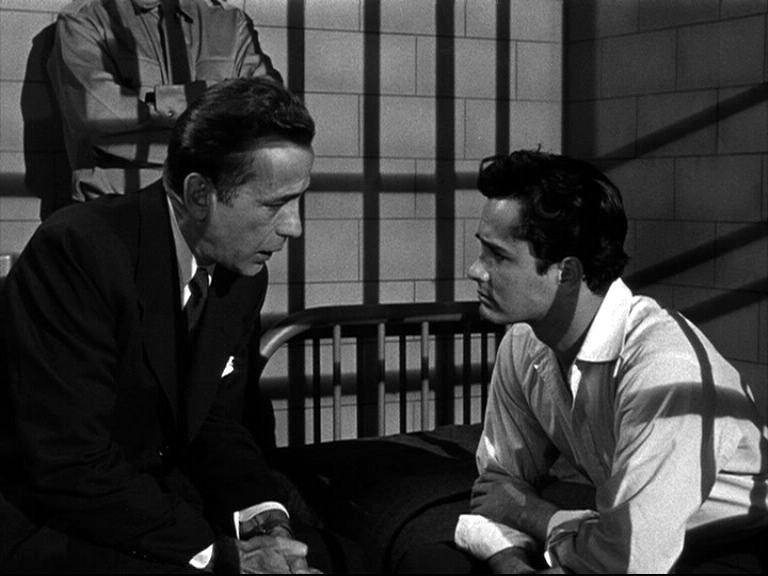
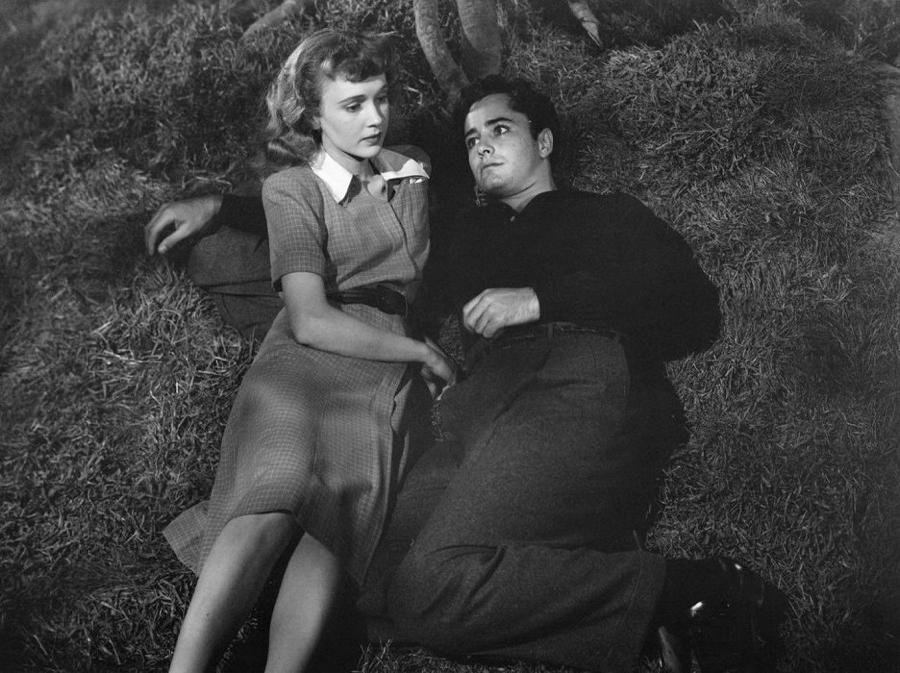
Many of the classic films noirs are ‘crime melodramas’ and here Ray builds on the melodrama elements, particularly in respect of Nick’s seemingly genuine feelings for Emma. She is in many ways his polar opposite and we know that their relationship is going to be very difficult to maintain. But then this is true of everything connected to Nick, including his behaviour in court which is exploited by the District Attorney in a heightened performance by George Macready. Macready was at this point a distinctive actor who was identified by Variety as a ‘polished villain’. Beginning as a theatre actor and the same age as Bogart, he was relatively late into cinema in the 1940s where his demeanour and his facial scar (the result of a car accident) made him perfect for roles in the developing field of films noirs such as My Name is Julia Ross (1945). In melodrama terms he makes a terrifying DA here in contrast to Bogart’s more liberal stance. In truth, Ray’s film seems structured around a series of contradictions in the sense that the courtroom scenes are broken up by the flashbacks and then caught between the melodrama moments and what can only be described as the realist details of the court procedures. This is well explained on the disc in the presentation by Geoff Andrew, who wrote a book on Nick Ray’s films back in 1991 with the romantic subtitle referring to Ray as ‘The Poet of Nightfall’ which in some ways works to describe the narration of this particular story. More discussion of Macready’s behaviour in the courtroom comes from Pamela Hutchinson in her audio commentary on the disc. I have only sampled a few scenes but it appears to be as well-researched and insightful as we have come to expect. The realist detail is explored by Andrew in one unusual scene in which the presiding judge (played by Barrey Kelly, a familiar character actor). Judge Drake adjourns the trial and takes the DA and Morton into his chambers effectively to give them both a warning about their behaviour. But what is also important here is the emphasis on the heat in the courtroom. Ray makes sure that this is a visual factor so several of the prosecution witnesses, who who find themselves caught between helping the DA because of some kind of reward and their past loyalty to Nick, are seen sweating on the on the stand as they are questioned. But Ray also shows us the court reporter who is drawing ‘pen pictures’ of everyone involved, being forced to get up and open the blinds for more sunlight – and suffering from the heat himself. We see the judge forced to change his shirt – a development that has nothing directly functional in the narrative but on a metaphorical level it certainly says something about the intensity of the trial.

I hadn’t realised that the novelist Willard Motley was African-American – one of the first Black novelists to have his work sold to a Hollywood studio. I did notice that one of Nick’s friends who acts as a witness providing an alibi for him is African-American and known as ‘Sunshine’, a derogatory name. I did think that Sunshine as played by Davis Roberts seems cast in the ‘noble Negro’ mould which carried into the early Sidney Poitier and later Brock Peters roles. It also seems stramge that he is the only Black character that I remember in the film. This may well be a function of the studio’s problems with presentation of African-American characters at the time. I understand that in Motley’s novel the character is more clearly ‘of the street’ especially in his speech. But it also seems that Motley himself was criticised as being a ‘middle-class’ writer and focusing on white characters. I was also unaware that there is a sequel to Knock on Any Door written by Motley and published in 1958. Let No Man Write My Epitaph was adapted for a film by Philip Leacock in 1960, again from Columbia (and photographed by Burnett Guffey). I must try to find this film with James Darren as Nick Romano Jr.


Knock on Any Door doesn’t have a happy ending. The social message is carried through but Nick is guilty and must be punished and there is no sense of the American legal system or American policing acknowledging its prejudice towards the disadvantaged. All the way through the narrative the shadow ‘bars’ created by the light through venetian blinds etc. seem to contain both Nick and Morton.I was surprised at the way the film delivers so much through its mix of genres and Ray’s approach to the story (although many of the decisions about the script had already been made when Ray came on board). There is some renewed interest in Bogart with a new documentary Bogart: Life Comes in Flashes (UK 2024) by Kathryn Ferguson the Northern Irish director, whose previous picture was the 2022 Sinéad O’Connor documentary Nothing Compares. The Bogart doc. appears to focus on the five women in his life – his mother and four wives and how they saw him. Bogart’s own words are spoken by Kerry Shale. We’ll no doubt blog on the doc if it appears locally in cinemas or on a broadcast TV channel. Ironically Knock on Any Door is unlikely to feature in the doc since the women in the film do not include stars of the stature of Lauren Bacall, Ingrid Bergman or Katherine Hepburn. That’s a weakness I think. Susan Perry (real name Candy Toxton) is given very little to do and this is mainly a father-son type of relationship which offers a different kind of role for Bogart.
I hope to cover some more of the six Santana films and will certainly post on In a Lonely Place (1950), the next Nicholas Ray title and in my view (and that of many others) Bogart’s best picture.
 itp Global Film
John Derek had an interesting career no doubt inspired by his earlier success as a good-looking minor star. Left his first wife for Ursula Andress who he helped mentor into a glamour queen in Hollywood, then left her for Linda Evans, another glamorous if wooden blonde, then on perhaps to his greatest success with Bo Derek who was probably the most eminent Hollywood sex symbol for the brief duration of her career following ‘10’ with our own Dudley Moore.
LikeLike
Yes, he seems to have had a history of his wives in his photography and directing duties having given up acting because he felt he didn’t enjoy it and wasn’t any good. A sad figure I think, but at least he survived unlike James Dean.
LikeLike