
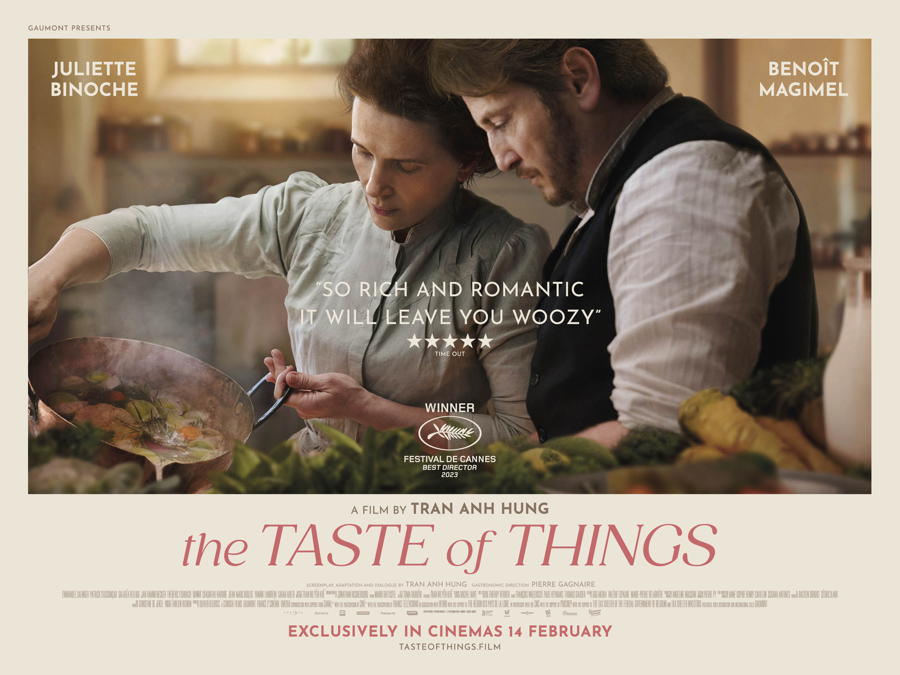
This film won the Directors Prize for Tran Anh Hung at Cannes in 2023 but I forgot that when the title popped up on MUBI. I lazily thought it would be another French heritage film, a romance set in the late 19th century. But it’s much more than that. It’s a beautiful film with fine performances and it is made with great intelligence and care. But I think I might be in a small minority because I struggled with its ‘content’ and specifically the concept of haute cuisine and the world of the gourmet and the gourmand. I had to look up the definitions of the latter two words. The older term gourmand refers to somebody who enjoys ‘good food’, perhaps excessively so. The second more modern usage leans more towards connoisseurship and ‘discernment’. This film is set in 1885 in rural France. Dodin Bouffant (Benoît Magimel) is a wealthy gourmet with a fine house and an excellent kitchen, gardens and an estate. For many years he has lived with his cook Eugénie (Juliette Binoche) in separate rooms. She has declined to marry him and he hasn’t yet directly asked her. Whether they will eventually marry is perhaps the central enigma of the narrative, but there are two other important sub-plots.

The first sub-plot concerns Bouffant’s reputation as a gourmet, especially among his four friends, all middle-aged men who meet to explore ‘fine dining’ in his household, but also with a visiting ‘Prince of Eurasia’ who has very extravagant tastes. What will he make of Bouffant’s kitchen and his ‘taste’? Finally the opening of the narrative introduces us to Pauline, a young teenage girl, the niece of Bouffant’s house-servant/kitchen maid Violette (Galatea Bellugi). Pauline (Bonnie Chagneau-Ravoire) appears to have a refined palate for one so young and she is presented as someone who might be a worthy apprentice in Bouffant’s kitchen to learn from him and from Eugénie. The film is long (over 130 minutes) but the narrative time is relatively short in terms of how these three plots work out.

In the long opening section the action is almost documentary-procedural. Eugénie collects vegetables from the garden, cooks breakfast and then begins to assemble the ingredients for a gourmet meal for Bouffant and his friends, so, for instance the lettuces she picks from the garden will be braised to accompany a dish of veal. There will be turbot poached in milk, other fish and a ‘baked Alaska’ a new American culinary invention of ice cream baked inside a dome of egg-whites, which Bouffant explains is possible because the egg-whites insulate the ice cream from the heat. There will be other dishes too and each will be accompanied by the appropriate local fine wine. Violette and Pauline will also get to sample the food. This opening reminded me of the relish of the father-chef in Ang Lee’s film Eat Drink Man Woman (Taiwan-US 1994) as he collects the ingredients to make a feast for his three daughters. In a slightly different way this is also similar to Babette’s Feast (Denmark 1987) in which a French cook (Stéphane Audran) fleeing from the Paris of 1870 under siege ends up in a remote Jutland village where later she is able to mount a feast for the locals, displaying her culinary knowledge. But both those films didn’t include such a strong focus on the food itself.
So what’s my problem with this? Partly it is political. Where does Bouffant’s wealth come from? How does he afford to entertain on such a lavish scale? These are not questions that are part of the narrative. In this film there are servants like Violette and Pauline and gardeners but even they seem relatively well-placed. Pauline’s parents appear to be progressive smallholders. I think it is more the veneration of haute cuisine that I find troubling. The director was born in Vietnam but schooled in France as a teenager and then attended film school in France. Here is how he explains his veneration of haute cuisine in the Press Notes for the film:
We learn how at a given moment in time, France put order into gastronomy. It was the French who decided that a dish should be prepared in one way and not another. It was the French who decided how to set a table, what silverware and which glasses to use with each dish. And it was the French who advocated marrying flavours by complementing this dish with this or that wine. France has such a rich and varied terroir. It is no coincidence that French gastronomy remains the top-ranked in the world.
I’m not sure that’s true today or that haute cuisine can be enjoyed by enough of the population to justify such a claim. Personally, I’d argue that Indian and Chinese food cultures as well as Japanese, Persian, Arab, other European food cultures and indeed food cultures on every continent are also important, but then I don’t eat meat or want food rich with cream and butter and gravies. And of course there is now nouvelle cuisine which directly appeals to gourmets. However, now that I’ve got that of my chest I need to applaud this film’s notable achievements. The central character is taken from the book The Life and Passion of Dodin-Bouffant, Gourmet by Marcel Rouff (1924) and the director says he invented a form of pre-narrative to that created by Rouff. He hired various chefs and other advisers to ensure he was able to create the kitchen processes and procedures necessary for what was ‘real food’. The two principal actors, both enthusiastic cooks, were able to learn the techniques and Tran Anh Hung, trained, I think, initially as a cinematographer, was able to frame all the procedures alongside his lighting cameraman Jonathan Ricquebourg. The presentation of the kitchen is marvellous and must have taken so much time to choreograph. Hung explains how he did this with his wife Tran Nu Yen Khe (credited as art director and costume designer) in this video (beware it includes SPOILERS, so best watched after you have seen the film):
In addition, I should say that even if I don’t want to eat a rack of veal, I do appreciate all the skill and thought that goes into creating food like this and I do applaud the attempts to use every part of the fish or animal that is killed for any dish. Food waste is the biggest sin of all. The coverage of the vegetable garden is also impressive. One of the features of the film that Hung discusses is the sounds of the kitchen and how he felt that the film needed only minimal music because the soundtrack was so rich.

I’ve spent a lot of time on the food angle but of course the romance is also central to the narrative and that doesn’t disappoint either. The original title of the film was Pot a feu. This refers to the classic French dish of boiled meat and vegetables, the quintessence of French family cuisine according to the chef Raymond Blanc, served everywhere to rich and poor which effectively challenges my view of haute cuisine and indeed in the narrative Dodin Bouffant argues that this is what should be on his menu when he entertains the Prince, the epitome of a gourmand. It’s a wonderful film now available on MUBI in the UK and on many streaming services worldwide. Do find it and enjoy. I’m off for a fried egg butty and a cup of tea.

 itp Global Film
What an enjoyable review!
“Food waste is the biggest sin of all.” I totally agree, which is why I was more forgiving of the lack of a political dimension: what *was* on screen were people who thoroughly appreciated their food and disdained excess eating (the prince’s menu), though I’d be interested to see a similar film that does go there. You definitely could critique the vision of feudal harmony and acceptance of roles on the country estate, as well as the way lower-ranking Dodin with his classless (?) pot-au-feu is positioned as the gentleman of taste and moderation in relation to the almost fairytale Prince of ‘Eurasia’ with his excessive banquet. The director’s unashamed celebration of French heritage from an outsider’s perspective also made me think of Merchant-Ivory and I wasn’t surprised to discover some French reviewers decrying the film’s conservativism. I think there’s an even more obvious feminist critique to be made of the extent to which Dodin’s and Eugénie’s arguably radical master-servant marriage and mutually respectful artistic co-creation is briefly undermined by the male gaze in the pear-body edit, the old misogynistic trope of female bodies as food for male consumption (ditto the doctor’s Freudian comment, which made me feel a bit queasy…). But these are minor quibbles.
On the whole, I found the film visually ravishing and a feast for all the senses, despite the fact that I’ve no desire to ever taste haute cuisine, sweetbreads, bone marrow etc and much prefer humble, comfort food. Yes, all the sophisticated cuisine talk was so earnestly French you might almost think it was a sly parody of French pretension, and the men’s pompous anecdotes about the Pope or their chewing of ungutted ortolans under napkins was almost funny, but I watched it with the same amused fascination as I would other escapist fine-dining viewing like Masterchef. I loved this film so much I rewatched it just a couple of days later and appreciated even more the exquisite golden lighting and painterly scenes of kitchen, dining tables and gardens. The sound design was just as much a pleasure; I much preferred the natural sounds of birdsong and distant peacocks to diegetic music, and found it a really meditative viewing experience. I didn’t buy the director’s claim in interviews that he actively avoided self-consciously beautiful shots because some, like the bathing scenes and of course the pear-body shots, looked too artfully contrived.
A lot of reviewers felt cheated the romance appeared to be secondary to the kitchen action, and by the lack of dramatic tension, but it worked for me as I understood it to be the story of a couple’s mutual passion for food and dedication to their art, and to their passing on of skills to younger apprentices – Pauline’s role as cook/daughter surrogate seemed central. Most of all, it’s a subtle, autumnal love story, made more poignant by Eugénie’s illness, and for both of them, food is something they see as in harmony with nature and the seasonal cycle – as ultimately life-affirming. I feel that’s how Hung gives the film real, lasting substance and lifts it way above crude, lazy charges of ‘food porn’ that I’ve seen from some. It’s the first film of his I’ve watched, but I’m really looking forward to his others, especially The Scent of Green Papaya.
The only thing that slightly marred my pleasure were occasionally stilted subtitles (I watched it on Mubi with a free trial, but through Amazon Prime, so had to rely on theirs). Inevitably, some subtleties are also lost in translation: despite being lovers, the couple address each other with the more formal ‘vous’, which may be partly due to greater formality in the 19th century, their difference in rank, the fact that they both ‘work’ together at times in the kitchen, and also Eugénie’s insistence on keeping Dodin at an emotional distance. We also lose what I guess must be a play on words in the French title – ‘bouffant’ ie puffed up – perhaps a reference to Dodin as the ‘Napoleon of gastronomy’…? / ‘bouffer’, colloquial for eat greedily, and of course the link to his lover implied by ‘passion’.
LikeLike