

This was the second of the films at Leeds International Film Festival in the season ‘Spice & Fire: The Films of Smita Patil’ that I managed to catch. Once again a restoration by the National Film Archive of India, this was screened in Pictureville Cinema at the National Media Museum in Bradford. It’s the best venue to watch any film but the audience was sparse. I felt for Omar Ahmed who introduced the film. It is always difficult to address a small audience in a large venue. I think the intention to screen the film in Bradford might have been to attract the local Malayalam community to watch the film. Malayalam films are occasionally shown at Cineworld in Bradford but I don’t know if the community have shown interest in archive prints like this. Anyway they missed a treat. This is one of the most visually stunning films I’ve seen for a while.
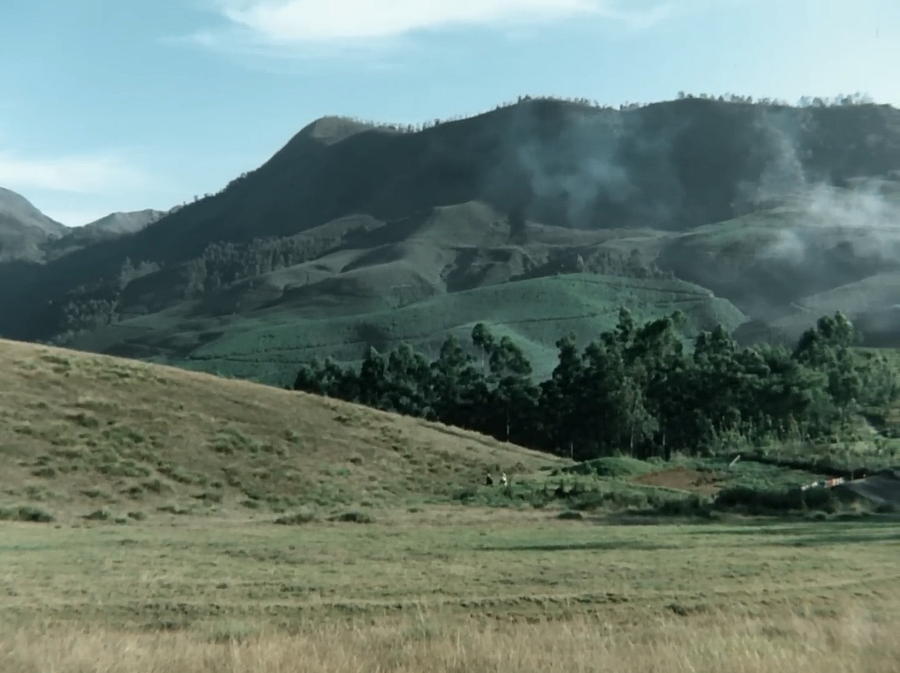


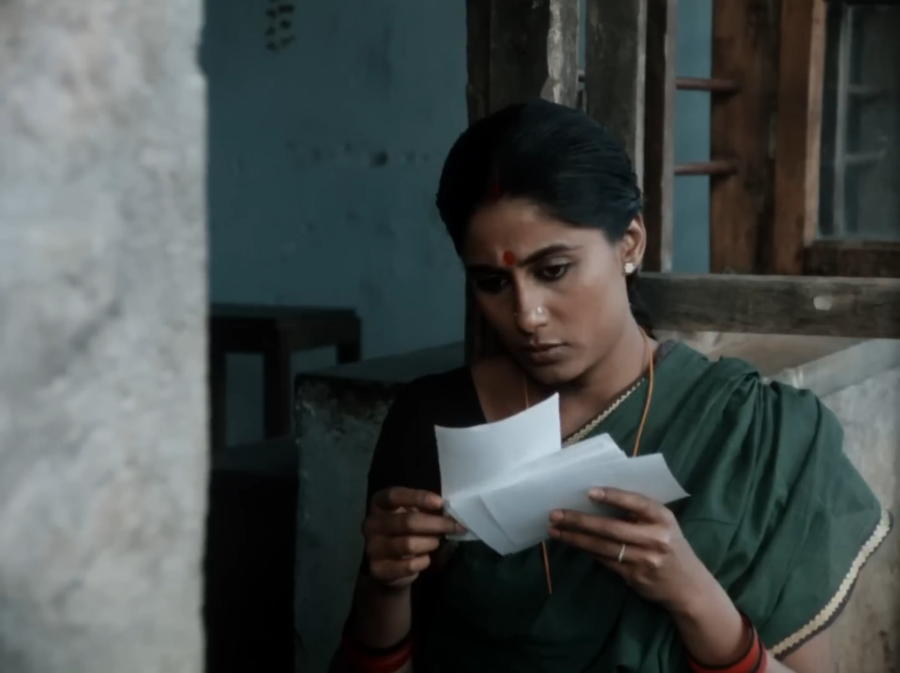
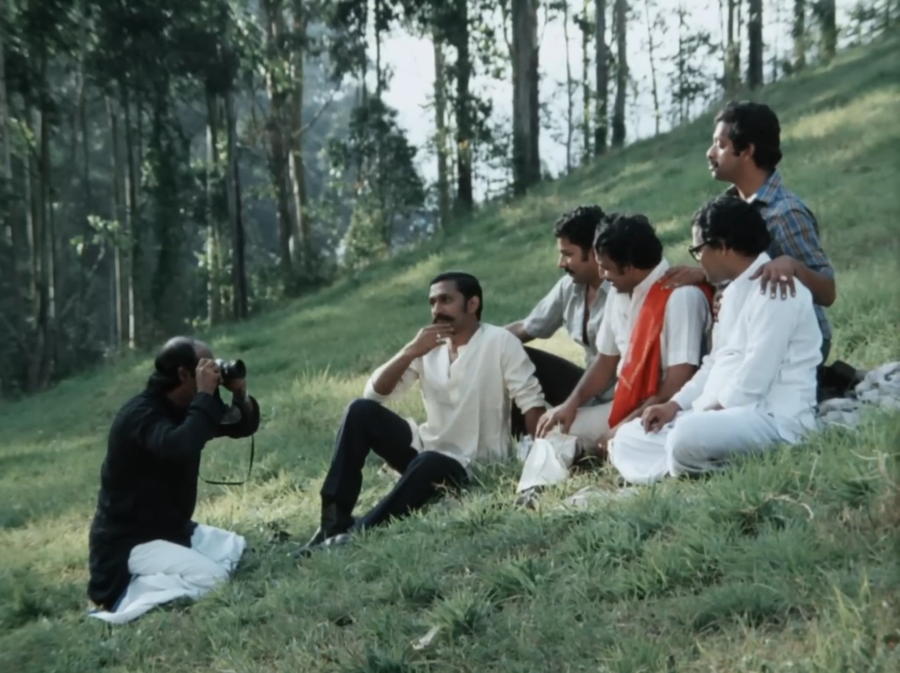
The narrative is set in and around Munnar, the Kerala district high in the Western Ghats and featuring tea plantations and dairy farming. The area is close to the border with Tamil Nadu and attracts Tamil workers. Muniyaandi (Sreenivasan) is a young man working as a cow herd on a large government farm. One day he tells the Office Superintendent of the farm, Shankaran (Bharat Gopy), a generally friendly man, that he has found a Tamil girl who he wants to marry. Shankaran is happy for him but the overseer Jacob is more curt and demands that Muniyaandi be back at work the day after the wedding. The tension between the three men gradually develops during the narrative with Shankaran photographing the wedding but also falling out with Jacob who thinks he shouldn’t be fraternising with workers like Muniyaandi. The plot is described in some detail on the Wikipedia page for the film. In fact the Wiki page covers the film very well using reference sources that can be checked out. I therefore find myself attempting a kind of ‘meta analysis’, picking out aspects of the production that interest me.

The film is based on a story by the well-known Malayalam writer C V Shriraman and this marked a change for the director Govindan Aravindan whose earlier film Thamp (1978) is one of the few Indian Parallel films to become available on Blu-ray in its restored form. Chidambaram represents a change for Aravindan in two ways, first because it is a narrative film based on a published story and second because it used ‘name actors’. Bharat Goy (as the Superintendent, Shankaram) who had appeared in Thamp was now well-known and the young bride Shivakami is played by Smita Patil who was at her peak as one of the leading actors of both Parallel and mainstream cinema in India. Both actors had won various awards and were nationally recognised. The narrative is in two or three distinct sections. In the first we meet the central characters in the period up to the marriage and in the second the tension between Shivakami, the Superintendent and Jacob develops, leading to a dramatic climax. Finally in the third ‘act’, Shankaran is overwhelmed by guilt and shame and takes to drink before being advised by a doctor to consider exploring religious ideas and values as an antidote. To do this he goes on a long journey, ending up at the temple of Chidambaram near the coast of Tamil Nadu, south of Chennai in the north-east of the state. The local name for the settlement is ‘temple city’ and I think the specific temple referred to might be the Nataraja temple, referring to Shiva in the form of a dancer. This suggests that there is a metaphor running through the film that refers to stories about Shiva. I’m not well-versed in Hindu mythologies but I am aware that Shivakami is presented quite often in relation to flowers and trees and the forest. Shankaran on his quest of some form of redemption does seem like another mythological figure.
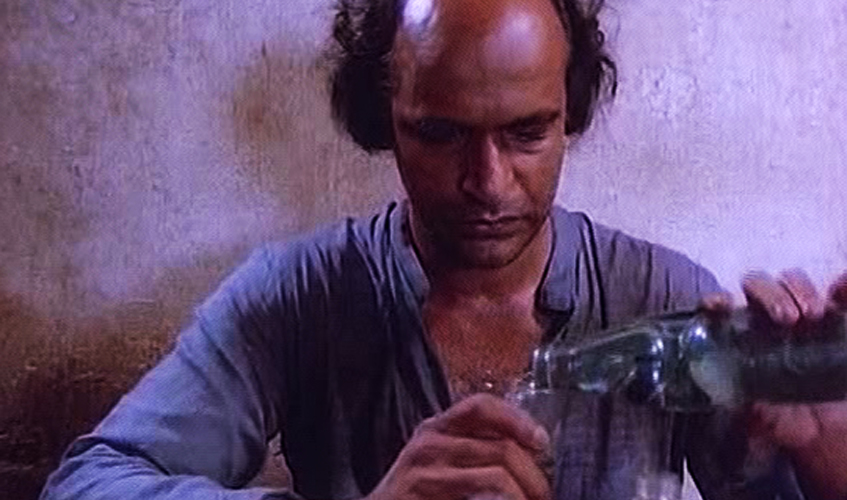
Elsewhere in the film there are several themes. The reference to Shivakami as a ‘Tamilian’ emphasises possible discrimination tied to ideas of caste. I understand that today the tea plantations in Munnar have found themselves in conflict with Tamil Dalit workers over pay and working conditions so the discrimination in the film may remain current. Alcohol, as it is in Thamp, is the curse of those who struggle with anguish in Kerala. In this film Shankaran offers rum to Muniyaandi and later drinks other spirits but in one scene it is ambiguous when he is brought a bottle of something that could be milk but is probably the local palm toddy. Two odd characters who appear in the film are a pair of film actors/extras staying near the farm during a shoot and finding themselves unwitting players in the drama on the farm.
The film has superb performances, great camerawork by Shaji N. Karun and an outstanding soundtrack comprising songs, percussion underpinning ‘action’ scenes and ambient sound of birdsong and the sounds of the forest and the farm. Often there is no music. Editing is another strength and includes at least one memory/dream sequence. At the end of the film Shankaran returns to the woman who looks after the shoes of the temple visitors. When she looks up it is Shivakami. I wondered if this was meant to be the ‘real’ Shivakami or another fantasy figure. Perhaps she is a ghost? Once again I am slightly at a loss as to what the markings on the woman’s face might mean.

After the screening I found an online version of the restored film from which I have taken some of the screengrabs shown here. I’ve been able to review scenes and to notice the pacing and editing in a way I couldn’t fully appreciate from the single cinema showing. They reveal just how well Aravindan has put together such a powerful story that seems both mythological and modern – highly recommended.
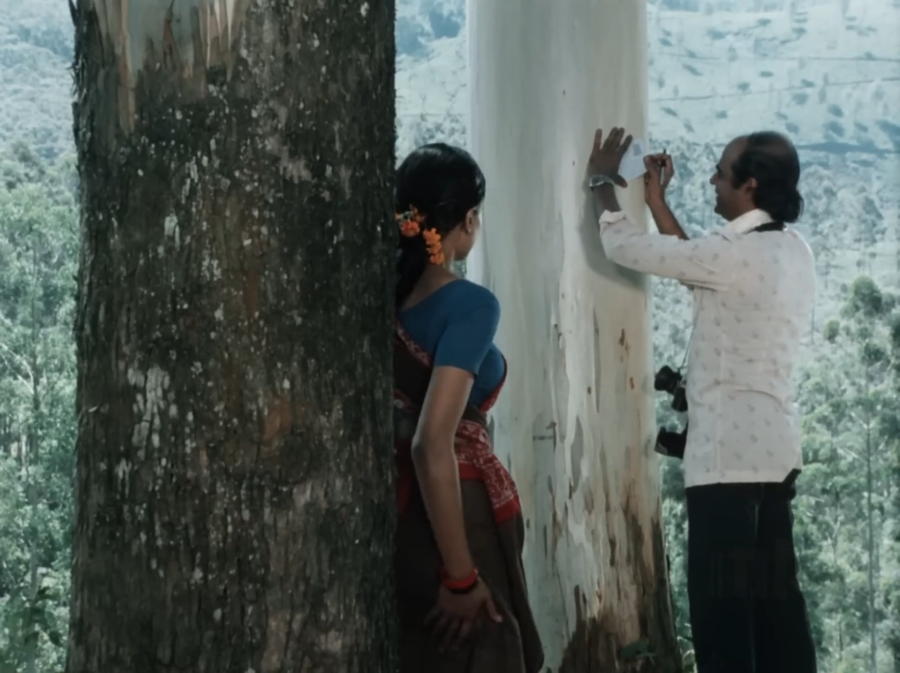
I’ve read a number of impressive reviews of the film by Indian writers who uncover many of the aspects of the film that I find difficult to explore. But simply on the level of how to tell a powerful but simple story without spelling it all out and using primarily camera, sound and performance this film beats most. One reviewer highlights the different impact of the two central performances, suggesting Bharat Gopy is all about understatement (though he has the most ‘actions’) whereas Smita Patil demonstrates a physicality in the way her ‘simple village woman’ not only smells the flowers “but [is] also tasting, feeling, and listening to the exotic atmosphere”. I think about this film as being very much a melodrama with an excess of colour, sound and performance. One last note, Gopy and Patil are both actors capable of working across mainstream and Parallel cinema and across different language cinemas. My next film sees Smita Patil in a Bengali film.


just a note on a possible reason the audience at Pictureville is sparse now. I went to see Suspiria on Halloween and it was the first film I had seen there for a while. Surprised firstly by the mess they had made of the roads to gain access to the car park, and then again when I discovered that the parking charges had been extended to 10 pm at the rate of £1.50 per hour. It was a flat £1 after 6 pm before. Therefore watching a film there in the evening probably costs an additional £3 at least and doesn’t tempt the driver to stay for a coffee. Sad, because I think the venue was struggling, and also because the Hyde Park is back in action and parking is free there.
LikeLike
Yes, the roadworks and pavement schemes for Bradford City Centre have been a nightmare this year but they are slowly coming towards completion. I never drive to the Museum except in extremis. Audiences have been low for all the screenings I’ve attended but, usually, being part of a festival boosts numbers.
LikeLike
South Tamil Nadu, with its rich history and cultural vibrancy, is home to a diverse array of districts, each offering unique contributions to the socio-economic and ecological fabric of the state. Spanning picturesque landscapes, bustling urban centers, and serene rural locales, these districts of South Tamil Nadu encapsulate the essence of Tamil heritage while paving the way for modern development.
https://www.indianetzone.com/districts_south_tamil_nadu
LikeLike
The woman’s name Sivakami means beloved of Lord Siva and Sankaran is another name for Lord Siva. The woman seen at the temple was Sivakami herself and the mark on her face is the scar of the wound inflicted on her when her husband tried to kill her before hanging himself, as told by Jacob the misogynistic farm supervisor.
LikeLike
Thanks. That’s very helpful.
LikeLike