
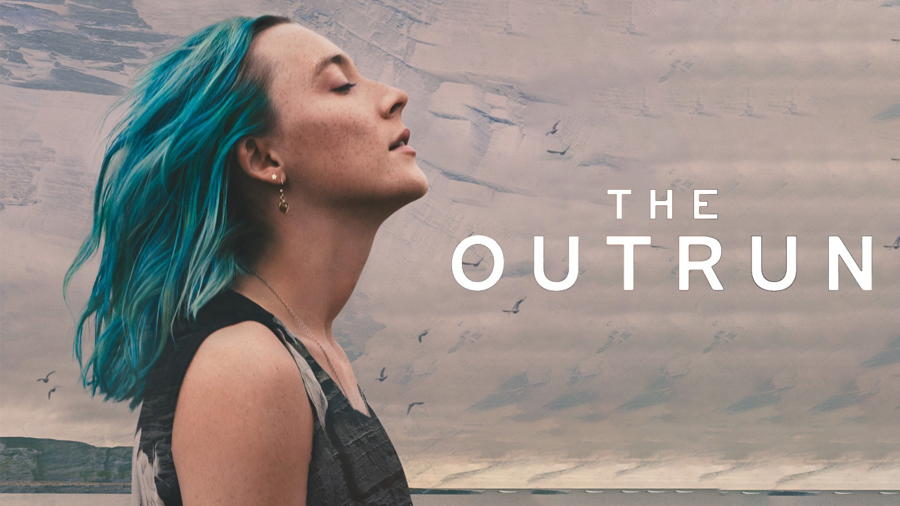
This film has been heavily promoted for a small independent, mainly I think based on Saoirse Ronan’s star image. I heard her twice in the last few weeks, on Graham Norton’s Show and on BBC Radio 4. Ronan not only stars but also produces with her husband Jack Lowden (and a host of associate and executive producers). I was initially put off by the idea of an addiction recovery drama, not a favourite genre for me, but then intrigued by the discussion about Orkney landscapes (and seascapes). When the film turned up at my local independent mainstream cinema I thought I should go and support the cinema. I enjoyed the film and I’m glad I went to the cinema but I must say that if I’d watched it at home I might not have made it through. I’ve only once left a cinema screening and I think buying a ticket is a commitment.

It’s a tough film to watch in parts. Saoirse Ronan portrays a character based on Amy Liptrop’s experience. Liptrop first wrote a book and then worked with director Nora Fingscheidt and another writer on the adaptation and then the screenplay. The character is renamed as Rona, the daughter of an English couple played by Saskia Reeves and Stephen Dillane who moved to Orkney either before Rona was born or not long after. Rona identifies herself as being from Orkney. The film doesn’t have a linear narrative but the point of entry appears to be when a 30 year-old Rona returns to her home which is now actually split between her parents with her father living in a caravan on the family farm and her mother living in the house. The return is prompted by Rona’s collapse into alcohol dependence after ten years of living in London, having completed a first degree and a masters and studying for a PhD. The back story is told through a series of flashbacks to which the main narrative returns at various points.


Nora Fingscheidt is the German director previously known on this blog for her film System Crasher (Germany 2019) which impressed Nick Lacey at the Leeds Film Festival in 2019. That film also covered forms of therapy attempting to treat a traumatised 9 year-old boy. Fingscheidt approaches Rona’s experiences with a range of ideas. Animation is combined with Rona’s voiceover to explore Oracadian myths such as the story of the selkies, the ‘seal people’ more at home in the sea than on land. Having just re-watched John Sayles’ The Secret of Roan Inish (Ireland-US 1994) in which he takes a story about a child and a selkie from the Hebrides and re-locates it to the West of Ireland, I was intrigued to see this presentation. I’ve seen a couple of reviewers refer to the animation sequences in The Outrun as ‘immersive’. I’ve no idea what that means, ‘immersive’ is now widely used in film discussions but the meaning seems to have changed. The film is presented in ‘Scope and the wide frame enhances the long shots of the Orkney landscapes. The islands (there are 70 in the archipelago) are mainly flat and with relatively little building for the sparse population the vista is generally free of crowds. That’s also true of the beautiful beaches. Even though the islands are close to the most Northern part of the British Isles (Shetland is the group of islands further North) the climate is relatively mild (but never as hot in Summer as South-East England). The contrast in London and specifically Hackney is represented by tower blocks, the Regent’s Canal and crowded streets.

My only problem with this film is simply that Rona is not only addicted to alcohol but also to loud electronic dance music, one of the very few forms of music I can’t listen to. She plays this on headphones that block out the natural sounds of both London and Orkney – but, of course we have to hear it too, and it’s loud. I’m thinking of my friend who is a big Saoirse Ronan fan but who also has some hearing impairment and has problems with his hearing aids in cinemas with loud soundtracks. Added to this, Rona parties in nightclubs with flashing lights to go with handheld camerawork, my one other no-no. None of this is a criticism of the film as such or of the taste of a 30 year-old woman. It is simply an explanation of why I found some scenes difficult to watch. But is the film narrative worth watching? The ‘addiction recovery narrative’ is a familiar generic narrative so we will have expectations of the fall of the central character until they reach a point where rehab will be virtually forced upon them. Their ‘fall’ will hurt not only them but potentially family and friends. Then we expect to see rounds of group meetings and therapy, probably several set-backs and finally a triumphant emergence into sobriety. All this is expected in a genre film which has a clearly defined ‘narrative arc’. This film does have most of these but because of the non-narrative structure and the two separate locations it offers something slightly different. Rona’s parents also offer something different for her to react against or seek support from. Her mother has discovered religion but her father has continued to suffer from a serious bi-polar condition. These factors face Rona with more difficult decisions. The other ‘difference’ is simply the environment of Orkney and also Rona’s understanding of the natural world through her studies and work experience. This offers a great deal but I was disappointed by the final scene of the film which seemed inevitable. I won’t spoil what happens though.

Genre films are built around ‘repetition and difference’. I think the ‘differences’ I have indicated above do allow Nora Fingscheidt and her creative team to to make an engaging and different film and Saoirse Ronan’s commitment to the role allied to her skills and strong star persona are a major plus. I’m fascinated by Orkney. I’ve seen a number of films located on the Orkney Islands and I enjoyed the cinematography by Yunus Roy Imer and all the performances very much. (There are quite a few YouTube videos by transport vloggers as well as environmentalists that show the beauty of the islands.) I think there were six of us in the cinema to watch The Outrun. It has been out for several weeks through Studio Canal, a ‘mini major’ in European terms, and seems to be doing very well. It opened at No 3 in the box office charts and by its fourth weekend had made nearly £2 million still playing on over 200 screens. Saoirse Ronan clearly has drawing power and I wish her well.
 itp Global Film
I saw this at Wakefield and initially had the same misgivings as yourself over recovering addicts, but it was a slow week for the pictures. The attraction was the wild landscape of Orkney which was beautifully presented, the journey back to recovery of an often stroppy young woman rather less so. Sairse Ronan first popped up for me in the Guy Pearce Houdini film of some years back, which I rather enjoyed despite not remembering the name. She seems to have done rather well for herself since.
In terms of struggling back from addiction then perhaps the Cheryl Strayed (Reese Witherspoon) film of some time ago had rather more to offer in terms of a challenge for the addict, because counting corncrakes and a bit of wild swimming lacked viewer involvement for me. I foresee an Academy Award for Ms Ronan at some stage but it will not come from this. Rather fewer murders in Orkney than in Shetland so I suppose that is a bonus.
LikeLike
But is the stroppiness partly a product of the alcoholism? I looked up your reference to Cheryl Strayed and you must mean Wild (US 2014), a film directed by Jean-Marc Valée and starring Witherspoon as the scriptwriter Cheryl Strayed who adapted her own memoir about a 1,000 mile hike on the Pacific Crest Mountain trail. This was intended as therapy after the death of her mother and the dissolution of her marriage. I’m not sure it’s the same thing as trying to dry out from alcoholism – it’s not easier or harder, just different I think.
LikeLike
not alcoholism, no, but Strayed (not her real name but an assumed one to say she had strayed from the chosen path) was a sex addict whose life was brought back into sharper focus when her mother died. The book and subsequent film were supposedly autobiographical but perhaps a little ‘heightened’ for effect. Still relevant I think.
LikeLike
OK. That’s interesting. It didn’t mention the sex addiction in the synopsis I read.
LikeLike