
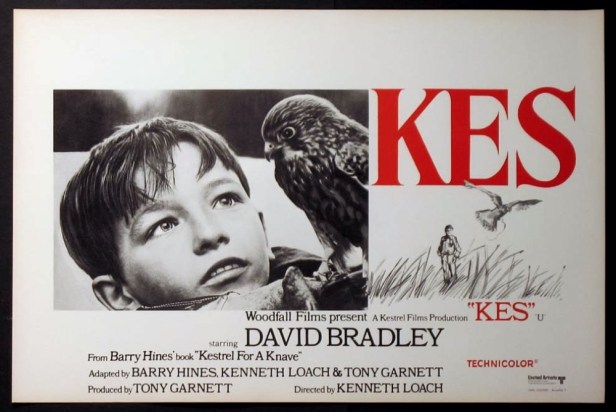
This 1969 release seems to be still the most popular of the many films directed by Ken Loach. Even critics who fulminate against some of his most political works have a kind word for Kes. The film was based on the book by Yorkshire writer Barry Hines, A Kestrel for a Knave (1968), and he drew on actual experiences. Loach was here working with Producer Tony Garnett who, for my mind, produced the most radical of Loach’s films, including those made for the BBC.
In the film young Billy Casper (David Bradley) seems to be a misfit at the local school and struggles to cope with a one-parent family. What the film demonstrates is that Billy’s problems stem from both his working class situation and the inadequacies of the state education system. What comes to illuminate his drab life is a young Kestrel, which Billy trains as in falconry. A sympathetic teacher, Mr Farthing (Colin Welland) supports Billy, but the contradictions and conflicts of home and school finally triumph over hope.
The film was shot around Barnsley, the setting and home territory of Hines’ novel. The cast are drawn from local communities in the now-familiar practice in Loach’s films; and offer fine, convincing performances. The production crew are excellent in this atypical environment and the cinematography of Chris Menges deservedly earned praise. The music by John Cameron is carefully minimal but also evocative.
The film is downbeat but also has moments of humour; notably Mr Sugden’s (Brian Glover) attempts to emulate Bobbie Charlton. The town, the school and the local countryside are all presented in that naturalistic style that Loach and his teams achieve. And the film is a fine example of British social realism.
Kes would seem to be one of the all-time classic avian movies [but missing from the only online selection that I found]. It stands out in the Loach output though it does not feature either organs of working class resistance or of the oppressive state, apart from the school; factors that have aroused the ire of critics regarding his other films. It is, like so many of these films, a melodrama of protest but, as with a number of other titles, one that ends in defeat. The dialogue confused US producers and distributors and the film fared poorly there. The language also confused the BBFC with their pre-occupation regarding ‘bad language’; originally a ‘U’ Certificate it is now PG.
Yorkshire audiences can enjoy this moving and compelling film in its original film format. This is thank you to the Parkway Cinema in Barnsley. The cinema frequently screens both 35mm and 70mm prints. It is currently the leading ‘reel’ cinema in Yorkshire. Several other venues do have 35mm but most rarely screen prints. Pictureville in Bradford, with both 35mm and 70mm, is currently closed but should reopen over the summer. The Hyde Park Picture House in Leeds still has a commitment to 35mm but they are seeking essential spare parts for their projectors, which severely limits screenings.
What is good news, though bad news for those who have not yet got tickets, is that the first screening on Saturday June 15th is sold out. That on Sunday 16th still has a few seats available; and this screening will also enjoy a Q&A with David Bradley. The final screening on June 23rd does have more seats available. All the screenings are in the ex-Odeon cinema’s original auditorium, which still seats over 300 patrons.
Given we may now have enjoyed the final film directed by Ken Loach this occasion provides a welcome testament to his important and central role in British cinema for sixty years.
 itp Global Film