
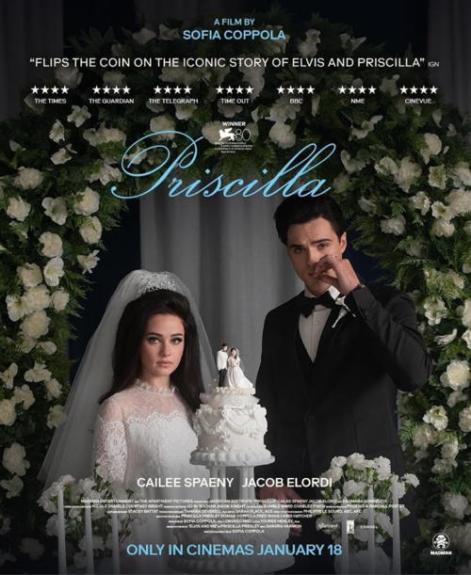
What a strange experience it was to watch Priscilla, now streaming on MUBI. I’m just not sure what I made of it. One thing I can say about it is that it is a triumph of hair, make-up, costume design, art direction and use of music. The performances by Cailee Spaeny as Priscilla and Jacob Elordi as Elvis are very good but they do make an odd couple. Neither actor is extraordinary as an individual but as a couple the visual image of a 6′ 5″ man next to a 5′ 1″ woman is quite a disparity and I found it distracting. I’m sure I heard Sofia Coppola say on the MUBI podcast that she didn’t think of the height difference at first and it was only later that she thought the image of the man towering over the woman was appropriate for the narrative. Add to this the fact that Elordi is only one year older than Spaeny and that she must age from 14 to 25 whereas he goes from 24 to 35. This is where the hair make-up and costumes do play a big role.
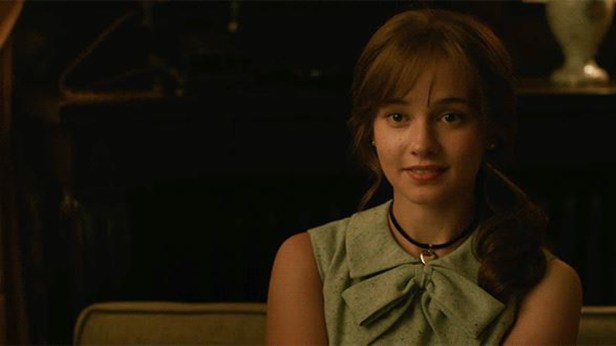
The film is based on Priscilla Presley’s own memoir Elvis and Me published in 1985 and written with Sandra Harmon, a writer specialising in TV and music material. Harmon died in 2018. Coppola rediscovered the book when she claims she was daunted by a possible literary adaptation (of an Edith Wharton novel?) and wanted to focus on something presumably less demanding. The script is by Coppola herself. I find this interesting in that her best film for me was her first, The Virgin Suicides (1999) which was an adaptation of a novel by Jeffrey Eugenides. I haven’t seen all her films but, apart from her version of The Beguiled (2017) a new adaptation of Thomas Cullinan’s novel, I suspect that her other films have scripts fashioned from her own original ideas. Her focus is invariably a young woman who finds herself in a pressurised situation of some kind. Coppola is is skilled and creative in terms of exploring these ideas but perhaps not in forging a clear narrative structure so that her films are often criticised for dealing only with ‘surfaces’ rather than ‘telling the full story’. I think that might be how I feel about Priscilla. The film is 113 minutes long but it ends just when Priscilla’s life apart from Elvis Presley is just beginning. The narrative is restricted to those dozen or so years when Priscilla is, for want of a better term, enthralled by her relationship with Elvis.

It is possible, of course, to construct an engaging narrative about a single relationship, even one as seemingly hermetically sealed (apart from the last few months) as this one. Once identified as being the girl for Elvis, Priscilla doesn’t appear to make any other close friendships and once in Memphis she is ‘forbidden’ to bring in any outsiders. The problem in terms of constructing a narrative is that the audience probably knows a great deal about the Elvis story (whether real or fantasy) but virtually nothing about Priscilla, unless they have read her memoir. The film is about Priscilla, not Elvis, but it is difficult to ignore the Elvis history. This is compounded by the fact that Coppola was denied use of any of Presley’s recordings by the singer’s estate. The result is that we are thrown little tidbits every now and again to remind us of what we know about the music, the persona of a star performer and the ‘real’ Elvis, his family and friends. I haven’t seen the Baz Luhrmann Elvis film from 2022, but I remember Elvis vaguely from my childhood and his music in more detail from my teens and since then through the various film and TV representations plus the detailed histories written by Peter Guralnick (1994 and 1999). I haven’t attempted to compare accounts of particular incidents but it does mean that, watching Coppola’s presentation of Elvis, there is another available narrative lurking in the background whether I want to think about it/investigate it or not.
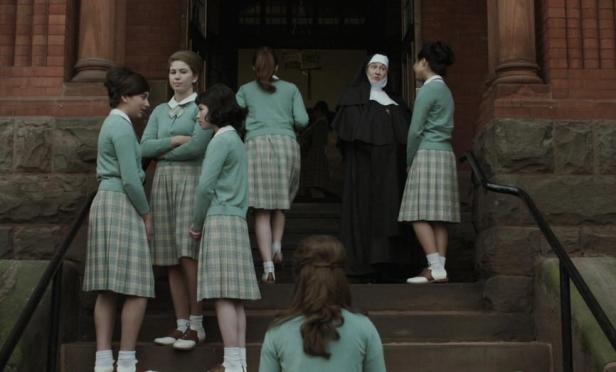
In a slightly different way, there is the same kind of double experience in the early part of Priscilla – the scenes set in West Germany. Coppola doesn’t attempt to present the reality of the American presence (which was pretty strange anyway with the importation of so much American culture onto American military bases) but it inevitably competes with other representations found in the films of Fassbinder and Wenders as well as Hollywood films like Walk the Line (2005) in which Johnny Cash experiences his military service in West Germany. When Priscilla joins Elvis in Memphis at Graceland, her world is so restricted that the only sense of time passing is through her changing costumes, hair and make-up. There is one brief line of dialogue in which Elvis disparages the Beatles but otherwise the great social, political and cultural changes of the 1960s are barely mentioned. When the re-birth of the Presley career takes place via the 1970 TV special and the tour, the sudden change in Priscilla’s appearance is marked. In the space of a few scenes she goes from the big hair seemingly modelled on the Ronettes crossed with Dolly Parton circa the mid 1960s to long straight hair in her natural colour and more natural make-up. The change is profound but it seems to come from nowhere. The ‘needle-drops’ chosen by Coppola similarly shift gear quite abruptly when Priscilla has a break from Elvis and a Santana track, “Oye Cómo Va” from Abraxas (1971), is an exhilarating accompaniment to Priscilla in LA.

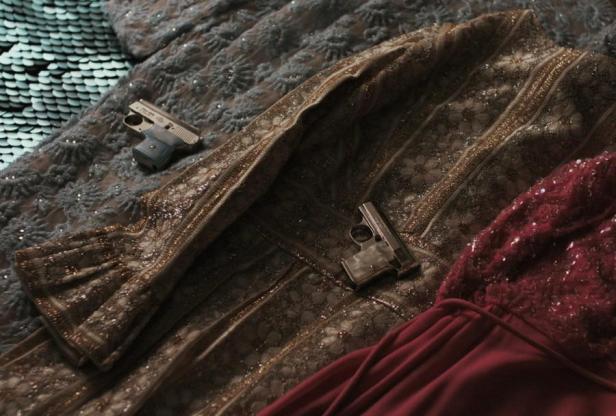
There are the intimate moments between Elvis and Priscilla which introduce some of the potentially darker aspects of the relationship. For instance, they play with a Polaroid camera and Priscilla wears a series of ‘sexual fantasy’ outfits – a maid, a schoolgirl. Here, the ten-year age gap does make such scenes disturbing and Coppola has said that she thought of Lolita (1962), a film she watched as a young woman. This behaviour could be argued as a form of abuse, but perhaps worse is the refusal by Elvis of birth control and his attempts to dress Priscilla like a doll rather than an intelligent young woman quite capable of making her own decisions. I noted these issues but though I don’t condone his behaviour, I do think the actions of Elvis are explainable to some extent given the loss of his mother on the one hand and the control over him taken by both his stepfather and his manager. The miracle is that Priscilla emerges as relatively undamaged at the end of her marriage to Elvis.

It’s a fascinating film, but not particularly enjoyable to watch (though I guess the history of hair and cosmetics may be interesting for some). The cinematography by Philippe Le Sourd, who shot Coppola’s previous two films, appears to create a distinct difference between the German scenes – gloomy inside and grey outside – and the American scenes – still hazy indoors but bright in the sunshine in the grounds of Graceland. Perhaps I am imagining this but I would like to have seen it on a big screen to be sure. In the end, I’m left feeling that my memories of Priscilla will be like my memories of Marie Antoinette (2006) a technically well-made film, and a central performance which does present on a teenage girl under pressure very effectively, but doesn’t tell a memorable story.


Not seen the film, but just an aside as the Dolly Parton version of ‘I Will Always Love You’ was on the soundtrack. There is a story that the Elvis management offered to use this song as a Presley release, but under the usual condition they offered that 50% of the proceeds of this song whenever used be given to the Elvis estate as the promotional push for another artist’s material merited that. Dolly Parton baulked at that, and she proved to be a smart businesswoman, as the Whitney Houston version of that song released alongside ‘The Bodyguard’ made her millions.
LikeLike
Yes that’s the story. The Presley estate denied Coppola the rights to any Elvis songs so her decision to use this track is an interesting response. The lyrics refer to Dolly Parton’s split from Porter Waggoner after he ‘introduced her’ as a singer on his show, only to be eclipsed by her success. The song actually qualifies as another Coppola use of an anachronistic track since it wasn’t released until after Priscilla had divorced Elvis. Dolly is arguably the most clued-up songwriter and performer there has ever been.
LikeLike
An excellent review. I had a chance to see this movie recently and absolutely loved it. I’ve always been a huge fan of Elvis Presley and his timeless melodies. I loved Baz Luhrmann’s biopic as well. Here’s why I adored that film:
LikeLike