
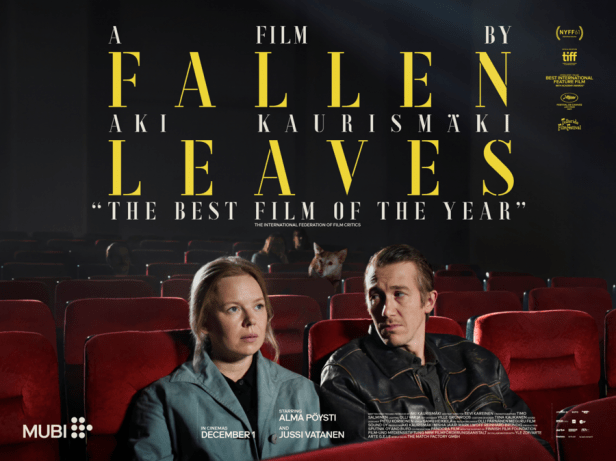
I was keen to see Fallen Leaves in the cinema when it was released in the UK before Christmas but the erratic pattern of screenings locally meant I just couldn’t make it. I’m pleased that it’s now on streamers, including as part of my MUBI subscription. Finnish director Aki Kaurismäki is one of the directors whose work I would always try to see. During lockdown I offered a Zoom event focusing on his 2002 film The Man Without a Past and his so-called ‘loser trilogy’. You can download the notes here if you want to know more about Kaurismäki’s career as a filmmaker (it’s a 7 page pdf):
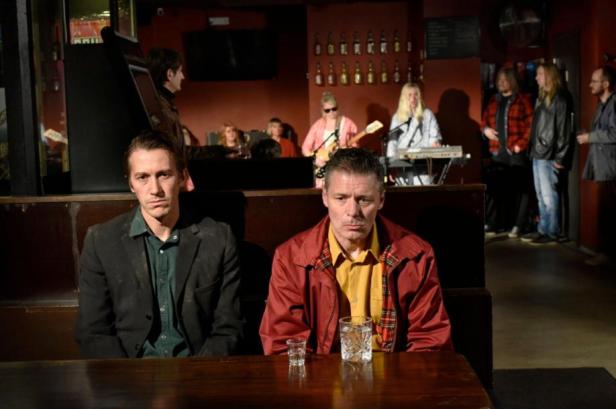
Fallen Leaves, as a title, refers to the 1945 song with music by Joseph Kosma and original French lyrics by Jacques Prévert. The English title of the song is ‘Autumn Leaves’, a very well-known standard. There are Finnish lyrics for the closing sequence of the film. The song tells us that this will be a romance and because it’s a Kaurismäki film it will involve two lonely people. Music is terrifically important in all of the director’s films but especially in the later ones where it is often used to replace dialogue. I do wonder what younger audiences make of his films. The music is usually American roots music or perhaps classical pieces by Northern European composers. As well as the music, the costumes and the locations in this film, as in the others, tend towards the 1950s to 70s in terms of styles so that this is clearly ‘Kaurismäkiland’. I was also reminded this time round of that other distinctive Nordic filmmaker, Roy Andersson, whose Swedish films have a similar distinctive look and ‘out of time’ feel. I’m a big fan of both directors, partly because it is so difficult to be distinctive today.

Cultural references abound in ‘Kaurismäkiland’. Our two lonely people are Ansa (her first name) and Holappa (his second name) – that’s how they are known. On their first tentative date he takes her to the Ritz cinema to see a Jim Jarmusch zombie pic, The Dead Don’t Die (2019). Ansa says she enjoyed it and had never laughed so much. As they stand outside the cinema awkwardly moving towards their first intimate moment, they are positioned in front of an array of posters for coming attractions and in particular one for the British romance melodrama Brief Encounter (1945). As the audience leaves the cinema on another occasion two older men discuss the film they have just seen. One refers to Robert Bresson and the other replies that he thought of Jean-Luc Godard’s Bande à part (France 1964). The IMDb entry for the film lists 16 film titles that are discussed or simply glimpsed as posters. The Jarmusch zombie pic is the only one that is relatively recent. A typically Godardian cultural reference is delivered by a brief shot of the one book that Holappa appears to own. I had to look up ‘Arktinen hysteria’ by Marko Tapio, a title of a novel in two parts from 1967/8 that has also been adapted as a stage play. ‘Arctic hysteria’ may be a phantom psychological condition but the writer suffered from alcoholism much as Holappa does. Holappa’s drinking is the main barrier to the possibility of holding down a job and developing a relationship with Ansa.

I realise that if you don’t know Kaurismäki’s work, you might think that all these cultural references make the film hard to understand and that what I’ve mentioned so far makes it sound grim. But in fact all his films have basic human stories, imbued with comedy as much as with tragedy and the overall effect in my experience is always uplifting. Kaurismäki’s characters are marginalised in modern society. They are working-class loners who are resilient but perhaps sometimes rather too direct. When they come together, however, we all want to cheer for them. There is a wonderful scene early in the film in which Ansa is sat in her room opening her post. We hear the news on the radio about the war in Ukraine and Ansa reads what is probably her electricity bill. She switches off the radio, unplugs other devices and finally turns off the electricity supply altogether before emptying her purse. She has lost her job and needs another. Nothing has been said but we understand. The Russian invasion of Ukraine is of course very worrying for Finns who have fought wars with their neighbour many times. But Ansa’s first concern is another job. It’s almost like a silent film. Kaurismäki has spoken about Chaplin as one of his influences and when a dog appears later in the narrative Ansa names her ‘Chaplin’.
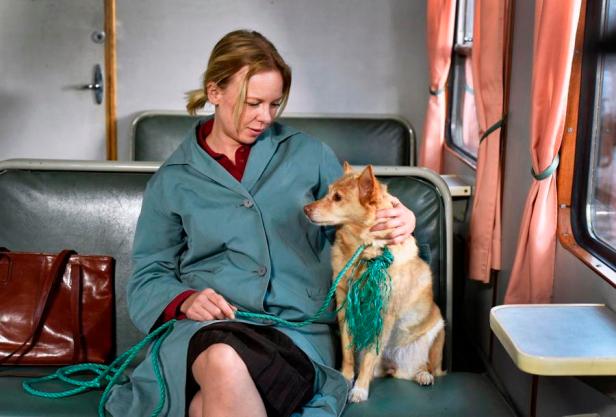
Kaurismäki’s other great love is classical 1950s Japanese cinema and there are some very subtle references in this film to Ozu Yasujiro’s use of ‘pillow shots’ – static images of empty rooms, corridors, buildings etc. that are carefully placed between different narrative sections, almost like punctuation but also carrying elements of meaning. It all looks very simple but everything is carefully choreographed and the performances in the film are just as good. Ansa is played by Alma Pöysti, seen recently in the eponymous title role of Tove (Sweden-Finland 2020) the biopic of the creator of the Moomins. I was wowed by that film and I loved her performance in Fallen Leaves as well. Holappa is played by Jussi Vatanen, seen in the Finnish TV drama The Man in Room 301 (Finland-UK 2019-2020) broadcast on BBC4 in the UK. He is tall, thin and handsome but gaunt in Fallen Leaves and also very good. Regular collaborator Timo Salminen is in charge of the cinematography and Fallen Leaves is 81 minutes of pure joy to watch and to listen to. If I had seen this in December it would have been on my list of the films to celebrate from 2023.


81 minutes of pure joy is what I got from this. Possibly the best of the year. Glad you had a similar experience.
LikeLiked by 1 person
I really enjoyed this film at the Hyde Park Picture House. It is sad that it was difficult to see at the cinema. I fear that streaming, like video discs, is not good for the health of actual cinema.
And a word for the excellent supporting canine role by Chaplin. There appears to be a homage to ‘Modern Times’ with all three of this lovable trio.
LikeLike