
I managed to find a subtitled showing of Miyazaki Hayao’s latest film at the Vue in the Light in Leeds – definitely an improvement in the availability of Studio Ghibli films since The Wind Rises in 2013. The English title of the film is a fair reflection of the story in one sense but the Japanese title refers to a book, important to Miyazaki in his childhood and featured in the film. The book is How Do You Live? by Genzaburo Yoshino. Published in 1937 it is a book aimed at educated boys in that familiar mode of Japanese publishing for young people and in this case it is about ethics and learning how to live in the world. Not surprisingly it was suppressed by the militarist authorities during the Sino-Japanese War.
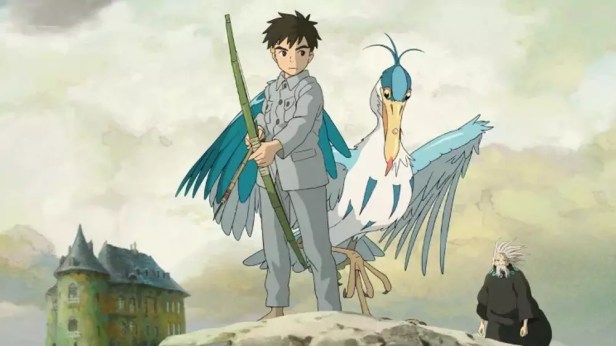
Miyazaki’s film is not an adaptation but it has similar aims. The reference clearly points to a film inspired by Miyazaki’s biography in some way. It also appears to link to the earlier Studio Ghibli films, My Neighbour Totoro and Grave of the Fireflies (both 1988 and at one point presented in a double bill) and The Wind Rises in terms of Miyazaki’s family history and commentaries on Japanese historical events from the 1930s through to the 1950s. The narrative begins during the Pacific War in Tokyo when a young teenage boy, Mahito sees ashes floating in the air and realises that the hospital where his mother works is on fire. He runs towards the fire but his mother dies. There is some confusion here over exactly what is happening. There were air raids, very small in scale, on Tokyo in March 1942 and a small number of incendiaries were dropped. A military hospital was hit at some point. In Sight and Sound, Winter 2023-4, Nick Bradshaw writes that Miyazaki himself in voiceover tells us that his mother died three years into the war and a year later he and his father left the city for the countryside. In Adam Nayman’s S&S review in the same issue, the synopsis suggests that Mahito moves to the countryside in 1943 after his mother’s death ‘in a fire’. I didn’t think the fire was caused by incendiaries. The notorious fire-bombing of Tokyo by the Allies took place in 1944 and is depicted in Grave of the Fireflies. My reading was that the narrative leaps forward a couple of years to the move to the family’s country home. Mahito’s father has married his dead wife’s sister Natsuko and his aircraft factory is now located close to that home, away from the bombing. Mahito struggles with the idea of a stepmother who looks just like his mother for whom he is still grieving. He is soon aware of a grey heron which seems particularly interested in him and which we suspect is some form of ‘spirit guide’. The boy is susceptible to any suggestion that might lead him to find his birth mother even if she is supposed to be dead.
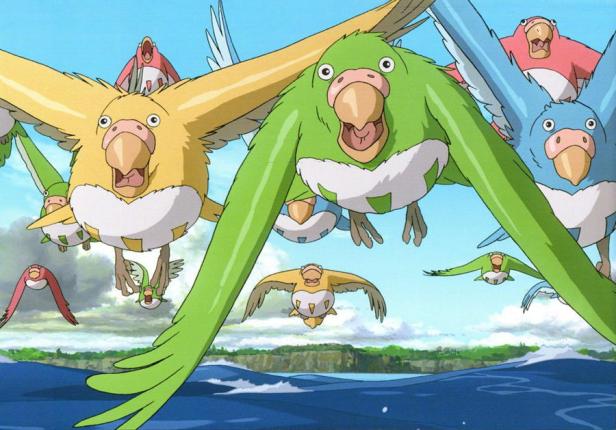
Without giving away too many plot developments, Mahito and the heron will eventually follow a pregnant Natsuko into ‘another world’. They find it through a ‘tower’ in the forest. which had first appeared soon after the Meiji Restoration in 1867. Mahito’s great-uncle, an architect, attempted to build a structure around the tower, but failed. The status of the tower is never clarified but Mahito will eventually meet his great-uncle and discover the problems of this ‘new world’. These include an army of human-sized parakeets armed with sharp knives and machetes. This ‘army’ has a distinctive fascist style leader, a ‘king’ of parakeets. I won’t spoil any more.
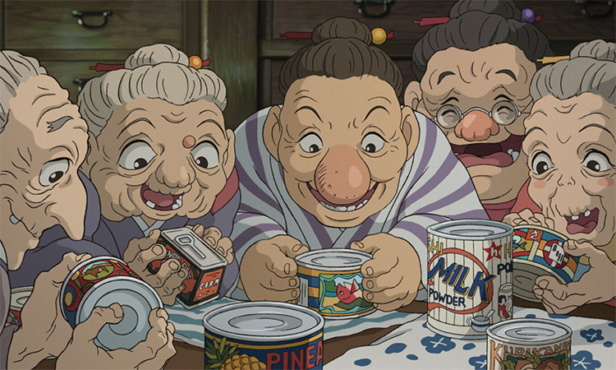
At just over two hours, the film is a visual treat and thoroughly engaging even if, as I watched it, I struggled to make sense of the narrative. We are in one of Miyazaki’s more serious adult worlds as in The Wind Rises (and the move to the country was earlier the starting point of My Neighbour Totoro) but at the same time some of the characters might have wandered out of Spirited Away. This is certainly the case with the elderly maids in the traditional country house who are rounded but gnarled and bent by work and age so that they scurry about around Mahito. The other characters are in one sense conventional in this kind of ‘alternative world fantasy’ – such as the great-uncle who has become a creator of worlds. On the other hand, the two ‘warrior-helpers’ who will make sure Mahito meets his great-uncle are both women. One is a powerful fisherwoman and the other is a childlike figure with power over fire. This takes us back to the young women who are the protagonists of films like Princess Mononoke (Japan 1997). There are moments of ecological awareness in the story and a few jokes, but essentially Mahito is on a quest. For him the quest is to find his mother, but the purpose of the story actually seems to be to teach him that he must work towards making the world a better place – i.e. as in the Japanese title from the novel by Genzaburo Yoshino, How Do You Live? A coda to the quest narrative suggests that Mahito might find his place in Japan after the end of the war.

In the UK The Boy and the Heron has been classified as a ’12A’ (needing adult accompaniment). That seems about right to me and matches many other territories. I think the subtitles are taken from the same script as the English-dubbed version. I did think that at points the translation was too anachronistic, losing some of the feel of the 1940s. I presume the translation is intended for the US market, though glancing down the English voice cast list, UK-born actors seem to predominate.

Miyazaki will be 83 years old next week. His previous film was thought to mark his retirement in 2013 but this feature has appeared ten years later, partly delayed by COVID. In his prime he produced a feature length film every three or four years. On The Boy and the Heron it appears that Miyazaki himself focused on storyboarding the narrative, allowing others from the studio to lead the animation team. The animation is less detailed in terms of minor characters, though the imagination and creativity shines through. I have no idea as to whether he can make another feature but if not . . . this is certainly a fine production to end his career.
There are some loose ends to the narrative and I clearly need to see it again to attempt to fully understand what the story is telling me, but this was a great way to end my cinemagoing in 2023, a horrific year in many ways. The release seems to be doing better than The Wind Rises which is not surprising, given the focus on the boy and the sense of autobiography. So far we haven’t seen complete returns from several major territories but it is likely to gross $175 million worldwide, some way below the take of Spirited Away back in 2001 but up on The Wind Rises. I recommend the film, preferably in the Japanese dialogue version. But it will deliver most if you have already seen several Miyazaki films. If you haven’t, I suggest watching a couple first.


I am not surprised that this Miyazaki film is getting a wider release. I saw the dubbed version at Showcase, not by preference but a friend booked and in all honesty the dubbing was fine, not remotely of ‘The Water Margin’ standard. When I saw the cast list for the dubbed voices it was apparent that the studio is treating this as an important release, with Christian Bale and Florence Pugh just two of the voices on offer. To the unsuspecting viewer they were indistinguishable from any other two jobbing actors. For the seasoned Miyazaki fan there is nothing new here, but it is all exquisitely done with very detailed backgrounds. Each granny, while superficially similar, has their own distinct look and personality. If it is the last Miyazaki, not a bad one to go out on but possibly too many ideas in the mix.
LikeLiked by 1 person
I travelled to The Showroom for a Japanese version of this animated feature. Like Roy and John I found the feature a visual treat. The narrative is not that straighfoward. I felt that it is more a series of episodes than a continuum. I wondered if the original book has the same feel. I had the same feeling, though to a lesser degree, with ‘The Wind Rises’
LikeLike
As I understand it, the ‘original book’ was mainly an inspiration or a starting point – or simply a title that Miyazaki remembered from his childhood. Most of the incidents in the narrative are prompted by Miyazaki’s memories.
LikeLike