

Sometimes, productions born out of difficult situations can turn out very well, especially if the ingredients have great potential and they are all realised. On Dangerous Ground is a tightly-wound 82 minutes starring Ida Lupino and Robert Ryan, directed by Nicholas Ray with cinematography by George E. Diskant and music by Bernard Herrmann. It’s a film noir crime melodrama adapted by A. I. Bezzerides and Nick Ray from a novel ‘Mad With Much Heart’ by Gerald Butler, a British crime writer who seems to have been known as the “English James M. Cain” in America. Three of his novels became films.

The ‘difficult situation’ here was basically the troubled state of RKO Studios and how it affected Nick Ray, but also the difficulties both Ray and Lupino faced in their personal and professional lives. Nick Ray was trapped by his contract at RKO and found himself having to deal with Howard Hughes in his violently anti-communist phase when he tried to ‘cleanse’ the studio. Ray, Lupino and Ryan were all liberal, Democrat or left. Ray was also attempting to establish his status so that he could make films without too much studio interference. I described some of the problems he faced on the production of A Woman’s Secret (US 1949) and in 1950 after he had got ‘time out’ to make In a Lonely Place for Humphrey Bogart’s company he was faced with making another picture for Hughes to be squeezed in before he was set to direct Flying Leathernecks, a project that enthused Hughes because it was a flying picture and decidedly ‘gung ho’! In fact, Ray had started work on Butler’s novel in 1949 and it was nearly three years before the adaptation was finally released thanks to the struggles Ray had with producer Sid Rogell and Howard Hughes. Ray, his producer John Houseman and RKO contract player Robert Ryan eventually persuaded Hughes to give the go-ahead. Born to Be Bad, another RKO picture with Ryan and directed by Ray would eventually appear in 1950, again after a delay of a year. Such was RKO under Hughes.
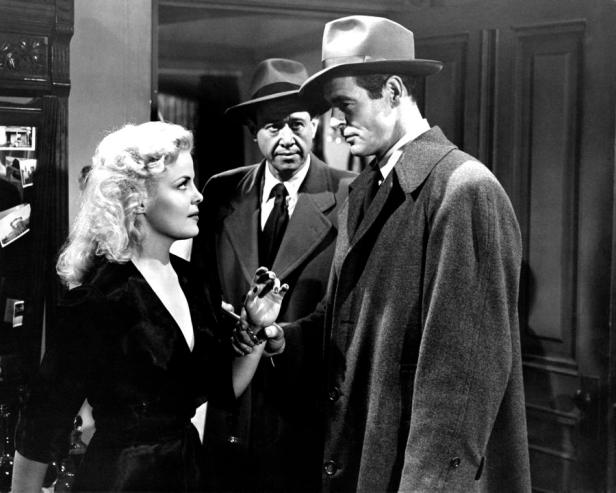
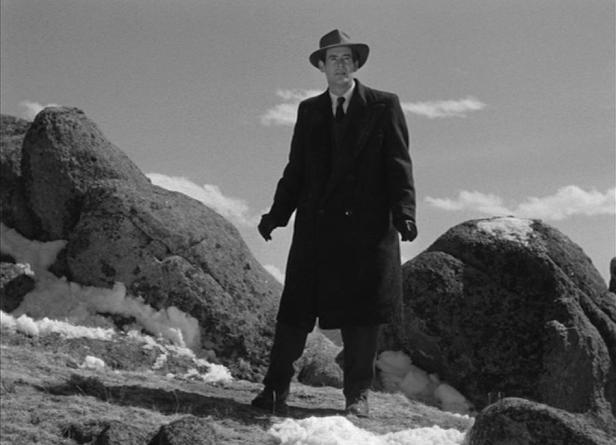
The basic narrative idea of On Dangerous Ground is a story in two parts. Ray and Bezzerides actually created the first part in which we meet Jim Wilson (Robert Ryan), a police detective in the city who has gradually been degraded by his work among the ‘snouts’ and ‘pushers’, the ‘girls on the game’ and the gangsters threatening businesses. Jim now solves problems with his fists and his gun, beating up suspects, who are certainly guilty, but as Captain Brawley (Ed Begley) points out, are unlikely to be convicted if they confessed after a beating. Jim is dangerously psychotic after eleven years on the job and Brawley seizes an opportunity to send him out of the city (which isn’t named), 70 miles ‘up state’ to the hill country deep in snow (the sequences were shot in Colorado). Here he must help out in the hunt for the killer of a young girl. This forms the second part of the story which comes directly from the Butler novel. But in terms of genre, there are perhaps three stories since the final section focuses also on the potential romance between Jim and Mary (the character played by Ida Lupino).
There is almost too much to say about On Dangerous Ground. It offers one of the most compelling of all Ida Lupino’s performances, though it is again a film in which Ida has top billing but she only appears in the final section of the film. The pairing of Lupino as star and Ray as director seems like a good match. I like to think that she would already be aware of his talent and equally he would be honoured to direct her. Although there are disputing claims it seems that Lupino agreed to work on the film as part of the arrangement that would see her next films as a director (from the company she owned with her husband) distributed by RKO. The studio perhaps saw her presence in the film as a bonus that might attract audiences, in a sense reducing the risks associated with the distribution of the unknown qualities of her independent productions. Lupino had already made and released two films before the RKO deal. Her third feature, Outrage was released by RKO in 1950 and her fourth, Hard, Fast and Beautiful in 1951. She had made the latter during the production of On Dangerous Ground and she and Ryan appear among the spectators at a tennis match. Lupino’s company then made Beware My Lovely starring Lupino and Ryan together and it was released by RKO in 1952. There have been suggestions that Lupino directed some scenes in On Dangerous Ground when Ray was ill. This is widely quoted in reviews but I haven’t yet found any evidence, but we do know that Lupino shot a test of Ray as an actor for her own film. Ida was reluctant to see her self credited for work on films that were properly someone else’s. She was a trouper and and a great collaborator.

Third-billed in this film is Ward Bond, typed yet again as the loud, blustering man who must be contained – though this time his anger is generated because his daughter has been killed. It’s a classic film noir set-up as Ryan’s Wilson seems to be suffering some form of PTSD (though the war, a familiar noir ingredient is not mentioned) and when he arrives in hill country, he meets Bond’s father figure, Walter Brent, with a shotgun and no time for niceties. Brent and Wilson are at this point like mirror images. The title of the film may refer to either Wilson or Brent, to the snowy landscape itself or the psychological ‘landscape’ on which the narrative plays out. The irony of perspective is that we realise Ryan is acting the role of a wild and dangerous police officer whereas Bond is playing to type and as an actor he was one of the main supporters of the anti-communist drive within the Actors Guild. In a straight contest, Ryan would have won at nearly 6 foot 4 and an undefeated college boxing champ. Another intriguing casting decision offers us Olive Carey, wife of Harry Carey and like Bond a member of John Ford’s company – but a Democrat, I think. Nick Ray’s nephew, Sumner Williams plays Danny, the suspected killer. Wilson and Brent are together only in the sense that Wilson recognises that on his own Brent is likely to shoot the first suspect he sees. Hurtling off in the chase and eventually crashing a borrowed car, they eventually come across the remote house where they are welcomed by Lupino’s Mary. Wilson senses and understands that Mary is blind but Brent thrashes about and then storms off looking for Mary’s younger brother. We fear what will happen.

Monthly Film Bulletin‘s reviewer ‘PH’ in the June 1952 edition gives the film a mixed reception. The story “attains an unusual level of pretentious foolishness” but “also remarkable is the strikingly clever and forceful technique with which the material has been put together”. I’d have to say that the reviewer displays the particular values of the time in suggesting that the combination of Mary’s blindness and concern for her younger brother is bound to produce a “whimsical philosophy”. Lupino plays her role “with customary high-geared intensity” according to PH. I think that Lupino plays the role very sensitively and with great intelligence aided by Ray’s direction. George Diskant’s camerawork is exceptional with use of subjective camera shots and, earlier in the film, hand-held imagery of policing in the city. Bernard Herrmann similarly makes his mark, especially in the opening sequences in the city and the during the chase across the snow in the mountains. Despite all the studio restrictions, Houseman and Ray produce a film with a real charge. Watching it this time I was impressed by the way that the scenes in the hill country with the snow-covered landscapes act like an ‘anti-noir‘ in the sense that the city is incredibly ‘dark’ – mainly seen at night, whereas the hills are startlingly white. At the inevitable end of the chase comes a conclusion that was by all accounts changed at the request of Lupino and Ryan. Well, it worked for me, as did the score that Herrmann fought for and which included soloist Virginia Majewski playing the viola d’amore that presents Mary’s theme. It’s a great melodrama ending.

The film received mixed but generally poor reviews on its release in the US in December 1951. It lost over $400,000 according to RKO’s accountants. It seems incredible now that the critics at the time didn’t understand what Ray was attempting to do. Their complaints seem to have been that in the first half of the film, there is little narrative as such and that in the second half the story is ‘ridiculous’ – even the producer, John Houseman, although a great supporter for Ray, seems to have thought this. Are we really now so much more sophisticated? I don’t know, but I first watched the film in 1975 and was very impressed at the time. Since then it has got better as I’ve realised how rich a film text it is. I’m not alone by any means, the film has grown in stature and is now widely celebrated as one of Ray’s best films. It shouldn’t work because of all the cuts before the final release print. But all the creative inputs are of the highest standards and Ray’s vision is delivered in detail. Here’s the original trailer. I watched the Warner Archive DVD. It is available to buy online as a digital print in the UK and freely available to rent from a wide range of streamers in the US.
Check out this perceptive review essay by Adrian Martin
Some of the material above references the Bernard Eisenschitz book, Nicholas Ray: An American Journey, English translation edition 1993, faber & faber
 itp Global Film
I have seen this as I think it regularly used to appear on the channel that now calls itself Legend but now has considerably fewer legendary films to draw on. It is certainly enjoyable but it struck me as a little discordant with the abrupt transition from gritty noir city and hard-bitten cop to the snowy landscape and rather angelic blind lady. Not too surprised if it left some of the cinema patrons of the era reluctant to tag along. Their loss, I suppose.
LikeLike
Interesting. I have noticed the Legend channel but when I looked it up I discovered it used to be the ‘Horror Channel’. I wouldn’t have thought a crime melodrama really fitted the channel’s profile. Having said that I have occasionally found gems on some very odd channels.
LikeLike
On reflection I might have got this wrong. It certainly cropped up early doors on 41 or 42, both having been renamed now, with 41 as Legend and 42 as Great Action (a bit of a misnomer here). There were more noirs at one time than currently, and I think they came on Action. Out Of The Past was a regular visitor.
LikeLike