
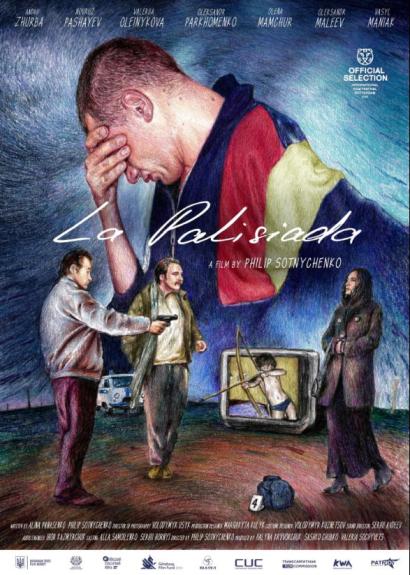
La Palisiada proved to be the most difficult of the films I saw at LIFF 2023 for me to disentangle. This isn’t necessarily a criticism of the film since some of the aspects I found difficult to follow were deliberately designed in that way. More, it is a question of my tiredness and struggle to concentrate. After the screening I discussed it with my viewing colleague and then searched for other reviews and information. I think I’ve now got something of a handle on this début feature by writer-director Philip Sotnychenko and his co-writer Alina Panasenko.

The film’s title is, I think, a made up term. It appears in the film as a favourite term of one of the two lead characters and it is suggested that it means “something that is used to explain something that has already been explained” – or something like that! This is a drama related to the approaching date when capital punishment in Ukraine will be abolished in 1996. It concerns two investigating police officials, one of whom is a forensic psychiatrist, and a case in which they are looking for the killer of a senior police officer. But it’s also a black comedy about the absurdity of the situation with plenty of dark Slavic humour. The narrative is in two parts. In the first short section it is the present day (i.e. 2022) and we meet a young artist and his friends. The young man appears to be the son of the psychiatrist and he may be in a relationship with the daughter of the detective, although we don’t know this yet. After a meal involving the two families, there is a shot fired in anger. The second (far longer) section flashes back to 1996 and the procedures leading to the arrest and eventual verdict of guilty, pronounced on the hapless suspect. This second section is shot on analogue video to more resemble the technology of the period and we do indeed see the police team using video technology and watching back the tapes. Just to confuse matters the opening shot of the first section is seen through the plastic windows of the young artist’s room – which creates a blurry image not dissimilar to video. Cinematographer Volodymyr Usyk is an important part of the creative team. Neil Young suggests in Screen Daily that the director and cinematographer, “shooting with consumer-grade video-cameras from this era achieve a striking verisimilitude in terms of period detail and atmosphere”. From my perspective the final big-screen image looks far better than the video formats of 1996 generally achieved.
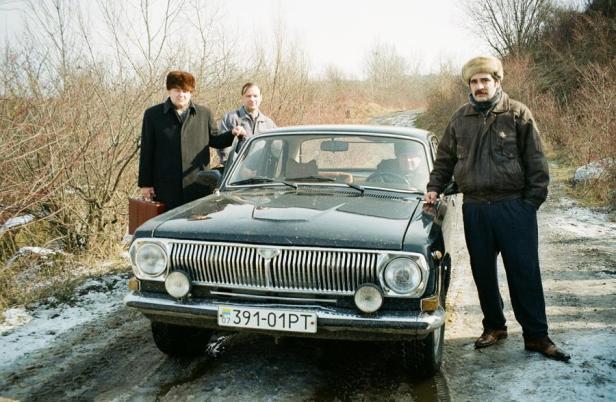
The aesthetic of the film is mainly built around long shots and long takes of the police procedure, including ‘reconstructions of the crime’, line-ups and interrogations. The two investigators are sent from Kyiv to the west of the country. The image we get of Ukraine in the 1990s is of a decidedly run-down country, perhaps best represented by the flea market that grows up over the railway tracks – it’s a shock when a train runs down the tracks and the stallholders reluctantly remove their goods from over the rails.
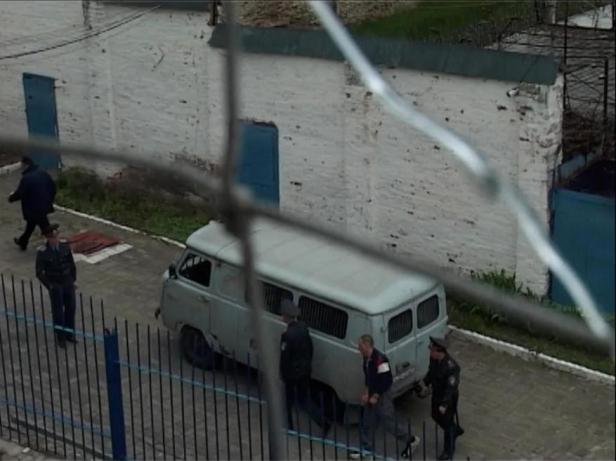
The comedy in the film comes from the small details and the way in which the narrative ‘immerses’ us in the investigation. The long shot approach also allows us to see action in the background. One sequence that stuck with me was the funeral of the murdered police officer. It appears to be a formal occasion with two soldiers on guard at the entrance to the house as the coffin is brought out carried by police colleagues (?) but as soon as it is out of the house, a local man walks from behind, past the static camera and down the pavement as if the carrying of the coffin was just an everyday event. We watch him walking on as the guards leave the door. (I might have got the description of this scene slightly wrong but the point remains I think.) I think it is also during the funeral that a song is playing through speakers when the sound begins to cut out. We then realise that a cheeky kid is deliberately pulling out wires from the speakers.
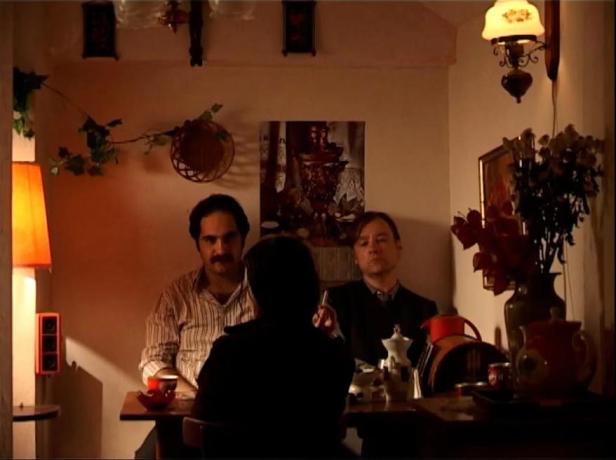
During the suspect line-up, which takes place in a theatre, the witness sits in the stalls and lines of men are brought onto the stage. The witness only makes a more confident identification when the suspect changes his jacket. We, the audience, don’t have any real confidence in her identification, just as the questioning of the suspect in order to determine whether he has mental health problems seems fairly perfunctory. The reviewer from Cineuropa suggests that the final sequences of the execution are filmed in Bucha, a city which has since been identified with Russian war crimes.
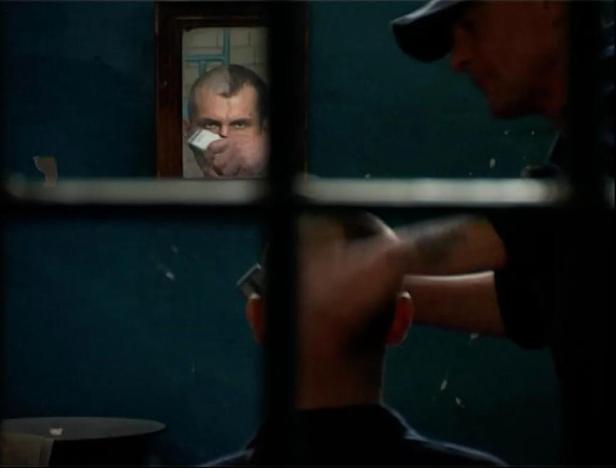
Throughout the film, I get the impression that there are references to events and aspects of culture which will mean much more to Ukranian audiences and those from the old Soviet bloc. Over the past thirty years or so Ukranians have seen the independence of Ukraine but still the vestiges of Russian control, The ‘Revolution of Dignity’ and the subsequent annexation of the Crimea and parts of Eastern Ukraine in 2014 and then the attempted Russian invasion in February 2022 and the continuing war. I’m sure the film responds to this series of events in various ways but I’m not sure exactly how. I do wonder about the school concert in 1996 in which the children of the two investigators are part of a chorus line singing about turtles – possibly of the ‘Mutant Ninja’ variety.
As another reviewer remarks, given the international interest in the Russian-Ukranian War, film festivals and potential distributors are likely to be on the lookout for Ukranian films that offer a commentary of some kind and this one comes with strong recommendations so it might be seen more widely. Here’s the trailer as a taster.
 itp Global Film
Great film, deliberately opaque but that just makes it more interesting. Captures 90’s Ukraine beautifully. It requires several viewings I actually watched it three times. Weil worth seeing.
LikeLike