

Celine Song’s début film Past Lives qualifies as a hit in the UK, currently appearing in the Top 15 films on release and making over £2 million at the box office after 5 weeks. It has received very good reviews and is still making the rounds of independent cinemas and the chains of ’boutique’ specialised cinemas – it’s distributed by Studio Canal. I want to record my unusual experience of watching it in the Curzon Cinema in Camden in a 30-seat auditorium, one of five such screening rooms built under railway arches. You can hear the trains running over your head but I didn’t really find that a problem. The screen is very large in relation to the number of seats and the presentation was very good. I did pay roughly twice what it would have cost me in my usual cinemas in West Yorkshire or Lancashire. On the other hand, I had the luxury of being the only person in the room for an afternoon showing.

I was attracted to the film because I had read that Celine Song was a Canadian-Korean filmmaker and I like to find Canadian films. I was a little disappointed to discover that although the film is inspired by the writer-director’s biography, the film is actually set mostly in New York with some sequences in Seoul and a couple of brief moments in Toronto. Celine Song moved to New York for an MFA in play writing at Columbia University in 2014 after her first degree at Queens University, Kingston, Ontario. In many ways the film is really what I would classify as an ‘American Independent’ feature produced by A24 partnered by CJM, the major South Korean entertainment company. Nevertheless, I still enjoyed the film very much.

The plot of the film is very simple. What follows is not a spoiler, just a description of the narrative structure. Two school students in Seoul, Young Na and Jung Hae Sung have developed a very strong connection when Na’s parents decide to emigrate to Canada. Na is given a new name ‘Nora’ and she and her sister accompany their parents to Toronto. It’s a big break for Nora at age 12 and she struggles to part from Hae Sung. The parents are both concerned with the arts and they believe their daughters will be better placed in North America to make the most of the opportunities that come their way. Leap forward 12 years and Nora is in New York for her MFA. She accidentally (?) discovers that Hae Sung has been looking for her on Facebook (this would be around 2010). They re-connect via video calls and the relationship rekindles online but eventually the calls stop. Twelve years further on they re-connect again. Nora is now a playwright and she is married to a writer. Hae Sung is now employed as an engineer and not yet married. They discuss whether they will ever travel to see each other. Eventually Hae Sung travels to New York for a week’s holiday and meets Nora and her husband. That’s it. The story of course is what happens in each of three time periods and specifically the kinds of emotions and ideas that the two central characters experience.

The grown-up Nora is played by Greta Lee, a second generation Korean-American born in California. The grown-up Hae Sung is played by Teo Yoo (Kim Ch’ihun), a German-Korean who has worked internationally in South Korea as well as the US after training at RADA in London. Nora’s husband Arthur is played by John Magaro, well known from numerous TV and film roles. I remember him from Kelly Reichardt’s First Cow (2019). All the performances are very good and I also enjoyed the camerawork by Shabier Kirchner, best known in the UK for his work on Steve McQueen’s Small Axe films. The music by Christopher Bear and Daniel Rossen is also worth picking out and among the seemingly myriad executive producers and producers, the name Christine Vachon stands out as perhaps the most experienced independent producer around in the US. For a début film, Celine Song certainly had a cast and crew of very talented people. What did they achieve?
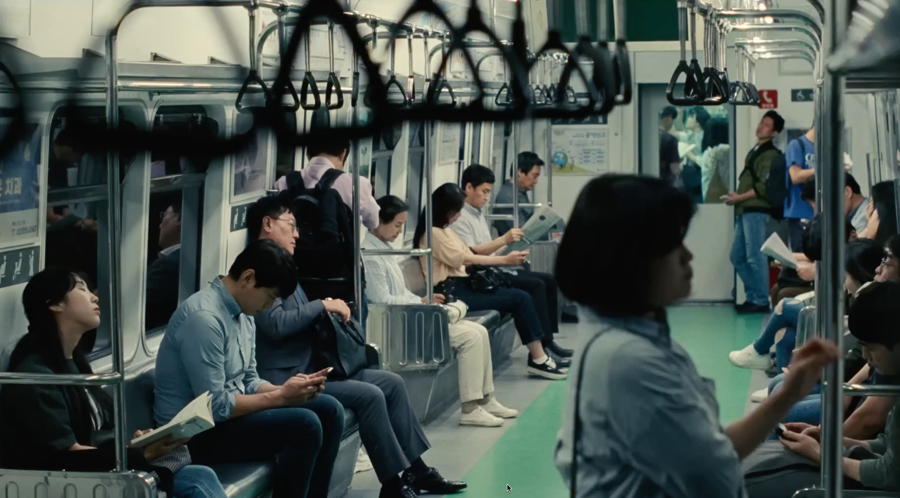
Rolling Stone called the film a “Stunning Pitch-Perfect Romance” and that is echoed in many other reviews. I also think the romance angle is what has made it such a popular success around the world (with several major territories still to come). But I’m not sure that’s all there is to it. There is also discourse about memory, separation and the impact of emigration as well as discussion of fate. Nora discusses the Korean concept of ‘in-yun’ and relates it to chance encounters when you might accidentally brush against someone with whom you had a close relationship several lifetimes ago. Are you then bound to become close to them again? Nora’s mother (I think) is the source of an observation about emigration – there is much to gain, but also something to lose. These kinds of questions permeate the film but not in a direct way.
One of the observations made by several reviewers is perhaps best summed up by Simran Hans in Sight & Sound: “Song is also sharply aware of the power of the unsaid, of what can be articulated through pauses and gestures. As the film swells to its emotional climax, not a word is spoken.” Watching the film, I felt that there was space for thinking built into the script and I began to think about people and events from my past. I was so glad that this wasn’t a rom-com. The film doesn’t feel impelled to create familiar kinds of meetings and incidents to propel the narrative forward. I also enjoyed the opportunity to join Nora and Hae Sung on a leisurely stroll by the Brooklyn Bridge and on a boat trip around the Statue of Liberty – though we do get the familiar response from Arthur about being a New Yorker and never having been to the monument. In relation to this day out, Nora tells Arthur that her meeting with Hae Sung raised questions of what it felt like in terms of being Korean or ‘not Korean’. Hae Sung had told her twelve years earlier about how he noted she was losing her Korean language skills.
There are some absences in the film. I would have liked to know something about what happened to Na’s sister and possibly her parents to see if Nora’s ideas/behaviour were similar or different as someone with a ‘hyphenated identity’. I realise too that by the end of the film I felt sorry for Hae Sung or perhaps that I simply wanted to know more about his life. There is a very sad moment in the narrative when he tells Nora that he can’t marry his long-term girlfriend back home because her parents think he isn’t good enough/rich enough for her. By contrast Nora seems to have achieved most of her goals without difficulty. This really is a film that got me thinking!
It should still be around so do try and see it. Here’s the US trailer:


I saw this with Richard and Heather and we felt a bit disappointed after the hype the film received – just a bit long, lacking in pace and the rise of the tyro film writer a bit implausible. Of course Arthur’s cardigan is enough to show that he is not sensitive enough for her. But perhaps we should have been more willing, like you, to go with the slow pace
LikeLiked by 2 people
Yes, we should talk about this. I want to know more about cardigans and sensitivity!
LikeLike
I saw this at Leeds Vue several weeks back, where I believe it is still playing, and also enjoyed it. It was the ultimate Friends Reunited film but more subtly played than that makes it sound. Friends Reunited was, of course, superseded by Facebook where the two protagonists intially reconnect, hopefully, before real life intervenes. I think it is a story that would resonate many.
LikeLike
That’s a really good point John. I never used those social media apps so I didn’t appreciate the importance of the Facebook searches. The film does indeed seem to have the ‘legs’ for a long run. It may turn to be the arthouse hit of the year.
LikeLike