

This was Douglas Sirk’s penultimate film in Hollywood and it is unusual for several reasons. First it takes Sirk back to (West) Germany to make an adaptation of an Erich Maria Remarque novel about a few weeks in Germany in 1944. Remarque himself appears in the film. Second, the film is in CinemaScope and Eastmancolor and last 132 minutes. Third it is a highly ‘personal’ film for Sirk whose son, brought up as a Nazi by his first wife, was killed on the Eastern front in 1944. Finally it is a film with a new, young actor, John Gavin who would also appear in Sirk’s last Hollywood film Imitation of Life. The female lead, the Swiss actor Liselotte (Lilo) Pulver was also new to American audiences.
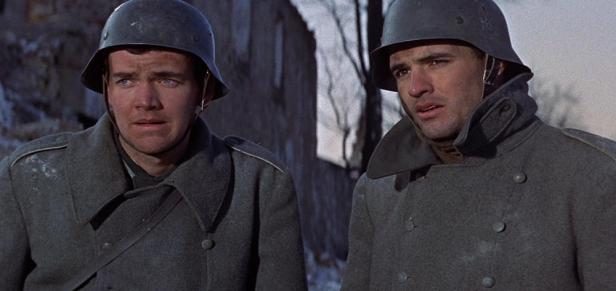
This must be one of the first films by a German filmmaker seen in the US/UK to present conditions in Germany on the Home Front during 1944. As such it introduces a Hollywood version of the post-war German genre of the ‘rubble film’ or ‘Trümmerfilm’. The narrative follows Lance-Corporal Ernst Graeber as he takes three week’s leave from the front and travels back to Berlin only to discover that the street on which he grew up has been reduced to rubble during Allied air raids. He struggles to find his parents but does find a young woman, Elizabeth, the daughter of his family’s doctor. She is living on her own in a house ‘ruled’ by an older woman, a Nazi ‘block warden’ and her father is in hiding. Elizabeth works in a factory making uniforms for the Wehrmacht.
With his great interest in titles Sirk was able to change Remarque’s title, at least in English. The change from ‘A Time to Live’ to ‘A Time to Love’ is significant. Sirk’s film is primarily a love story sandwiched between two relatively short sequences on the Eastern Front. These sequences are almost abstract in setting – they reminded me of the First World War sequences in The Life and Times of Colonel Blimp (UK 1943). By contrast, the long sequence of the love story in Berlin is presented in a more ‘realist’ way. The film was actually shot mainly in Bavaria. Remarque plays a cameo role as Graeber’s old teacher who is in hiding because of his political views. The film does have elements of a familiar ‘anti-war’ film, especially in the scenes at the front but it is the sense of the community under attack, both from Allied bombing and Nazi surveillance that is at the centre of the narrative.
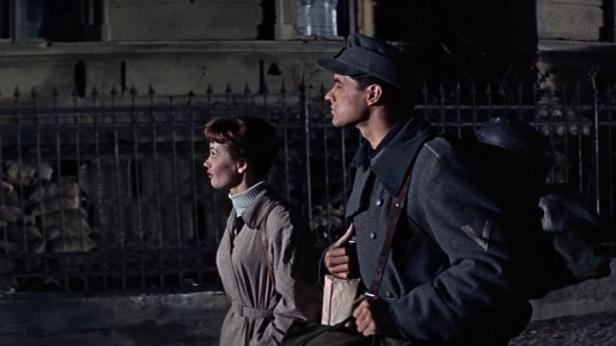
One of the features of the many interviews that Sirk gave after his retirement from Hollywood is the almost complete absence of his experience during the First World War. Sirk was born in April 1897 so he would have been 17 when the war started. At one point it was reported that he had been a student in a naval college and that he had become a Naval officer and served in Turkey. He also said that his interest in flying began during the war. There are other significant gaps in his life story and in several cases the stories he tells his interviewers are possibly ‘false memories’ – he often claims not to remember. Apart from his concern about his son, there is little concrete to say about his experience in 1939-45 which he spent in America. The adaptation was by Orin Jannings, a writer in his forties and born in New York. Sirk did return to Germany in 1949 and he appears to have searched for information about what happened to his son. In interviews he says that German audiences didn’t accept the film and that it was banned eventually in both the Soviet Union and Israel. It was not a box office success in America and one of its few supporters was Jean-Luc Goddard, ahead of the game as he often was. In the UK, Monthly Film Bulletin‘s reviewer finds several good points in the film but overall thinks it doesn’t work. I’m struggling to think what it must have been like to watch this film in 1958 in the context of so many British and American wartime pictures and with memories of the war seemingly so close. I did watch the film around five years ago and although I enjoyed it, I struggled to work out what I thought about it. But this time, deeply immersed in Sirk’s films and what I could discover about his ideas, I was very impressed with the film.

The most pertinent issue for audiences was probably the presentation of Ernst as what became known as the ‘Good German’ in wartime films. But Sirk was unrepentant. He always argued that highlighting aspects of social criticism in films is a bad policy. Remarque’s novel has several examples of ‘social criticism’ but there are perhaps fewer critiques of Nazi attitudes and behaviour than audiences might have expected. Sirk did include some pointed scenes, including a sequence when Ernst visits an old school friend who has become a Nazi officer and lives in an ostentatious manner in a large house where senior Nazis enjoy parties. Sirk said later that he wished he’d cut out more scenes like this, arguing that would make the film more powerful. He makes the same arguments about his lauded American family melodramas.
But the really important issue for Sirk is the love story, the brief three weeks of tenderness and humanity amidst the horrors of war. In this context it is the humanity of the people sheltering from the air raids that is as important as the signs of oppression and brutality that are still visible.

Sirk was able to resist any studio pressure to cast stars in the lead roles. In fact he says the studio wanted him to create a new star in John Gavin, as he had done with Rock Hudson. Gavin is an intriguing presence. He is literally ‘tall, dark and handsome’ and therefore not stereotypically ‘Aryan’. His family heritage goes back to the period of Spanish California. He had little experience as an actor but Sirk is able to use his physical presence, his solidity and occasional awkwardness and I think there is a chemistry with Lisolette Pulver who was experienced in German cinema and had already appeared in Jacques Becker’s Arsène Lupin film in 1957. I think she has enormous vitality as well as being very attractive and I found their scenes together became very moving in the second half of the narrative. Apart from Keenan Wynn in a small but quite important role, I didn’t recognise the other actors apart from Klaus Kinski as a Gestapo officer. Russell Metty’s cinematography is excellent as usual and I was impressed by Alexander Golitzen’s art direction. Leslie Carey was nominated for sound, the film’s only nomination.
I can’t find a decent quality trailer, but here’s a clip from a sequence in the air-raid shelter by Elizabeth’s building.
 itp Global Film
I have seen this film a couple of times in 35mm and CinemaScope prints; I really like it. I wondered if Roy saw it on film or in digital?
I do think John Gavin is rather limited in his role but that Lilo Pulver is delightful. She has a fine supporting comedy role in ‘One, Two, Three’ (1961). The CinemaScope colour cinematography is excellent. And Klaus Kinski has a memorable scene.
I wondered why it was banned in Israel?
LikeLike
Sirk couldn’t understand why it was banned in Israel, he thought the ban was ‘silly’. Presumably there are too many ‘Good Germans’?
LikeLike
I agree with Sirk. Now Wikipedia has a page on ‘Censorship in Israel’. It notes,
“Israel banned all films produced in Germany from 1956 until 1967.”
I suspect that a mass of Arab films have been censored; that requires another search. I do remember seeing some titles that were banned.
LikeLike