

This title receives its release across Britain on January 24th and should get a wide distribution: Picturehouse and Cineworld both have the film listed. I saw it at a preview screening by Picturehouse at the National Media Museum. This is the new film co-written and directed by Alexander Payne. His earlier films, like Sideways (2004) up to Nebraska (2013), have been relatively successful and critically praised. However, for me this film fell between two stools: it opens as a social satire (and is also science fiction) but in the last third changes into a socially conscious drama. It was that last third that I found increasingly less interesting and less entertaining.
The basic idea that drives the plot has been well aired in reviews, in the trailer and in publicity, so it is not a spoiler to explain this. [But some plot is discussed below]. In the pre credit opening we discover that Rolf Lassgård as Dr. Jørgen Asbjørnsen has developed a new scientific technique that shrinks living beings, including humans, approximately by a twelfth: humans are reduced to about five inches. At a scientific conference this new technique is presented as solution to global problems,including over-population, excess waste and climate change.
Ten years on 3% of the world population have faced this challenge, reduced their size and now live in special cocooned communities. But full-size human society has bought in facilities so that the different types of humans can, to a degree, interact. Matt Damon plays Paul Safranek, an occupational therapist, with Kristen Wiig as his wife Audrey Safranek. They sign up for the transformation. Part of their motivation is that they discover that after the operation they can move to one of the reduced gated communities and that their resources will transform in an inverse ratio to that of their size reduction: they will be wealthy there and have an affluent lifestyle.
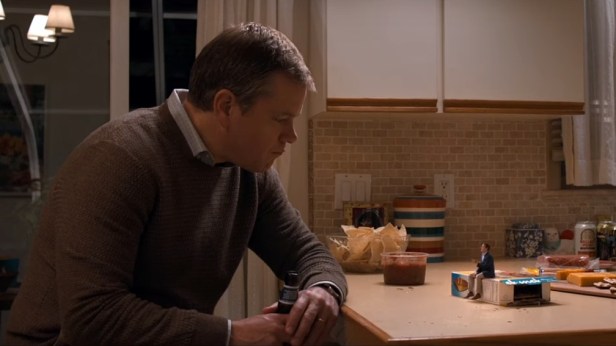
Predictably things go wrong and Paul finds himself alone in Leisureland and minus a sizeable amount of his promised wealth. He works in the Leisureland equivalent of a Call Centre. Then he meets his neighbour Dušan Mirković (Christopher Waltz), who throws great parties and makes money in what is the ‘downsized’ black economy. Paul also meets Ngoc Lan Tran (Hong Chau), a Vietnamese activist forcibly downsized and who ended up as an illegal migrant in the USA. Through Tran, a proper ‘Good Samaritan’ in the New Testament sense, Paul discovers the other side of the track/wall at Leisureland.
In the final third of the film Paul, Dušan and an associate, together with Tran, travel to the original ‘downsized’ community set in a Norwegian Fjord. Here they meet Doctor Jørgen and discover his latest plan to save humanity. The first two-thirds of the film struck me as a very funny satire. There are some very witty lines and some delightfully comic scenes like the opening ‘scientific’ conference. The contrasts between the world of five footers and fives ‘inchers’ is well drawn and makes great play with these. However, the last third, involving the trip to the Norwegian community, is increasingly dramatic rather than comic. The film’s tone changes from satire to a sort of ecological/religious representation. Dušan comments that this community is like ‘a cult’. I agreed with him but the film treats this seriously.
The film is well produced. The cast are fine and Hong Chau is particularly good. The production design, cinematography and editing worked well. I thought some of the soundtrack music was interesting but the credits ran by so fast I did not pick out the songs. The film relies on extensive CGI and special effects but this is well done, and most of the time I was not especially aware of the techniques.
In the early stages of the film my main pre-occupation was with the economic strand. Paul and Audrey find that their limited middle class means soar in value in Leisureland. The rationale for this appears to be that the much smaller commodities there are reduced in monetary value equivalent to their human owners. At one point Dušan point sought that the Cuban cigar that he is smoking costs 50 dollars in the full-size world but only a dollar here. I do not remember seeing a ‘downsized dollar’ but presumably it is one twelfth the size of the standard bill. It would appear that the plot assumes that the cost of reproducing labour power, which determines exchange value, is reduced in the same proportions in the downsized world. That might be so. But, in fact, the commodities in this world rely to a great degree on production in the full size world. And, Leisureland. which seems to be commercial company, operates there. Its source of income is not explained but the exchange values it deals in are ‘full-sized’. It did not add up: not just in Marxist terms but in terms of classical economics. I think someone like Ricardo would have found this puzzling. In the film this is not just a motivation for Paul and Audrey but the basis for the class divisions in the Leisureland complex. Other aspects of the plot are treated with greater care. So only organic matter can be downsized. We see that before the operation people’s fillings and such-like are removed. And we learn that people who have had hip operations cannot undergo the operation.
Even so I found the film very funny, at times witty, at times sardonic. There are accurate shafts at a number of deserving targets. Leisureland is surrounded by a wall, beyond which the proletarian servant class live. Their dark, dingy tower blocks are reminiscent of other dystopian settings. Given that the bulk of this class are Latinos I assume that this was a salvo at Donald Trump’s much lauded ‘wall’. The contrast between the predominately white inhabitants of Leisureland, with some middle-class African-Americans as well, and the ‘proles’ who perform the still necessary junk jobs is notable.
But the film has limitations. Early on, in a throw-away line, we hear that the Israelis are downsizing Palestinians. But the only victim of forcible downsizing central to the plot is Tran, the victim of the Vietnamese. I rather thought this one more barb against Vietnam by the losing side in that historic conflict.
And for the last third of the film the humour dissipates and the film seems to get serious about the ecological issue. But given downsizing would appear to be a fantasy I thought that the story needed something more ambitious that the solution proposed by the film. It does essay a romantic resolution, in fact reversing the break-up of earlier. But the increased level of sentiment in these final sequences does not fit with the satirical tone of the earlier segments.
The film was scripted by Alexander Payne and Jim Taylor and their previous work includes Sideways and The Descendants (2011), It seems that they were working on this script between those two productions, seven years apart. This might explain matters. Much of Downsizing offers the wit and humour that made Sideways such a success. But the final third of the film is closer to the drama of The Descendants, including the larger does of sentiment in that film.
The film was shot digitally and is distributed as D-Cinema. It is in colour and a 2.39:1 ratio. The dialogue includes English, Spanish, Vietnamese, Icelandic and Norwegian. Only parts of this have English subtitles but I did not have any problems following the plot on other occasions. I found Downsizing entertaining for much of its two hours plus, and the final sequences are interesting because of what has gone before. But with a darker and still satiric resolution I think the overall film would have been better.
 itp Global Film