
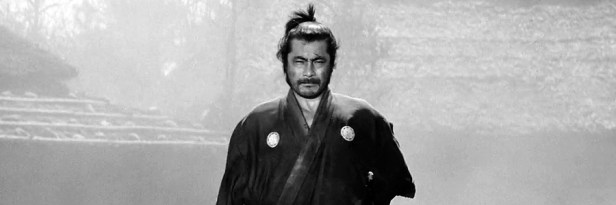
This is a classic samurai film and enjoys the talents of two stars: filmmaker Kurosawa Akira and actor Mifune Toshiro. Both bring their special talents to an entertaining and exciting action movie. Like much of their work the film has been remade several times, including as a spaghetti western, A Fistful of Dollars (1964), and as a Hollywood prohibition/action film, Last Man Standing (1996).
The film is set in 1860, just prior to the Meiji period and the rise of modern Japan. Mifune plays a ronin, that is a masterless samurai whose traditional functions have vanished and who takes on whatever work he can find. In this case in a small town he is offered work as a bodyguard (the English sense of the title) by rival merchants. The merchants are the emerging class in this period, but here they rely more on criminality than trade, forerunners of the modern Yakusa.
The main character and the film’s story are strongly sardonic. The opening sequence shows our hero passed by a dog carrying a severed hand. And the violence implied here is a central right through the film.
The cinematographer on the film was Miyagawa Kazuo. He had worked with Kurosawa on the earlier Rashomon (1950) as well as with other major directors like Mizoguchi Kenji and Ozu Yasujirô. As in some of the director’s other films Kurosawa and Miyagawa make great use of the telephoto lens. There is a depth of field in the shots, but a rather flat image as the action is foreshortened. Among the distinctive editing techniques, performed by Kurosawa himself, are frequent wipes, a technique rarely seen in post-war (WWII) cinema. And the music track by Satô Masaru uses distinctive instrumentation including wood blocks.
Kurosawa had set up his own production company. The first film was a variation on Shakespeare’s ‘Hamlet’, The Bad Sleep Well / Warui yatsu hodo yoku nemuru (1960). Mifune was the lead actor. Yojimbo was the second film from the company . Both film were also scripted by Kurosawa.
The film was popular in Japan and Kurosawa made a sequel titled with the character’s name, Sanjuro (1962). Once again Mifune played the lead. Yojimbo had a relatively large international release and has remained a regular title for revivals over the years. On its initial release in the Britain the BBFC gave it an ‘A’ Certificate.
The film’s format was black and white TohoScope. almost identical to CinemaScope with an aspect ratio of 2.35:1: with Perspecta Stereo sound., Now Hebden Bridge Picture House are screening the film in their ‘reel film’ series on Saturday January 6th. So it can be seen in its original 35mm format: what a treat.
 itp Global Film
Unfortunately the BFI print turned out to be in a poor state. I think it was fairly brittle and it kept breaking in the projector. So the Picture House had to call the screening off. A disappointed audience of about 60 plus, though they all get complementary tickets.
A hazard of ‘reel’ film screenings. And the cinema cannot arrange another screening as it seems that the BFI do not have any other prints of his films; amazing!
So, if anyone knows of a 35mm print, let Hebden Bridge know.
LikeLike
I think this shows two things.
1. Good 35 prints are going to be harder and harder to find as existing prints are not replaced.
2. The BFI seemingly no longer has the staff with knowledge/time to check prints before sending them out. It’s disgraceful but I can recall occasions when it has happened before (as I’m sure you can).
LikeLike
Great job with the review. I’m glad there are actually blogs who focus on non-mainstream films. It’s been rough since so many of them focus on Hollywood. I like the academic style and you talking more about the cinematography/production techniques. You got yourself a new follower.
LikeLike
Great review, I loved the cinematography in this one, but prefer the one in Rashomon. When you say that Mifune’s character and the film is “sardonic”, I would like to ask you, in line with your observation; what do you think why exactly was Kurosawa looked upon scornfully in Japan, while internationally was a huge success, gratefully to this day. Thank you for your reply in advance and for an insightful post.
LikeLike
The opposition of Kurosawa and Ozu is something journalists like to work up, but apart from the fact that the two men were very different individuals it doesn’t mean very much. Kurosawa was deeply rooted in Japanese culture and history and Ozu was just as interested in watching American films as Kurosawa.
LikeLike
I am not sure ‘scornful’ is quite the right word. Kurosawa was both praised and criticised in Japan. He tended to a humanist critical stance, as with the samurai films, and some voices disliked that.
And he was influenced by western genres, for example westerns, and I think some critics were not happy with that.
The latter aspect also helped with his international reputation. Some of the more obviously Japanese filmmakers took longer to establish their reputation abroad: Naruse and Ozu being good examples.
Mizoguchi also made an impression in the post-war world. I think his use of melodrama made him seem accessible.
LikeLike