
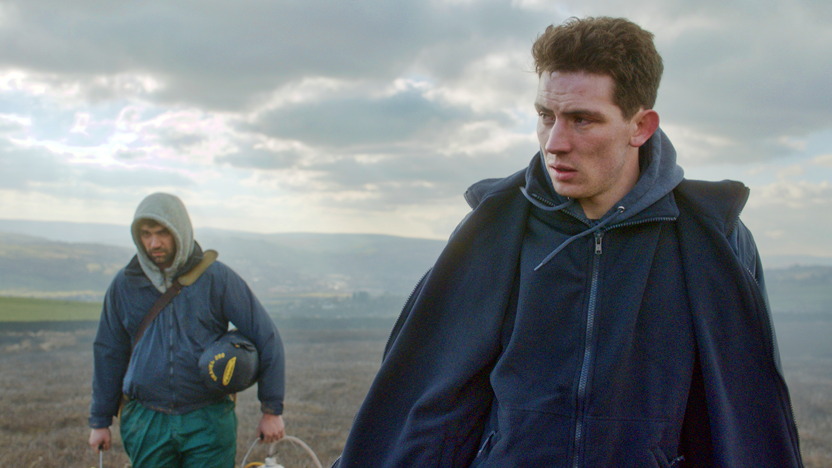
God’s Own Country is a terrific film and one of the very best to be released in 2017. It has two standout lead performances, ably supported by two ever-reliable industry vets. It looks wonderful and tells an emotional story with limited dialogue and enormous power. It will be discussed partly because of the gay love story at its centre, but also because it’s a story about small farmers in rural Britain – an increasingly marginalised group in the UK (although it’s one of three such films this year with the earlier The Levelling and Dark River to follow). You’ll read a lot about the film as it picks up prizes so I’ll concentrate on my personal response to a film made on the moors close to my home.
For readers outside the UK, the film’s title refers to some Yorkshire people’s sense of their home county (it’s the biggest of the traditional English counties). I’m assuming it’s ironic in many ways since the writer-director Francis Lee seems quite sensible as well as being highly talented. He’s had a career as an actor in British theatre, film and television and this is his first feature after a trio of well-received shorts. His work with two young and highly promising actors demonstrates his understanding and empathy. Perhaps surprisingly in a film so carefully located in the director’s own backyard (Lee was brought up on a farm near Halifax and the main locations for his film are all around Keighley, just a few miles away), the three actors playing the farming family are not local. Josh O’Connor (one of the UK’s rising young actors to watch), who plays the central character Johnny, is from Cheltenham and he is the one under most scrutiny as a young farmer. Lee sent him, and the Romanian actor Alec Secareanu, to work on local farms for some intensive acclimatisation to livestock farming in the Pennines. It certainly paid off and the farm work looks genuine to this non-farmer. Johnny’s father is played by the Liverpudlian actor Ian Hart and his grandmother by the Londoner Gemma Jones. These two simply make sure the family is a credible working unit. Francis Lee knows the location and he knows actors, so his film narrative has a sound basis. The narrative itself is fairly straightforward – Johnny has stayed on the family farm while some of his friends from school have gone to university. It’s a hard life and socially isolating on the farm, especially when his father has a stroke and everything falls on Johnny in terms of physical work. His only respite is swift casual sexual encounters and fierce binge drinking in the village pub. In classic genre style this is all changed when the smoothly handsome and very capable Gheorghe arrives as a temporary hired hand. It’s to the film’s credit, I think, that Georghe is represented as a skilled worker and not as stereotypical migrant labour. But Georghe is more than a skilled worker, he is also an intelligent and sensitive young man – and just what Johnny needs. But can Johnny develop a relationship and sustain it? That’s the narrative enigma.
The film is a gay romance and that might be part of its attraction as a different kind of story since many such romances, especially for younger characters, are urban affairs. I’m not sure the many references to Brokeback Mountain from journalists and reviewers are helpful – the narratives are not that similar apart from sheep and ‘isolation’. The love story in God’s Own Country is universal. It’s also the case that the isolation Johnny experiences is nuanced. Johnny may be a Pennine hill farmer, but in reality he only lives a mile or two from a large town (this area for the last two hundred years or so has mixed the agrarian and the industrial cheek by jowl). His sense of isolation is social and psychological, not geographical. At the beginning of the story he is a character with wild energy but he’s sullen and not very likeable. Josh O’Connor handles his development as a man very well.
I only have one quibble with Francis Lee. He says very clearly that he didn’t want the landscape to look ‘beautiful’. I can understand why, coming from an upland farm, Lee wants to stress how a young person might feel. But for those of us who don’t have to deliver lambs out on the moor in all weathers, this land is beautiful – and in fact there is a scene in which Georghe makes this point. It’s worth noting that these are the moors on which the Brontë sisters might have tramped, but few of the film or TV versions of the Brontë novels have actually been shot here with filmmakers selecting similar, but still different, moors elsewhere. The credit for the film’s look also goes to cinematographer Joshua James Richards who is also having great success with American landscapes for Chloé Zhao, whose 2017 film The Rider is about a young cowboy in heartland America. Francis Lee can obviously attract talented collaborators. God’s Own Country is a must see film, both rivetingly ‘real’ and also romantic. I can’t wait to see what he will do next.
 itp Global Film
I liked the many blunt Yorkshireisms in this one, also coming from a background local to this area. When young Saxby comes back from a hard day’s lambing up on t’moors and sits down to his meagre plate of stew, he brazenly asks : “is there owt for afters ?” “Aye, lad, there might be a tin of fruit cocktail.” comes the reply.
He should have asked if there was a tin of evaporated milk to put on it too, but I guess his nerve failed him.
LikeLike
I liked the film but where was the sheep dog? I can only assume that the younger Lee lived on a farm without one: but would any self-respecting Yorkshire famer do so?
And whilst Roy writes a good review I take issue with his use of ‘sensible’. As a migrant privileged to live in ‘God’s own county’ I am sensible of the privilege. And the film does do a sort of justice to the county and its folk.
LikeLike
Keith, I’m happy to be outed as a Lancastrian who can’t be doing with nonsense Yorkshirisms like proclaiming the superiority and exclusiveness of the county. I’m very happy living in Airedale which has many good points that I appreciate. One of which is the Pennines, shared with Lancashire.
LikeLike
(There is a possible SPOILER in this analysis)
Not a pretty film – a beautiful one. Lee is determinedly anti-pastoral so avoids picturesque panoramic shots, but there is real beauty in the way he shoots the small scale and intimate, celebrating the fragility of life and the tenderness of human emotions. No scene better exemplifies this than the one in which Georghe revives a struggling lamb by dressing it in the pelt he has skinned from a dead one: the scene is a long, graphic close up, but it’s the very painstaking precision which it is filmed that makes it an act of love, highlighting the fine line between life and death on the farm. I read Georghe’s action here as a metaphor for the way he slowly breathes emotional life into Johnny. Georghe was a joy to watch but I couldn’t help feeling he was something of a fantasy figure (maybe even with hints of the gypsy lover archetype?) and almost too good to be true – and not as intriguing and complex a character as Johnny is eventually revealed to be. However, his role makes more sense if we see the film less as a romance of equals than an exploration of masculinity and sensitivity within Johnny, whose behaviour is partly learned from his equally monosyllabic father. I see Georghe therefore as essentially a catalyst for Johnny’s journey from brute inarticulacy towards greater self-expression. In the scenes where Georghe pulls a pained kiss out of him and then, in the final sequence, almost forces Johnny to make an anguished but indirect expression of his love and commitment, he almost seems – as with his lambs – to be birthing a new Johnny.
I also really liked how Lee normalises the central relationship, avoiding the obvious cliché of a melodramatic discovery/confrontation scene outing the couple. It’s left to us to work out whether Johnny’s parents know about his sexuality, with a strong hint that his mother does (in her own confused terms) but prefers not to go there – hence the metaphorical flushing away of the condom. The ‘happy’ ending suggests Georghe and Johnny’s relationship will find its own level and probably unspoken acceptance in a rural community that has to just get on with whatever life throws at them. Interestingly, it’s only here in the final frames that Lee allows himself anything close to pastoral, with nostalgic golden shots of haymaking underscoring the quietly hopeful mood.
So overall, an impressive first film with a subtly poetic sensibility (Lee is very much an auteur consciously crafting his work, and has confessed to a fondness for metaphor), but with its feet firmly planted in real Yorkshire muck….I agree, Lee is ‘sensible’ – as in down to earth and honest.
LikeLike
Some very interesting points here – but I hope you haven’t given away too much of the plot in spoilers. The film is still on release. I hadn’t thought of the ‘gypsy lover’, but yes it is a literature trope – perhaps to be banished though? Otherwise I agree with your reading of Georghe as an emotional catalyst for Johnny. I saw the film several weeks ago and had to wait for the release because of an embargo on reviews. Consequently I’d forgotten the closing home movie footage which is an odd inclusion I think and reminds me of a time when I showed Yorkshire Archive footage of farming in the dales – only to be told by audience members that the Archive’s description was all wrong!
LikeLike
Apologies- would edit in ‘spoiler alert’ at the top if I could….And forgot to mention that it was home movie footage, which enhances the nostalgia.
LikeLike