

The 50th Anniversary (actually Christmas 2017 in North America) release of The Graduate is an odd anniversary for me. I now discover that the film is deemed a classic and it has received the same 5 star reviews that all ‘classics’ seem to receive automatically. I’ll have to wait until I watch it again in a cinema to see what this means in practice. For now I want to try to remember the first time I watched it during 1968. The circumstances are memorable since it was a preview screening several weeks before the UK release (which was several months after the US release date). My university Student Union received a large number of tickets for a late night screening (i.e. after the last house) at the London Pavilion, the large cinema still standing but no longer showing films, on Piccadilly Circus. I don’t remember how we got back to our digs in Streatham at 2 a.m. in the morning but I assume we got the night bus. I think I must have enjoyed the film and I think we followed the distributor’s plan by talking about it to friends several weeks before its London release in August 1968.
My main recollection of the film is that I was taken by Paul Simon’s songs more than the film itself. I think I already knew ‘The Sound of Silence’ and ‘April Come She Will’, but ‘Scarborough Fair’ and ‘Mrs Robinson’ were possibly new to me. I enjoyed the film which I found very funny but I’m not sure what kind of lasting impression it made on me apart from the music. The soundtrack was certainly innovative and predated Easy Rider (1969), Mean Streets (1973) and American Graffiti (1973) – the most frequently quoted music soundtrack ‘breakthrough’ films. Pop music had often been used in Hollywood films in the 1950s and 1960s before The Graduate but never so carefully integrated in the narrative and certainly not in a film that wasn’t ostensibly about musicians or the music industry. The one odd aspect that occurs to me now is that Paul Simon’s songs and Simon & Garfunkel as a duo were very strongly connected with New York and I’d forgotten that The Graduate is an LA movie.
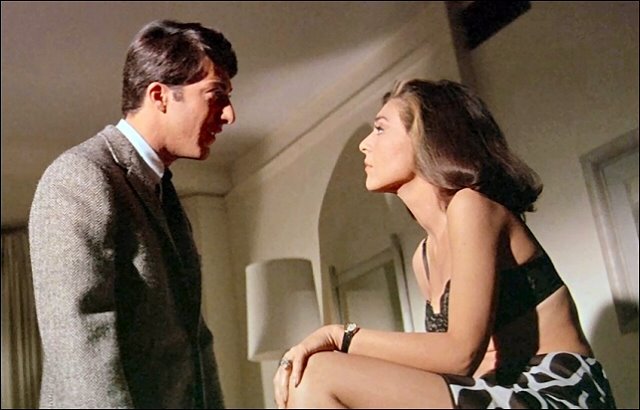
Listening to an item on the re-release on Radio 4’s The Film Programme and reading some of the print reviews, I was surprised at several of the comments. Reviewers now seem to focus on the older woman, younger man aspect of Anne Bancroft and Dustin Hoffman, though they know that in fact Bancroft was playing much older than her ‘real’ 36 and was only in fact six years older than Hoffman. I don’t remember being ‘bothered’ by the relationship. It makes me think of Cary Grant in North by Northwest (1959) with his mother played by Jessie Royce who was only eight years his senior. I think that this shows that The Graduate was a film still tied to ‘old Hollywood’ in 1967. It surely isn’t a ‘New Hollywood’ film. I suspect that Mike Nichols is now seen as more of an innovator than he was considered at the time. Yes, he did win the Best Director Oscar for the film, but wasn’t that an indication of how skilfully he made a film in the tradition? Nichols was well-known first as a comedian in partnership with Elaine May and then as a highly-successful director on Broadway. His first three films were all adaptations – Who’s Afraid of Virginia Wolf? (1966) from Edward Albee’s play, The Graduate from Charles Webb’s novel and Catch-22 (1970), my favourite of the three, from Joseph Heller’s novel. Aged 19 in 1968, I wasn’t a cinephile, so I didn’t make critical judgements about The Graduate. I remember the unusual ending better than anything else. For me, at that time, Dustin Hoffman didn’t represent a young graduate. He wasn’t much like the American grad students I came across in London. It was probably not until Midnight Cowboy in 1969 that I began to think about Hoffman. Similarly, Katherine Ross made more impression on me in Tell Them Willie Boy is Here and Butch Cassidy and the Sundance Kid, both also in 1969. Having said that, the notes in my film diary suggest that it was Ms Ross, alongside the music, that caught my attention.
It’s important, I think, that in the late 1960s, it often took Hollywood films a good six months to arrive in the UK. The Graduate took eight. Its American success set up its UK opening – it was the biggest US box office film of 1968. The truth was that it was one of the very few witty adult Hollywood films of the 1960s to attract a mass audience (it had an ‘X’ certificate in the UK, making it out of the reach of those under 16). (The script by Calder Willingham and Buck Henry must take plenty of credit.) In the UK, the 1960s, for my circle of friends, was remembered mainly in terms of British films. The American box office film of 1968 that made the biggest impression on me was probably Polanski’s first Hollywood film (after he left the UK), Rosemary’s Baby, which I actually saw a couple of years later in a Paramount double bill with Lindsay Anderson’s if . . . . (a 1969 UK release).
Here’s part of the ‘Scarborough Fair’ sequence from The Graduate – at least, I think it is, there are so many YouTube clips! I think this represents what I thought was new at the time. Watching it again, it’s the combination of the music with the camerawork by the veteran Robert Surtees that seems important. It’s interesting to read some of the contemporary reviews from 1967. Bosley Crowther in the NY Times was coming to the end of a glittering career as a critic in 1967 when he panned Bonnie and Clyde but praised The Graduate as a throwback to Preston Sturges. Roger Ebert liked the film but loathed the music and the ‘arty camerawork’ shown below. Interestingly, he saw the same vitality in the film that he saw in the British films that had done so well in the US in the 1960s (he was thinking of Tom Jones and The Knack among others). Thirty years later he downgraded his rating and decided that the film had dated and that Mrs Robinson was actually the most interesting character.


Lovely piece on a classic film, I feel like I missed the golden age of cinema because of my age but it’s nice to read pieces like this so I can imagine that I was there.
LikeLike
I saw The Graduate at almost the same time as Roy which I think was December 1968 somewhere in the West End when I had a week’s holiday in London from my civil service job. Certainly I felt there was something fresh about the film, markedly different from films such as Charade (1963), with Cary Grant and Audrey Hepburn and directed by Stanley Dolan which for me typified the mid-60s and also, oh my god! all those coachloads of nuns arriving at the Odeon in Glasgow for The Sound of Music. Those two films typified the mid-60s for me. I don’t know what it would be like to now but I found it slick and incredibly boring as I found most of the Hollywood films of the era. Like Roy I watched a lot of British films then, many in black and white which was still quite common for lower-budget films (and I was beginning to pick up on the French New Wave – almost all in black and white). Roy mentions Look Back in Anger from the British New Wave which is strange because during the same holiday I saw the play at The Royal Court, with Jane Asher as Alison (mainly famous at the time for being “Paul McCartney’s girlfriend”), Victor Henry who played Jimmy Porter and the late John Le Mesurier (later famous for Dads’ Army) as the father.
My first memory of The Graduate was Benjamin floating in the pool to the melancholy strains of Simon & Garfunkel’s ‘Hello Darkness My Old Friend’ [The Sound of Silence]. This scene was halfway through the film and the explanation is that I still carried on with the earlier habit of coming in whenever, watching the end, then staying for the beginning and if I liked it, seeing the second half again. Does anyone else of the pre-multiplex generation remember this practice? It must have played havoc with our sense of narrative.
Like Roy, I wasn’t a film student at the time but I’m sure combination of music (and sound in general) and cinematography was what most affected me. Was it a New Hollywood film? I think it certain respects it was, as the term was usually defined by a combination of aesthetic, social and institutional factors. What it wasn’t was what some critics called it at the time – counter-cultural – at least in the sense of, say, Alice’s Restaurant, Easy Rider, even Bonnie and Clyde. Benjamin does hang around Berkley for a while in pursuit of Elaine and his landlord thinks he is “one of those outside agitators” but he is dressed very ‘square’ in contrast to the Berkley students (the most radical thing he does is to not wear a tie). Elaine herself ‘blends in’ with the dress code of the campus but changes back when she went home to LA. Benjamin does, however, represent the alienation of young people at the time with the post-war economic-cultural settlement although this hardly takes a political form.
About seven or so years ago I used it for teacher in-service training and it stood up pretty well, and it was aspects such as camerawork and lighting which struck me most, and I was glad, as a marker for the exam board, to see a later generation of young people, with a completely different cultural formation, respond to it enthusiastically. However, I think Ebert was right at least in this – Mrs Robinson was actually the most interesting character and the film is a little hard on her.
LikeLike