
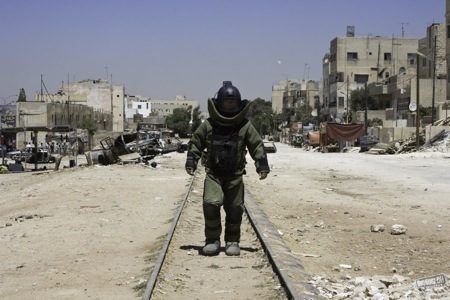
As the critical response has suggested, this is an impressive war film about Iraq. Stylistically similar to the hyper-real visual style seen in Cloverfield (US, 2008), it uses extreme handheld shake to signify ‘thereness’. If you’re filming defusing an unexploded bomb the niceties of framing and composition are going out of the window. The cinematographer is Barry Ackroyd who shot United 93 (US, 2006) and The Wind that Shakes the Barley (Ire-UK, 2006), both realist films. However, although documentary-style camerawork, that follows rather than leads the action, is evident in these films, they remain carefully composed; I felt mildly nauseous watching The Hurt Locker such is the camera shake on the big screen. Ironically, this effect makes it more of a ‘roller coaster’ than Hollywood blockbusters even though this is nothing like a mainstream movie.
The best review I’ve read is by the reliably excellent Philip French in The Observer and I agree with much of what he said. I’ve written about most of the Iraq movies and The Hurt Locker is certainly a fascinating addition. Its focus on the American viewpoint is slightly problematic for me as all Iraqis are filmed as potential terrorists; take the shot of the DVD vendor that suddenly makes him look sinister when he’s simply a guy trying to make a living. However, if we accept that this is a function of the film’s viewpoint, the protagonist and addicted risk-taker SSgt William James, then this is acceptable. Peter Bradshaw, in The Guardian, suggests this is a challenge to ‘political correctness’ as if there’s something wrong in questioning the representation of the antagonists.
The British do get to show their face but are so money-seeking and inept, once the shooting starts those that haven’t been shot yet don’t even fire a gun, that we descend into a gung-ho Hollywood movie despite the fact that the sequence is brilliant.
The sound design is spectacular, by Paul N.J. Ottosson, adding to the visceral discomfort of the experience. This is cinema that is about experience; experience that most of us, thankfully, won’t have. I don’t know any serving soldiers but met one on leave from Afghanistan on a train journey. The soldier obviously needed to talk about their experiences and now I know of someone in the front line each time I hear of casualties they won’t be in the abstract. Cinema can also do this, to an extent, allowing us to understand the experiences of others. If we learn nothing of the ridiculous politics fueling East-West conflict from The Hurt Locker, we do get a sense of what it might be like to be there.
 itp Global Film
I completely agree about the mastery of the action sequences. I want to use the word ‘expressionistic’ about the use of cinematography in some of the scenes, but because it is hand-held camerawork it disguises that sense of spectacle so obvious in the conventional ‘filmic’ action blockbuster. I think this can be related to Bigelow’s previous film styles, where she has worked within the action genre and constructed that ‘100% adrenaline’ high production values spectacles we expect. Even though she is working with stripped down technology, the use of camera angles and the ‘grain’ of the footage has a heightened sense of that reality associated with ‘being there’ – so as well as the experience of the tension of the scenes because it feels so real, it has a filmic intensity that is unreal – so it seems more ‘pleasurable’ to watch visually compared to other films that use a documentary style that don’t suture me in quite so completely. Bigelow has always, I think, had that capacity for innovation. The chase sequence in Point Break (the one they watch part of in Hot Fuzz!) is filmed using a Steadicam and achieves incredibly fluidity for something that actually has a large number of cuts. Similarly, the POV sequences in Strange Days are created using a specially developed Arri that was really light, in order to mimic the quickness and mobility of the human eye. There is a great interview with her (and Gavin Smith) in Film Comment (it’s in the Wallflower Bigelow book ‘cinema transgressor’) where she talks about this awareness of geography and rhythm in creating different kinds of action sequences. I think that sense of structure and design – the holding of the spectator in a network of shots and sequences rather than distancing you by its jarring or jerking – is still evident in The Hurt Locker and contributes to that sensation I am trying to describe above.
I watched it in a cinema largely dominated by young men and you could have heard a pin drop (not a taco crunch in earshot). As you said, quite rightly, the technology of the film is there to serve the content and the focus. This is about what it is like to go to war and to live that life. Its politics do seem problematically (perhaps for us Europeans in particular?) slanted towards American imperialism, due to the sketchy portraits of ‘the others’. As far as its sexual politics go, it does interestingly investigate that masculine trait that has an addiction, a need for the drug of danger and excitement. The vulnerability of men blended with their force/aggression/pressure to be dominant is explored here as it has been elsewhere in her work – without undermining any of the ‘pleasure’ in watching the masculine display of action. I recognise the word pleasure is itself problematic – but I think that is where the film itself self-reflexively encapsulates the problem of its theme – this is horrible work in a terrible situation for all. Once we make a film about it, for entertainment, we have all entered the same conflicted place that Bigelow’s characters (especially Jeremy Renner’s) occupy – involved and excited by a situation that is, in fact, a banal evil for those who actually live it.
LikeLike
I enjoy this site, it is worth me coming back
LikeLike