
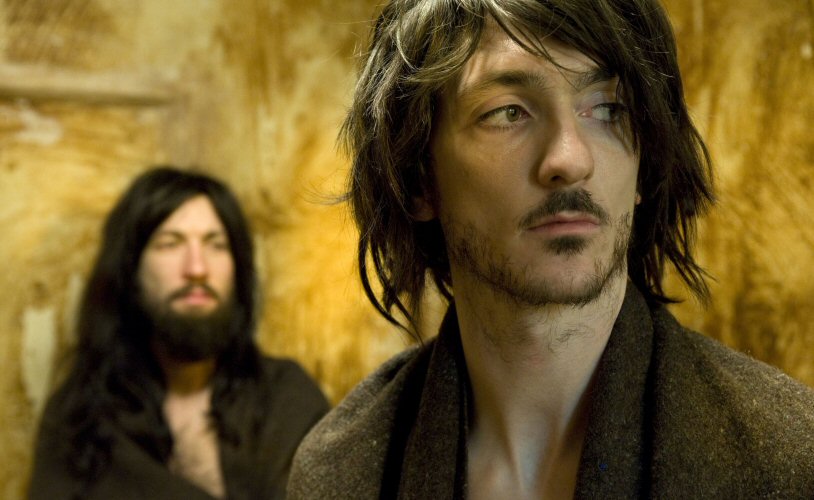
Steve McQueen’s debut feature has rightly been described as brutal, visceral filmmaking. It’s an incredible experience in the cinema, visually and aurally, that does leave you shaken with the power of the images it has shown you, and the ideas that underpin them. The film blends a broad narrative arc, with more experimental styles that make it recognisable as an art, or avant-garde, film. It begins with a wordless montage of the life of one of the prison guards. Without giving away the details, there is an emotive juxtaposition of the banal and the extreme in this daily routine – and the sense of a man barely containing his emotions and the stress under the brutality he is part of, is powerfully conveyed. I want to say that here, as elsewhere, the emotions assault you such that you begin to experience that fear and tension, despite a recognition that this is at odds with the controlled, fluent sequence and its attention to cinematographic detail and controlled compositions. You are never in doubt that there is a guiding artist behind the scenes presented to you; an artist who knows how to create visual beauty, which you feel and respond to, at the same time as you are repelled or horrified by what is actually happening in the filmed sequence.
As we are taken into the cells with Davey, the new arrival, the expressionistic camerawork allows us the sensation of the degradation and horror of those living conditions – the rotting food, occupied by tiny grubs, the swirls of excrement on the walls. Time and again, McQueen and his cinematographer Sean Bobbitt, create a focal point using a vivid colour within the frame – arresting and attracting your eye, and engaging you with the dialectical argument, simply through the aesthetic affect. The moment where the prisoners are given ‘joke’ Irish clothing to wear as civilian clothes (accompanied by the sniggers of their guards), its bright, jaunty patterns are a visual explanation for the fury of the inmates. With all the brutal violence that is, unflinchingly, shown on screen, it is these daily, petty inhumanities that are, convincingly, as inhumane. The film makes you experience the inhumanity generated person to person by an inanimate political system. Without any particular narrative or dialogue to emphasise it, McQueen (and his collaborators including writer Enda Walsh) demonstrate the futility of violence and opposition on both sides, which only serves to degrade those involved.
I don’t believe it is a film that seeks to impose a viewpoint or an ideology on its viewer. I don’t think it is a film that would, or tries to, change your viewpoint of those times. Terrorists, freedom fighters, political prisoners or murdering criminals? These terms are not (apparently) much debated and extended. The central meeting between Sands and Father Moran lays out the arguments for and against the self-sacrifice of a hunger protest for a belief, not the beliefs themselves. The balance of representation is only adjusted (I felt) by what I took to be the import of their use of Thatcher’s speech on pity – attacking the hunger strikers for being willing to use pity to advance their agenda. This acts as an introduction to Sands’ slow and horrific death – and through this section of the film, the intense focus on the wasting of his body and terrible sores and lesions that afflict gives us nothing but pity as a way out. All we can do is relate on a human level to this one man. Even where we might be antipathetic to his beliefs, his extremism, we do not have to sacrifice our human pity. That is still within our choice. Now, here, McQueen does seem to lean towards a sympathetic portrait – in a flashback, we see the intensity of the young Sands on an outing he has previously described. Running through the cornfields, the beautiful image is invested with portent; we know (from his tale to the priest) that even at eight, Sands is being taught a political lesson in this moment of freedom, which will end in a political act of knowing self-sacrifice.
The fact that we understand this, as we watch the young boy lean against the bus window, is intensely powerful. His life has been invested with a certain knowledge far earlier than others, that will inevitably, almost without his own will, shape it forever. This seems a tragedy – never to have known what freedom is, to experience knowledge that this is not your path.
The images used here – the point of view from Sands’ hospital bed, the shots of the Donegal countryside drive us to experience these feelings for ourselves. The film’s tour-de-force, however, is a single take (apparently 16 minutes long), which dominates the scene between Sands and Father Dom (Liam Cunningham). The balanced debate moves from lively, intellectually nimble banter to emotional expressions of different ideologies. The camera keeps a fixed distance, not too close or favouring either side in its composition. Again, you can find your own access points and sympathies between these two illuminated figures. Emotionally strong, conventions of filmmaking are broken again by creating a theatrical performance at the centre of a cinematic experience, which we experience as if we are in a theatre. The intensity of the static camera translates to an intensity of focus for us.
The film knows how to use dialogue and debate here, but it also uses silence very effectively. Silence seems to allow you to watch and understand. The movement between over-exposure to sound (in some of the violence) and to silence added to the emotional impact.
The rustling of sweet wrappers (unbelievable!) stopped, anyway, very quickly. People did leave the cinema. I honestly wasn’t sure why they went, as it felt it could have been just as much the emotional intensity as the violence. Whatever your feelings about the subject matter, it’s filmmaking that demands to be seen.
 itp Global Film
I saw the promos the other day on TV and was puzzled to hear “Steve McQueen’s Irish film…”. It was only after a few minutes that I came to know of this young director.
LikeLike
Steve McQueen won the Turner Prize for British artists in 1999. He was linked to a film feature project for several years before completing Hunger.
LikeLike
Here’s a link to another current work by McQueen ‘Queen and Country’- representing soldiers who have died in Iraq through the medium of British stamps. http://www.artfund.org/queenandcountry/index.php
LikeLike
I saw the exhibition in Manchester – it’s a great idea and works well.
LikeLike
I went to see it with Nick and it is certainly a remarkable piece of work – which I think your review presents very eloquently, Rona. My first reaction was to try to classify it as a film and I found this very difficult. I think it is experimental cinema – an ‘artist’s film’? Yet it at times references the ‘prison genre’, especially in the first half and I’m not surprised that the flashbacks to a childhood experience in Donegal have caused some critical remarks about ‘corrupting the aesthetic’. I thought in a way it was unfortunate that whilst Michael Fassbender was relatively unknown before this film, Liam Cunningham (as Father Moran) is a well-known Irish actor in films and television (most notably in The Wind That Shakes the Barley). I think it makes it more difficult to integrate elements when some could be generic and others appear to belong to a more formalist approach. I think the film does just about hold together through the assertive direction, camera and sound and the acting.
Nick said that he thought the interesting question is what people under 40 will think. (A quick check on IMDB gives a wide range of responses, some very informed, others completely ignorant of the history.) There is very little to help anyone understand the context. McQueen says that he does not take sides, but I’m not sure I buy that. I did feel manipulated. I do know some of the history and I know where I stand, but I think the film did push me away from the prison warders towards the prisoners and Thatcher’s speeches made me feel sick.
I’m intrigued by some of the comments I have read about the ‘play’ with the Christ image and myth in the film and I’m not sure what meanings I took from this. McQueen says he has been obsessed with Bobby Sands since the images appeared on his TV set in 1981. But I wonder if he could have used the same ideas in a more abstract film?
LikeLike
I agree that the film is on Sands’ side; and I don’t have a problem with that. The ending, where we see him as a child, shows that he was a lad like many others but one who was ‘fated’ to meet an extraordinary end. It’s true that the IRA atrocities are shown (an extremely effective shocking scene) but when you’ve got such a principled person as Sands lined up against Thatcher, morally, there can only be one winner.
I’ve just watched Goodbye Bafana and it’s interesting to compare the Apartheid regime’s treatment of its ‘political’ prisoners with the British government’s. From the films, it appears that the British were worse than the Afrikaans.
LikeLike
It doesn’t take you very long in studying British domestic political history or colonial history before you come to the conclusion that the British state has little to learn from anybody about brutality. This is another aspect of Hunger that perhaps needs to be foregrounded – the history of hunger strikes as a means of resistance to British colonial power in Ireland (and the response of forced feeding). It was also used in India and in the civil rights struggles of the suffragettes.
LikeLike
I agree with most of the comments posted. I only caught up with the film last week and settled down with the Sight & Sound review after I saw it. I was surprised that about half of the S&S article was about the style in which the film was shot. While interesting to analysts of movies the power of the film pushed such thoughts aside for me. As Rhona says it’s the visceral side which grabs the attention.
I saw the film at an ‘art’ cinema and given the amount of coverage the film received in the press I expected a large turnout. Admittedly it was an early evening showing but I think only about 20 were present. Any idea how it’s doing at the box office?
LikeLike
Hunger was one of the most commercially successful ‘British’ films of last year. Once you strip away Hollywood financed films made in the UK, most British films fail to make £500,000 at the box office, but Hunger passed that figure mainly, I think, based on the first few weeks in London arthouse screens. As of now it’s made over £750,000. Your screening was one of just two in cinemas last week.
LikeLike
I agree with you I don’t believe it is a film that seeks to impose a viewpoint or an ideology on its viewer. Viewer will make ou their own minds in regard to this. Thanks for the great post.
LikeLike