

This is where my life-long passion for films and cinemas really took off. It must have been in the summer of 1970 and I wandered into the Berkeley Cinema on Charing Cross Road where Stolen Kisses was playing in the bottom half of a double bill, supporting Women in Love (UK-US 1969). I didn’t know much or even anything at all about François Truffaut at that point but it was this film rather than Ken Russell’s that really had an impact on that day. I’ve just re-watched the film nearly 56 years later and I want to try to understand what has changed. I’ll start with the film itself and then discuss the context of 1970 and compare it with 2026.

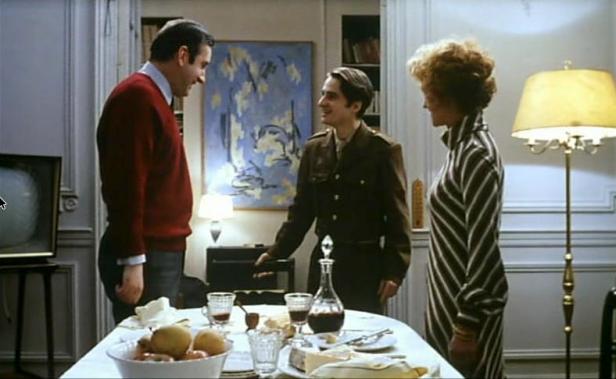
Stolen Kisses was Truffaut’s seventh feature. Since Les quatre cents coups in 1959 he had directed roughly a feature each year alongside four shorts. Stolen Kisses is also the third of the five glimpses into the life of the fictional Antoine Doinel, Truffaut’s alter-ego as played by Jean-Pierre Léaud. In this case, Antoine is in his early twenties and has just been dishonourably discharged from the French Army after signing-up for three years but failing to conform and going AWOL. On release he returns to his old habits, first visiting a brothel (simply because he could but also because he promised the others in his detention cell that he would) and then the parents of his girlfriend Christine. From this meeting he gets the offer of a job as a night porter at a hotel. For the rest of the narrative he will have several ‘interactions’ with Christine and her parents as well as two more jobs. The film is fast moving and comic as well as charming, sad and romantic. From the early 1960s, all of Truffaut’s films were more or less guaranteed a cinema release in the UK. This film was acquired by Hollywood distributor United Artists, indicative of Truffaut’s status at this point, but still it opened at the Academy, the most important arthouse in London, which at this point had three screens and was the first place to look for new foreign language films in the capital. A few years later, Truffaut’s La nuit américaine (France 1973) would open at the newly re-modelled ABC Shaftesbury Avenue by Columbia-Warner and also be dubbed into English on some prints.
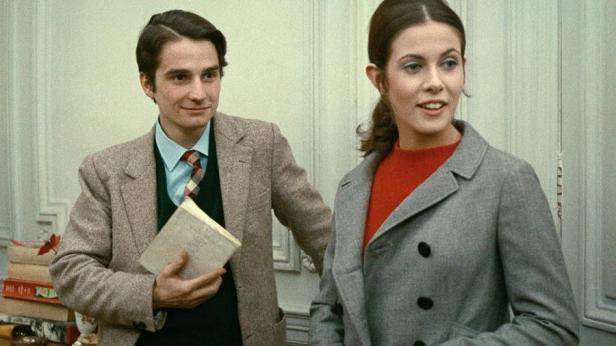
The narrative might be described as ‘picaresque’ as Antoine moves from job to job, seemingly with little idea of where he is going or why – but that’s not unusual for someone of his age?Christine (Claude Jade) is much more focused with her music studies. She comes across as more mature even though the actress is younger than Jean-Pierre Léaud. It was her first film whereas he was already a veteran of several key films from both Truffaut and Jean-Luc Godard. The opening to the film is interesting in its brief allusions. Under the credits the camera takes us to the Cinémathèque Français with a note on the door showing it is closed. Truffaut, in this opening, makes several decisions that give clues to his overall approach. The glimpse of the Cinémathèque is an indication that during the filming of Stolen Kisses Truffaut, not usually given to direct political statements, was moved to support protests against government actions to remove Henri Langlois, one of the founders of the museum, as the person in charge. Truffaut and other directors protested in support of Langlois (and halted the Cannes Film Festival) and he was eventually re-instated although with some reduction of funding. This protest was seen as a prelude to the street protests of 1968 known as Les événements de mai 68. Antoine does not join the protests but they are referenced later in the film.
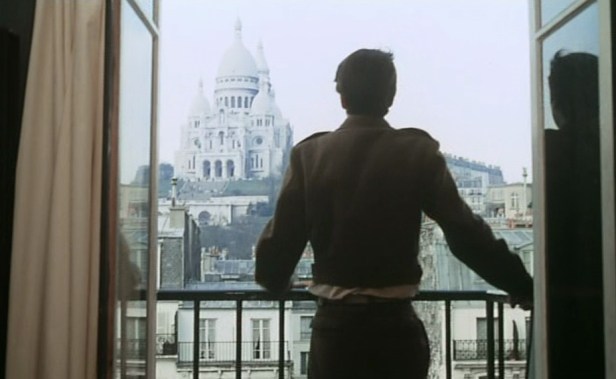
The second sequence of the film begins with a rooftop view of Paris dominated by the Eiffel Tower. This might be construed as a tourist image of Paris or an iconic image of the city. But then the camera scans the rooftops and eventually dips down towards a building, ultimately hovering before a window. A cut then takes us inside the building, a military barracks with a large communal gaol cell. At the back of the cell is Antoine in military uniform. He emerges from behind the book he is reading – Balzac’s Le Lys dans la Vallée (1835), one of several novels collectively known as ‘La Comedie d’humaine‘ and this novel deals with a romance that is never consummated. Truffaut often references his love of Balzac’s work. This panning shot going in through a window is also reminiscent of the start of Hitchcock’s Psycho (1960). As Annette Insdorf (1994) suggests, this film will present everyday Paris imbued with a creative tension created by Truffaut’s interest in the different filmmaking approaches of Hitchcock and Jean Renoir. Added to a sense of a sad romance is the Charles Trenet classic chanson “Que reste-t-il de nos amours?” (“What remains of our love?”) first recorded in 1943 and probably known to Truffaut as a boy. The film’s French title is taken from the lyrics of the song and the music is used again at different moments in the narrative. Maintaining its God-like position after a sequence covering Antoine’s ‘dishonourable discharge’ the camera then tracks along Paris streets to observe Antoine running across a roundabout and causing havoc amongst the traffic. He nips into a doorway and we join him in his room which we assume he hasn’t seen for most of the last three years. When he opens the window of his bedroom and looks out from the balcony his view is straight across to the Sacré-Coeur on the hill above Montmartre. It is another tourist/’real Paris’ image. From here Antoine is off to Christine’s family home in the middle-class suburbs. My geography of Paris is not what it should be but I feel we are in both the ‘real Paris’ and the Paris of the imagination (and of the cinema).
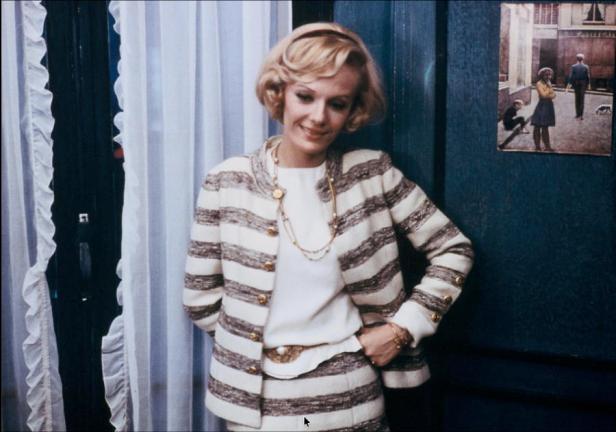
Antoine’s adventures are underpinned by a basic belief in and tolerance of human behaviour in all its forms, though this does seem to be gendered in the sense that the men in this world are generally restricted by a lack of social skills or understanding whereas the women are practical and clearly know what they want and what they should do. In his detective work Antoine is assigned to work in a shoe shop and to investigate why the staff seem so opposed to the shop’s owner. Antoine is seduced by the wondrous apparition of Delphine Seyrig as the wife of the shop-owner and sends her a love letter using the pneumatique. I remember this technology being used in large department stores from my childhood. I hadn’t realised such a system existed below the streets in Paris so that a message might be read only an hour or so after it is sent. I won’t spoil the ending to the narrative except to say that it does set up the next chapter in the story of Antoine Doinel which appears some two years later as Domicile conjugal (with the English title Bed and Board).
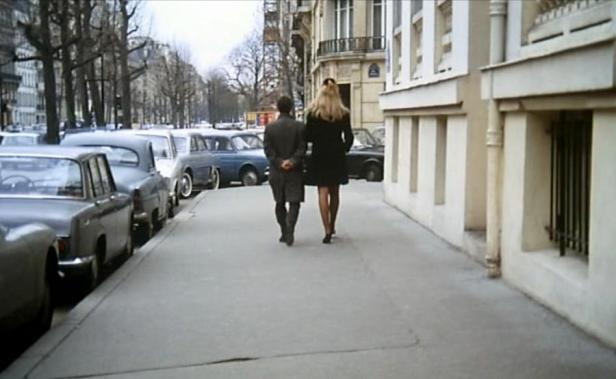
What did I make of the film a second time around? (Actually I think I watched it for a second time on ITV when they still broadcast subtitled films in the 1980s).The obvious point is that when I first viewed the film I was roughly the same age as Antoine and Christine and I think I must have been blown away by seeing a different world to the one I knew – aged 21 I had never even been overseas. Now when I watch the film I have 50 years of studying films to draw upon and I have visited Paris. I can recognise what Truffaut is doing as well as ‘feel’ it. 1968 seems a long time ago but even so there is a sense of Truffaut romanticising the present and feeling nostalgic about the past. On the other hand, Truffaut was a real student of Hitchcock and Renoir. There is a love of pure cinema in Antoine’s antics and there is the undoubted humanism of Renoir. I have written about several of Truffaut’s films on this blog and I’m conscious of shifting from an impatience with his views of women as simply ‘magic’ to a fan boy’s wonder at the skills displayed in his filmmaking. I must find time to watch/re-watch the other films I haven’t written about. Basiers volés is certainly recommended. I found it on BFI Player (along with Domicile conjugal) in the UK and it is available in the US on Amazon, Apple and Criterion. Here’s a montage of clips of Antoine around Paris.
Reference: Insdorf, Annette (1994) Francois Truffaut, Cambridge: Cambridge University Press
 itp Global Film