

This was a programme of films from the 1940s and 1950s provided ‘from the icy vaults of the Danish, Norwegian and Swedish Film Archives’ presented at Il Cinema Ritrovato 2025.
Violent crime and betrayal is as rampant as daylight is sparse in this cross-section of Scandinavian film. Dangerous liaisons between enigmatic characters on the shady side of the emerging welfare states abound while tough cookies and fatal femmes wrestle with fate and ill fortune. The scene is urban, seedy and erotic, the darkness of night overwhelming.” (Lars-Martin Sorensen in the Festival Catalogue).
Lars-Martin sees some influence from both French poetic realism and Hollywood noir, though the latter only arrived after the end of World War II; but also from the state of the societies during the war years There were six titles, some on 35mm prints some digitised. I only caught three of them; the size and variety of the Festival create constant difficult choices.

This was quite bizarre movie with a serial killer whose strangles women, but all with the name of Sonja. The murder are accompanied by a repeated melody/song about Sonja. The plotting became odder as it developed. The labyrinth motif of serial killer movies appeared in the shape of a deserted mansion at the climax. The director, Bodil Ipsen was one of the few women to hold this role in the period.
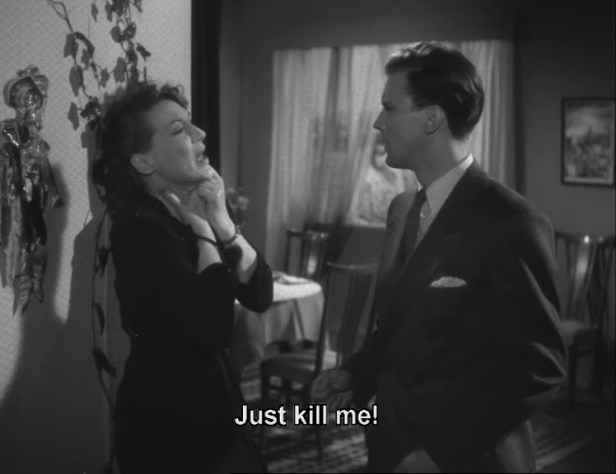
This was a familiar noir plot; think Double Indemnity. Mechanic Erik (Claus Wiese) begins an affair with a wealthy married customer Sonja (Bjørg Riiser-Larsen). Rather untypically for the genre the husband is disposed of in a divorce. Eric and Sonja marry, however she controls the money and Eric is increasingly dissatisfied. Their frequent quarrels finally lead to violence.
The film operates in the confessional mode; at the beginning Eric is taken in by the police and we see his account to his lawyer. The story is fairly sexual; Eric and his girlfriend early on, Marit (Eva Bergh), have several scenes with ellipses, clearly signalling intercourse. And Marit is pregnant by the time Erik dumps her. The relationship between Erik and Sonja is clearly powered by lust and obsession. About the strain of being a kept male a Norwegian site comments:
Few films have ever more effectively conveyed a kind of male-hysteria, as Erik comes to regard his wife increasingly as an enigma whom he can’t control or understand.” (Wikipedia).
The film is shot with well judged camera and editing, though there is only a limited amount of the typical low-key lighting. And the plotting is presented with economy, concentrating on the characters problematic relationship.
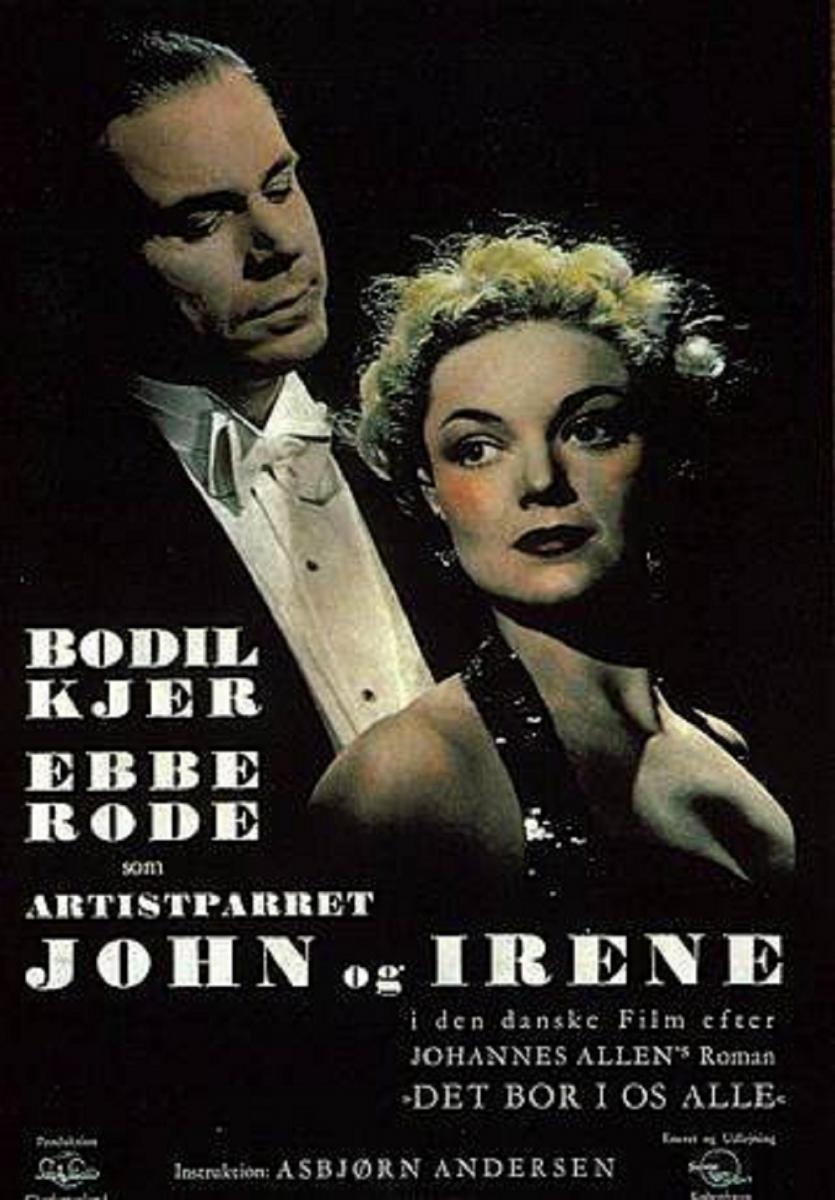
This was the film that most impressed me. Whilst having many noir characteristics it also has a distinctive story as a a married couple face a decline in their fortunes and in their relationship.
The titular couple, John (Ebbe Rode) and Irene (Bodil Kjer) are professional dancers; they married when they embarked on a career of dancing displays working in clubs and ballrooms. The initial promise has given way to disenchanting round of seeking out temporary engagements across Scandinavia. At the beginning they are in Stockholm where Irene waits in a dingy hotel room as John tours clubs looking for an engagement. We see them driving round cities, Stockholm, Oslo Copenhagen, their travails signified by the decreasing state of their automobile. When they find a booking it is usually for a few nights; their status in one club shown by their dressing room being a space clearly used for junk and disused equipment. This contrasts with the bright lights and jazzy dance floors where they perform.
Then at the Honolulu club in Copenhagen John is invited to a late night party at the owner’s villa. There he chances on a hoard of loose cash but his robbery goes wrong leading to violence. John now has to be on the run, not in the car but by foot and then in an empty rail van. He is planning to try and escape to the USA. When he meets up with Irene, she is pregnant, and desperate to preserve their relationship and their work, she has decided on an abortion. Their downward spiral ends in a tragedy.
This film is also in the confessional mode; as John unburdens himself to a a policeman with the main plot presented in flashback. Like Eric he becomes a victim hero. The evening sequences off the dance floor are in familiar low key whilst the daytimes tend to grey and drab exteriors. And there is the sense of the couples world closing in on them. Irene is not a typical femme fatale; sadly, her devotion to John vacillates between dependence and disdain. Their fall into the world of chaos is caused by the siren of success, always seeming just around the corner but never realised.
There was also Flicka och Hyacinter / Girl with Hyacinths, Sweden 1950. This was title that I had seen before but not on this occasion. Several people told me that they thought it was the best of the series. The drama opens with a suicide of a young woman. Her neighbours, puzzled, investigate and seek out her friends, lovers, acquaintances and her sad tale emerges. The movie uses flashbacks and offers different perspectives on the young woman. The Catalogue notes draw comparison with the Hollywood’s Citizen Kane,
Stylistically, while Eckman [the writer and director] doesn’t strive for technical innovations like Welles, he effectively employs established techniques from 1940 American [i.e. USA] film noir. Notable similarities include the camera’s mobility and angles, the use of deep focus and long takes, and dramatic lighting.” (notes by Kajsa Hedström).
All these four films were projected from good 35mm prints; and there were four other titles in the programme, three of those digital transfers. Not all the films are strictly film noir. But there is a general sense of alienation and fatalism. The use of low-key lighting, seen as central to noir, varies considerably. But a world of chaos where protagonist mainly fail is general.

