

This film reached the UK in 2019 but I missed it completely. I watched it recently on BFI Player. I haven’t seen many science fiction films in the last few years but this sounded like it would be different and it proved to be so. The narrative begins with a large body of passengers being taken up to the ‘Aniara’ spacecraft that is scheduled to make the journey to Mars in three weeks. Under the credits we see that Earth is suffering all the disasters wrought by climate change – floods, wild fires etc. Our way in to the story is through Mimaroben (Emilie Jonsson) who is with the passengers but gets off the shuttle from Earth before them and rushes to reconvene with her machine intelligence on the spaceship. This is ‘Mima’, designed to offer virtual experiences of nostalgic beautiful moments on Earth to keep passengers calm and safe on the trip.
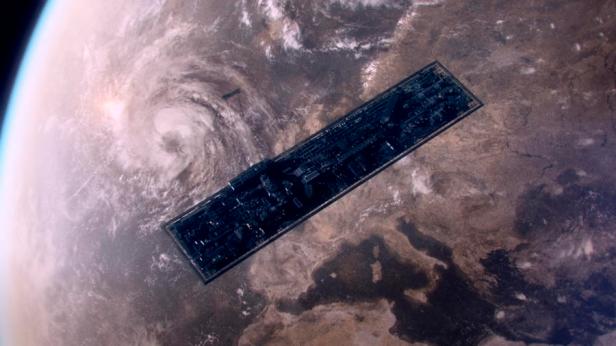
As the passengers board the ship we realise that it is very large and as one waggish reviewer notes feels like an IKEA outlet crossed with an airport terminal. Unlike the craft we see in ‘sci fi’ space adventures the emphasis is on consumer facilities – shops, bars, restaurants, play centres etc. Apart from these the accommodation feels more like a chain hotel or a cruise ship. Engaged by these diversions, Mima isn’t a major attraction for most passengers and Mimaroben seems frustrated. She has other duties as well and she appears to be a teacher. She shares a room with an older woman, an astronomer who is drunk much of the time and seems very cynical about these journeys to a ‘new life’ on Mars.

After a few days ‘Aniara’ flies into some space ‘garbage’ suffering minor damage. Or rather it seems minor but a small piece of debris has damaged the fuel system on the ship. I confess to finding the explanation as to what has actually happened confusing but eventually the Captain is forced to make an announcement which is relayed throughout the ship. He has had to jettison some nuclear material and as a result the ship has lost its steering power. It will travel on but its trajectory can’t be adjusted and they will miss Mars. At first the prognosis is vague and the passengers and crew believe that there will be a solution but it will take much longer to get to Mars.
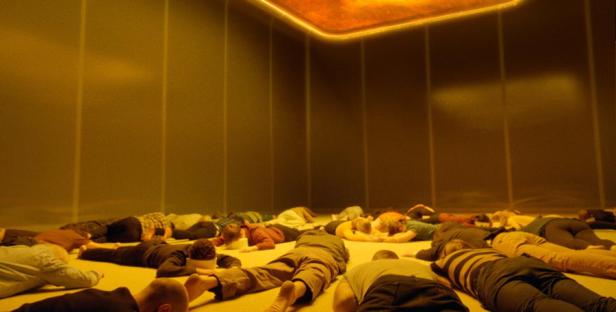
I won’t spoil the rest of the narrative but this is an example of dystopian science fiction in the sense that the senior crew members know that they are unlikely to be ‘rescued’ and the chances of some other solution being found are slim at best. Mimarobe finds herself now much more in demand as anxious passengers find it a soothing escape to use Mima to remember beautiful scenarios from their time on Earth. Eventually even this will pall as the journey stretches into months and then years marked by chapter headings telling us how much time has passed and giving each ‘chapter’ a unique name. I should point out that the narrative is based on an epic poem by Harry Martinson first published in 1956 and the title cards might be taken from the book length poem. The poem has been translated into several languages and is seen as a major work in Sweden, having previously inspired an opera and a television film as well as musical works and a planetarium show. Martinson was a Nobel Laureate for Literature so there was significant pressure on Pella Kagerman and Hugo Lilja who adapted and directed the film.

I was reminded of Tarkovsky’s Solaris (USSR 1972), which made a deep impression on me when I first saw it at the London Film Festival. Like Solaris, Aniara poses existential questions for the passengers and crew but unlike the Russian film there are many passengers rather than just one. There is much more likelihood of a mass breakdown and of the emergence of cults and religious groups. I must admit that the film did prompt me to think about the scenario. In very simple terms what would I do in this situation? The film is rated ’18’ in the UK because of ‘strong sex’ and suicide issues, both of which are are likely to be central in any attempt to represent social behaviour in a community effectively heading into the ‘nothingness’ of deep space. Aniara isn’t a horror film like Alien but some of the scenes are distressing.
Aniara is available on several major streamers and on physical media.

